TL;DR: Shopify vs Etsy comes down to traffic versus fees. Etsy takes roughly 10% to 11% of every order but brings its own buyers, so it is the faster start for handmade, vintage, and craft sellers. Shopify charges $39 a month plus 2.9% + 30¢ per card sale, which makes it cheaper on fees alone above about $550 a month in sales. The catch is that every Shopify visitor has to come from your own marketing.
The actual difference: marketplace vs storefront
Etsy is a marketplace. You are one seller among millions, sharing a search bar with everyone else in your category. Buyers arrive at Etsy already intending to shop. Some of them find you.
Shopify is a storefront builder. Nobody arrives at your Shopify store by accident. Every visitor comes from something you did: an ad, a social post, an email, a search result you earned.
That distinction drives every other difference. Fees, control, timeline, and risk all follow from it.
Shopify vs Etsy pricing: what each actually costs
Etsy has no monthly subscription in its standard tier. You pay per listing and per sale instead. New sellers now also face a one-time setup fee, typically $15 to $29 depending on region, which Etsy sometimes waives during promotions.
Here is the 2026 fee structure on each platform:
| Etsy | Shopify | |
|---|---|---|
| Setup fee | $15 to $29 one-time for most new sellers | None |
| Monthly cost | $0 (Etsy Plus is $10 optional) | $39, or $29 billed annually |
| Listing fee | $0.20 per item, renews every 4 months | None |
| Transaction fee | 6.5% of order total including shipping | None with Shopify Payments |
| Payment processing | 3% + $0.25 (US) | 2.9% + 30¢ (US) |
| Ads | Offsite Ads 15%, or 12% over $10k | Whatever you choose to spend |
Etsy charges a 6.5% transaction fee on the order total including shipping, plus 3% + $0.25 for payment processing in the US. The listing fee is the one that catches people out. It is charged per item listed, not per item sold, and it renews every four months whether the item sold or not. A shop with 100 listings pays $20 every four months just to stay visible.
What a $50 sale looks like on each
On Etsy, a $50 order costs you $0.20 in listing fee, $3.25 in transaction fee, and $1.75 in processing. Total fees: $5.20. You keep $44.80.
On Shopify, the same $50 order costs $1.75 in processing. Total fees: $1.75. You keep $48.25, minus your share of the monthly plan.
That gap looks decisive until you divide the $39 plan across your order volume.
Shopify vs Etsy fees at three revenue levels
This is the comparison most guides skip, and it is the only one that answers the question.
At $500/month across 20 orders. Etsy takes about $56 in fees, an effective rate of 11.3%. You keep $444. Shopify takes about $21 in processing plus the $39 plan, so $60 total. You keep $440. Etsy is marginally ahead, and you did not have to build traffic.
At $2,000/month across 60 orders. Etsy takes roughly $217, so you keep $1,783. Shopify takes about $76 in processing plus $39, so $115 total. You keep $1,885. Shopify is now roughly $100/month better.
At $5,000/month across 100 orders. Etsy takes about $520, an effective 10.4%. Shopify takes about $175 plus $39, so $214. The gap is now over $300 a month, or $3,600 a year.
On fees alone, Shopify becomes cheaper than Etsy at roughly $550 a month in sales on the $39 monthly plan, and lower on annual billing. Below that, Etsy's fees are cheap relative to the traffic you get for free. Above it, you are paying a growing tax on sales you increasingly generate yourself.
One caveat matters here. These numbers assume you are not paying for ads on either platform. That assumption breaks at a specific point, covered next.
The $10,000 rule most Etsy comparisons ignore
Etsy runs Offsite Ads on Google, Facebook, Instagram, and Pinterest. If a buyer clicks one and purchases within 30 days, you pay a commission on that order.
Sellers under $10,000 in trailing twelve-month sales can opt out. Etsy Offsite Ads become mandatory once a shop passes $10,000 in trailing twelve-month sales, at a 12% fee on each attributed order. The rate drops from 15% to 12% at that threshold, but you can no longer decline it.
This is a real structural issue for a growing shop. The moment Etsy starts working well for you, a slice of your best orders carries an extra 12% charge you cannot refuse. Stack that on the standard 10% and some orders cost you more than 22%.
Shopify has no equivalent. Your ad spend is a decision, not a rule.
Is Etsy or Shopify better for beginners?
Etsy is the better start for most beginners, because it gets you to a first sale faster and it is not close.
You can list a product on Etsy in an afternoon and have buyers see it that week. Etsy's search is a real acquisition channel. For handmade, vintage, craft supplies, and personalized goods, buyers are already there, actively looking.
A Shopify store can be built just as fast. Getting anyone to visit it is the hard part. Expect weeks to months before organic traffic means anything, unless you already have an audience somewhere or a budget for ads.
For a beginner testing whether a product has demand at all, Etsy answers that question faster and cheaper. That is a genuinely good reason to start there.
But two things temper it.
Etsy's category rules are strict. Everything must be handmade, a designed product made with a production partner, vintage over 20 years old, or a craft supply. Generic dropshipped goods are not allowed and shops get suspended for it. If you are sourcing from AliExpress, Etsy is not your platform, even though dropshipping itself is legal on your own store.
Etsy also owns the customer relationship. You cannot email your buyers for marketing. You do not control the checkout. Your shop can be suspended without warning, and sellers report that appeals are slow.
Traffic: Etsy search vs Google search
The two platforms make you compete in completely different places, and the skills do not transfer.
On Etsy, you compete inside Etsy's search. Ranking depends on listing titles, tags, attributes, recent sales velocity, review score, and shipping speed. The pool is other Etsy sellers in your niche. It is a smaller, more winnable contest than Google, and results move within weeks rather than months.
The catch is that Etsy controls the rules. Algorithm changes hit every seller at once, with no warning and no recourse. Sellers who ranked well for a term can lose that position overnight through no fault of their own.
On Shopify, you compete in Google against everyone, including Etsy listings themselves. Product pages rarely rank on their own for competitive terms. Most successful Shopify stores get organic traffic from content, not from product pages: buying guides, comparison posts, and how-to articles that pull people in and route them to products.
That takes six months or more to work. It also builds an asset nobody can revoke. An article ranking on Google keeps sending traffic regardless of what any marketplace decides.
Paid traffic works on both. The difference is that Shopify ad spend drives people to a store you own, where you keep the email address and can sell to them again. Etsy ad spend drives people to a listing on someone else's platform.
Design, branding, and control
Etsy shops look like Etsy shops. You choose a banner, a logo, and an about section. Everything else follows Etsy's layout, including the product page, the cart, and the checkout.
That is not purely a downside. Etsy's layout is tested against millions of transactions and converts reasonably well. A new seller with no design sense will probably do better inside Etsy's template than with a badly customized store.
Shopify gives you the full storefront. Free themes cover most standard layouts, and premium themes run $180 to $500 as a one-time purchase. You control the product page, the cart, the checkout flow, and every piece of copy.
The trade-off is that all of it is now your responsibility. A slow theme, a confusing checkout, or a broken mobile layout costs you sales, and no platform will catch it for you.
What you actually own on each platform
This is the part that shows up two years in, not two months in.
On Shopify, the customer list is yours. You can export it, email it, retarget it, and build repeat purchase revenue that costs nothing to acquire twice. Your domain is yours. Your design is yours.
On Etsy, buyers are Etsy's customers who happened to buy from you. Etsy's own policy prevents you from using their contact details for marketing. Build a $200,000 shop and you still cannot email the people who bought from you.
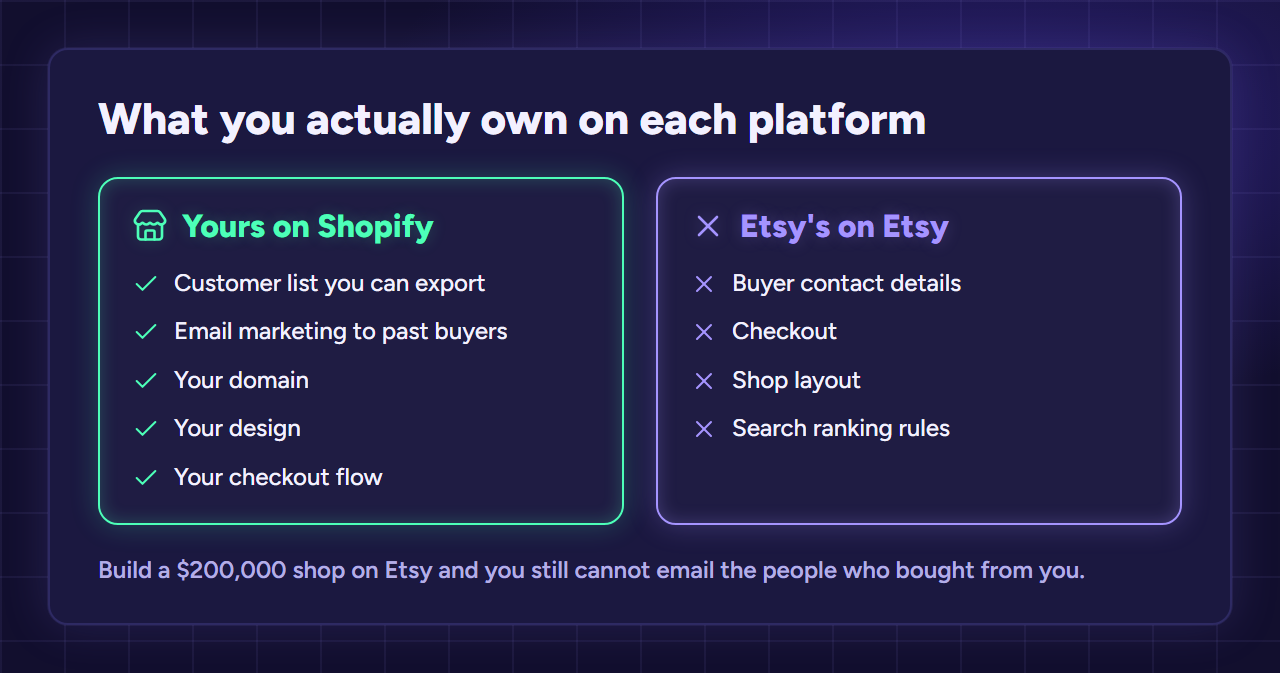
For anyone building a brand rather than a product listing, that difference compounds every year.
There is also platform risk. Etsy has raised its transaction fee before, from 5% to 6.5% in 2022. Shopify raises plan prices too, but a plan increase is a fixed cost you can see coming. A commission increase scales with everything you sell.
Where Etsy still wins outright
Fee math is not the whole argument, and a few situations favor Etsy regardless of volume.
Very low order volume. Under roughly 15 orders a month, the $39 plan is a meaningful fixed cost with no traffic guarantee attached.
Discovery-driven products. If people find your product by browsing rather than searching for your brand, Etsy's search does work you cannot easily replicate.
Testing a new product line. Listing on Etsy costs $0.20. Spinning up a Shopify store and driving traffic to it costs considerably more to answer the same question.
No marketing appetite. Etsy's fee is real, but so is the cost of learning SEO, ads, and email. If you have no interest in that work, Etsy's commission is buying you something.
The AI search change worth knowing about
One long-standing argument for Etsy is that a marketplace has distribution you cannot match alone. That is getting slightly less true.
Shopify launched Agentic Storefronts in March 2026. Product catalogs now syndicate to ChatGPT, Google AI Mode, Microsoft Copilot, and Perplexity, managed from the Shopify Admin. Eligible stores were enabled by default, at no extra cost.
That does not make an independent store equal to Etsy's built-in traffic. It does mean Shopify merchants now have a discovery channel they did not have to build.
It is early, and nobody should switch platforms over it. Treat it as one more thing narrowing the gap rather than a reason to move.
Can I use Shopify and Etsy together?
Yes, you can run Shopify and Etsy together, and for a lot of sellers this is the right answer rather than a compromise.
The common setup runs Etsy as a discovery channel and Shopify as the brand home. Etsy brings in buyers who would never have found you. Shopify serves repeat customers, higher-margin bundles, and anyone arriving from your own marketing.
Shopify's Etsy integration apps sync inventory between the two so you are not overselling the same stock. Keep your catalogs deliberately different. Many sellers put entry-priced items on Etsy and reserve premium or bundled products for their own store.
Two things to watch. Running both means double the listing maintenance and double the customer service inbox. And you cannot email Etsy buyers to redirect them, so moving customers to your store has to happen through package inserts and brand recognition rather than direct outreach.
If you are moving from Etsy to Shopify
Most sellers do not switch cleanly. They overlap for a few months, then wind Etsy down or keep it as a secondary channel.
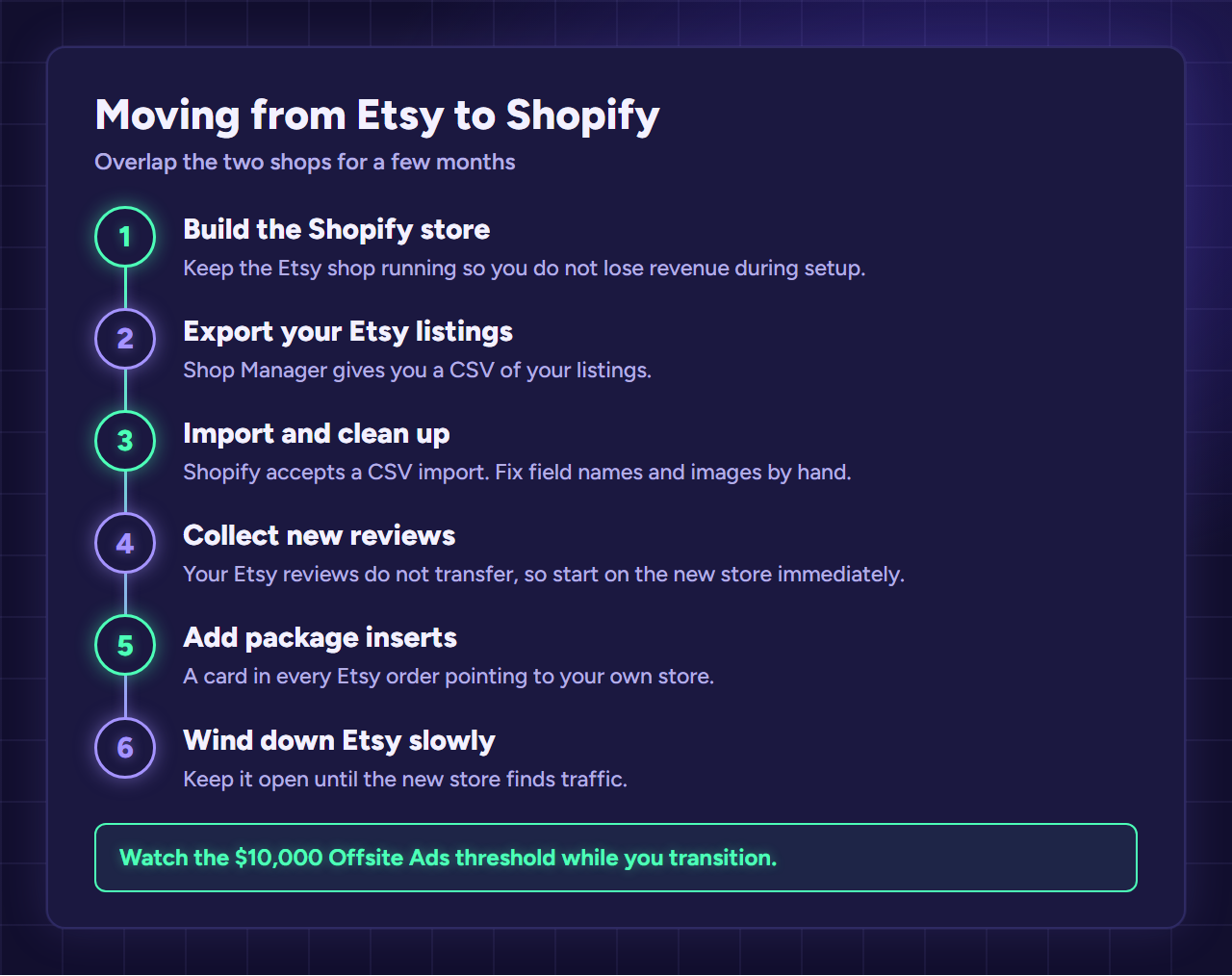
Build the Shopify store while your Etsy shop is still running. There is no reason to lose revenue during setup, and the 3-day trial plus $1/month promotional period covers most of the build.
Export your Etsy listings from Shop Manager. Etsy provides a CSV of your listings, and Shopify accepts a CSV import for products. Expect to clean it up manually. Field names do not map perfectly and image handling usually needs attention.
Your reviews do not transfer. This is the part people underestimate. A shop with 800 reviews and a 4.9 rating starts at zero on Shopify, and that social proof was doing real conversion work. Start collecting reviews on the new store immediately, and consider screenshotting your Etsy rating for the about page.
You also cannot email your Etsy customers to tell them you moved. Etsy policy prohibits using buyer contact details for marketing. Package inserts are the realistic option: a card in every Etsy order pointing to your own store. It converts slowly, but it is compliant.
Keep the Etsy shop open longer than feels necessary. It costs $0.20 per listing to stay live, which is cheap insurance while the new store finds traffic. Closing it early means giving up your only working acquisition channel before the replacement works.
Watch the $10,000 threshold on the way out. If your trailing twelve-month Etsy sales are near it, Offsite Ads become mandatory, which changes the fee math while you are still transitioning.
Shopify vs Etsy: how to decide
Start on Etsy if your products fit its handmade, vintage, or craft-supply categories, you have no traffic of your own yet, and you want the fastest possible read on whether anyone wants what you sell.
Start on Shopify if you already have an audience, your products fall outside Etsy's allowed categories, you are dropshipping, or you are building a brand you intend to own outright.
Move to Shopify, or add it, once a real share of your sales comes from traffic you bring yourself. On fees alone Shopify is cheaper from about $550 a month, so past that point Etsy's commission is paying for buyers you may no longer need. As you near $10,000 in trailing twelve-month sales, the mandatory Offsite Ads rule adds another reason.
Whichever way you lean, run your own numbers first. Take last month's real order count and revenue, apply both fee structures, and compare. The answer is often less dramatic than either platform's marketing suggests.
Shopify's free trial runs 3 days with no credit card, followed by $1/month for three months. That is enough to build a store and see the difference for yourself before committing to anything. Our launch guide walks through setting up a Shopify store step by step. Our cost breakdown covers what a Shopify store really costs to start, including the fees you pay once the trial ends.
FAQ
Is Shopify cheaper than Etsy?
Yes, on fees alone Shopify is cheaper once you sell more than about $550 a month. Below that, Etsy usually costs less because there is no monthly fee. Above it, Shopify's flat $39 plan beats Etsy's roughly 10% to 11% in fees, and the gap widens as you grow.
What are the real Shopify vs Etsy fees on a $100 sale?
A $100 sale costs $9.95 in fees on Etsy and $3.20 on Shopify, before Shopify's monthly plan. The Etsy total is $0.20 listing, $6.50 transaction, and $3.25 processing. On Shopify it is the 2.9% + 30¢ card rate, plus your share of the monthly plan.
Does Etsy charge a fee to open a shop?
Yes, most new sellers now pay a one-time setup fee between $15 and $29, depending on region. Etsy sometimes waives it during promotions. Listing fees, transaction fees, and processing fees apply on top.
Can I sell dropshipped products on Etsy?
No, Etsy does not allow generic dropshipped products. It requires items to be handmade, made with a production partner you disclose, vintage over 20 years old, or a craft supply. Reselling generic dropshipped goods breaches policy and gets shops suspended.
Can I use Shopify and Etsy together?
Yes, many sellers run both, and inventory sync apps keep stock accurate across the two. Most sellers who run both use Etsy for discovery and Shopify for repeat customers and higher-margin products.
Which is better for beginners, Etsy or Shopify?
Etsy is better for most beginners, because you get buyer traffic without building it. That is why Etsy vs Shopify for beginners usually ends with Etsy. Shopify is the better beginner choice if your products are not Etsy-eligible or you already have an audience to sell to.
Leave a Reply