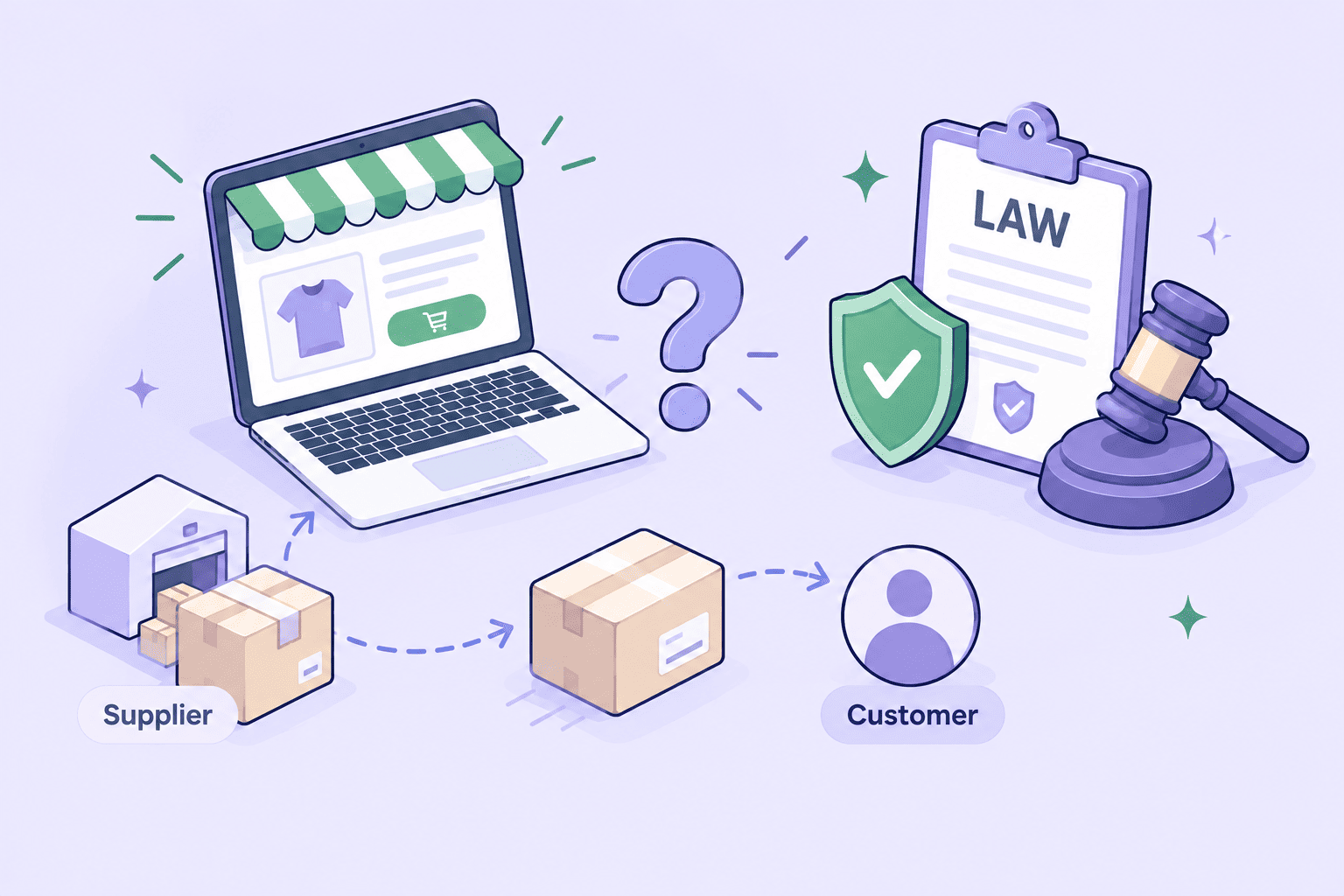
TL;DR: Yes, dropshipping is legal in all 50 US states and in every major market. What gets sellers in trouble is four things any retailer could do: selling counterfeits, missing the FTC’s shipping deadline, ignoring sales tax nexus, and making claims they cannot support. The shipping rule catches honest sellers most often, because it defaults to 30 days when you advertise no delivery window. Three-week overseas delivery leaves very little room under that limit.
This is general information, not legal advice. Rules vary by state and country, and anything involving your specific situation is worth an hour with an actual lawyer.
Is dropshipping legal? The short answer
Yes, dropshipping is legal in every US state and in essentially every developed market.
Dropshipping is a fulfillment method. Your store takes the order, your supplier ships the goods. There is no legislation anywhere that bans this arrangement, and some of the largest retailers online use it. Wayfair and Overstock built entire businesses on it, and parts of Amazon’s marketplace run the same way.
The question keeps getting asked because of who else uses the model. People selling knockoffs, running misleading ads, and vanishing when refunds are requested all use dropshipping too. That gives the category a reputation the mechanism does not deserve.
The useful framing is this. Dropshipping does not create legal obligations. It creates distance between you and the product, and that distance makes it easier to breach obligations you already had as a retailer.
Is dropshipping illegal in any situation?
Dropshipping becomes illegal only when you do something that would be illegal for any retailer. Four things account for most cases.
Selling counterfeits or unauthorized branded goods. Brands including Nike and Louis Vuitton routinely sue dropshippers. Copyright infringement in the US carries statutory penalties from $750 to $150,000 per work.
Missing the shipping deadline without notifying the customer. Covered in detail below. This is the rule most people have never heard of.
Not collecting sales tax where you have nexus. Also below, and the mechanics differ depending on where you sell.
Making claims you cannot support. Delivery times, product performance, health benefits, before-and-after results. The FTC treats advertising claims the same whether you made the product or not.
Note what is not on that list. Not telling customers you dropship is not itself illegal, though some marketplaces ban it in their terms. The obligation is to be accurate about delivery, not to disclose your fulfillment arrangement.
The FTC shipping rule almost nobody mentions
This is where ordinary, well-intentioned dropshippers are most exposed, and most legal guides bury it under the counterfeit section.
The FTC’s Mail, Internet, or Telephone Order Merchandise Rule requires you to ship within the time frame you advertised. If you did not advertise one, the default is 30 days. A store that states no delivery window and ships on day 31 without the customer’s consent is already in breach, however honest it is.
If you cannot meet it, you must do three things. Notify the customer of the delay. Offer them the option to cancel for a full refund. And obtain their consent to the new timeline.
Read that against a typical overseas dropshipping operation. Supplier processing takes a few days, shipping runs two to three weeks, customs adds unpredictable time. A store with no stated delivery window and a 25-day average is already operating on the edge of the default, and one supplier delay puts it over.
What this means in practice
Three changes remove most of the risk, and none of them are difficult.
State a delivery window explicitly. “10 to 21 business days” on the product page and at checkout. The rule binds you to what you advertised, so advertising a realistic window is protective, not a conversion problem. A vague site inherits the 30-day default whether you wanted it or not.
Build a delay notification into your process. When an order passes your stated window, an email goes out offering cancellation. Most customers accept the delay. The ones who do not would have filed a chargeback anyway, and a refund costs you less than a dispute.
Do not use “ships within 24 hours” language unless the supplier genuinely dispatches that fast. Fulfillment speed claims are advertising claims.
The reason this matters more than counterfeit risk for most readers is simple. You have to choose to sell counterfeits. You can breach the shipping rule by doing nothing at all.
Dropshipping legal requirements: registration and permits
Most US sellers need two things: a general business license and a sales tax permit. Exact requirements vary by state and sometimes by city.
You can operate as a sole proprietor. Many people do at the start. Two practical notes: your storefront identity and your payment accounts need to match, and forming an LLC separates your personal assets from the business if you are ever sued. Most sellers who intend to stay in this set one up before their first sale.
Outside the US the equivalents are straightforward. Australia requires an ABN. The UK requires registration with HMRC as a sole trader or limited company. Canada requires a business number through the CRA.
You also inherit privacy obligations the moment you collect customer data. CCPA applies if you serve California customers, GDPR if you serve the EU or UK, PIPEDA in Canada. A privacy policy is not optional decoration.
Sales tax: the part that actually costs people money
Since the 2018 South Dakota v. Wayfair decision, states can require sales tax collection based on economic activity alone. No physical presence needed. By 2026, every state with a sales tax has economic nexus rules.
The common threshold is $100,000 in annual sales into that state. Historically many states also triggered nexus at 200 transactions.
That transaction trigger is disappearing. Through 2025 and 2026 states have been dropping it. That helps sellers doing many small orders, who used to cross a nexus threshold on volume without approaching the revenue figure. It also means any nexus map you built from transaction counts is now out of date.
The distinction that decides your workload
This is the single most important thing on this page for a Shopify seller.
Marketplace facilitator laws exist in all 45 sales-tax states plus DC. Under them, the marketplace collects and remits sales tax, not the individual seller.
If you sell on eBay or Amazon, the platform handles collection and remittance in every state that requires it. You can largely ignore the mechanics.
Shopify is not a marketplace facilitator. Shopify gives you tax calculation tools, but the legal obligation is yours. You must register for a sales tax permit in every state where you have nexus, collect, and remit on that state’s schedule. In most states, that obligation starts once your Shopify store passes $100,000 in annual sales into the state.
That is a genuine operational difference. A marketplace seller can grow for years without thinking about this. A Shopify seller needs a compliance system from the point they approach a threshold, and most do not realize it until they are past one.
Learn more: Step-by-Step Guide to Launching a Shopify Store (2026)
Why your supplier charges you tax
Dropshippers frequently find suppliers charging sales tax on wholesale purchases that should be exempt. There is a reason.
When a state audits a supplier, the auditor reviews every exempt sale and asks for the resale certificate supporting it. If the certificate is missing or invalid, the sale becomes taxable retroactively, and the supplier owes the tax plus interest and penalties, not you.
Suppliers know this. So they refuse exempt treatment until your paperwork is clean. Getting your resale certificates in order is not bureaucracy for its own sake, it is what stops you paying tax twice on the same goods.
Intellectual property: where the lawsuits come from
Counterfeits are the obvious version. The subtler version catches more people.
You can infringe without selling a fake. Using a brand name in your product title when you are not an authorized reseller. Selling something described as “inspired by” a protected design. Using the supplier’s product photos when they lifted them from the brand. Registering a domain containing someone else’s trademark.
In 2026, Shopify, Meta, and payment processors all actively scan for IP violations. The practical consequence is usually not a lawsuit. It is a suspended store, a disabled ad account, or frozen payments, which arrives faster than any court would.
Run a trademark search before listing anything that resembles a branded product. USPTO’s database is free. If a DMCA or trademark complaint arrives, remove the listing immediately and respond, because platform suspensions follow non-response far more often than they follow the original complaint.
Product categories that carry extra rules
Some things are legal to sell but regulated, and the regulation lands on you as the seller.
Supplements and anything with a health claim. Heavily restricted in advertising, and a magnet for regulator attention.
Cosmetics with active ingredients. Labeling and ingredient rules apply.
Electronics containing batteries. Shipping restrictions, safety certification, recall exposure.
Children’s products and toys. Safety testing requirements in most markets, and the consequences of getting it wrong go well beyond a refund.
Anything resembling a medical device. A category where marketing language can convert a legal product into an illegal claim.
The pattern is that regulated categories require you to know things about the product you are not holding. If you cannot get compliance documentation from your supplier, that is your answer.
Customs became a compliance issue, not just a cost
One change that most legality guides have not caught up with.
The United States ended the $800 de minimis exemption for all countries on August 29, 2025. Every imported parcel now goes through customs entry and carries duties regardless of value. The EU is following with its own per-package fee.
This turned an invisible step into a documented one. Customs declarations now exist for shipments that previously passed through untouched, which means the declared value, contents, and country of origin on your supplier’s paperwork are now records with your business attached to them.
Inaccurate declarations were always a problem. Now they are a problem that generates a paper trail.
Is dropshipping legal on Amazon and eBay?
Dropshipping is legal on Amazon and eBay, but each platform permits it only under its own conditions.
Amazon’s policy requires you to be the seller of record and to remove any packing slips, invoices, or branding identifying a third-party supplier. Shipping an Amazon order directly from another retailer breaches this.
eBay permits dropshipping from wholesale suppliers but prohibits sourcing from another retailer or marketplace and having them ship to your buyer.
Breaching either is a policy violation rather than a crime. The consequence is account suspension, which for a marketplace seller is functionally worse than a fine.
Here is how your own Shopify store compares with the two marketplaces on the rules covered in this article.
| Rule | Your Shopify store | Amazon | eBay |
|---|---|---|---|
| Who collects and remits sales tax | You, in every state where you have nexus | Amazon, as marketplace facilitator | eBay, as marketplace facilitator |
| Dropshipping permitted | Yes | Yes, if you are seller of record | Yes, from wholesale suppliers |
| Ordering from another retailer to ship to your buyer | Allowed if the goods are genuine | Breaches policy | Breaches policy |
| Most likely consequence of a breach | Processor hold or back tax bill | Account suspension | Account suspension |
Learn more: The Shopify Starter Plan Is Gone: What to Use Instead in 2026
Is dropshipping legal under 18?
Dropshipping has no minimum age, but you generally need to be 18 to sign contracts, register a business, or open the payment accounts a store runs on.
The model is not age-restricted, but the infrastructure around it is. Shopify, Stripe, and PayPal all require account holders to be of legal age.
The common arrangement is a parent or guardian holding the business registration and payment accounts, with the young person running the operation. That is legitimate. What does not work is misstating your age on an account application, which puts your payment processing at risk of freezing with funds in it.
What actually happens when something goes wrong
Legal guides describe fines and lawsuits. For most sellers, that is not how trouble arrives.
Stage one: a platform acts. A trademark complaint reaches Shopify, or Meta’s scanning flags an ad. A listing comes down, or an ad account is disabled. This is by far the most common outcome and it happens in days, not months.
Stage two: money gets held. Chargebacks from customers who never received orders push your dispute rate up. Payment processors respond by holding a rolling reserve against your payouts or freezing the account entirely. This is the stage that kills stores, because your revenue stops while your ad spend does not.
Stage three: a tax bill arrives. Sales tax exposure accumulates quietly. It surfaces when you register in a state and get asked how long you have been selling there, or when a supplier audit works backwards to your resale certificates. Back taxes come with interest and penalties.
Stage four: someone sues. Rare, and generally reserved for repeat counterfeit sellers or something with a safety consequence.
The order matters because the early stages are survivable and reversible, and they are also where the warning signs appear. A single trademark complaint is a signal to audit your whole catalog, not just remove one listing.
Learn more: Understanding Dropshipping Success Rates
Is dropshipping legal outside the US?
Dropshipping is legal in the UK, the EU, Australia, and Canada, with local versions of the same tax, consumer, and privacy obligations.
United Kingdom. Register with HMRC as a sole trader or limited company. VAT registration becomes mandatory above the turnover threshold. Consumer contract regulations give buyers a 14-day right to cancel most online orders, which is stronger than typical US return rights and applies whether or not your policy mentions it.
European Union. Similar 14-day withdrawal rights, VAT obligations on cross-border sales, and GDPR on any customer data. The EU is also ending its own low-value import exemption with a flat per-package customs fee.
Australia. An ABN is required, GST registration applies above the turnover threshold, and Australian Consumer Law guarantees cannot be contracted out of by your refund policy.
Canada. A business number through the CRA, GST or HST depending on province, and PIPEDA for privacy.
The pattern is consistent everywhere. The fulfillment model is fine, consumer protection and tax rules are not optional, and the cancellation rights in the UK, EU, and Australia are more generous than most dropshipping refund policies assume.
A short compliance checklist
Most of this is an afternoon of work if you do it early.
Register the business and get a sales tax permit. Publish a privacy policy, refund policy, and terms. State a delivery window on your product pages and at checkout. Set up a delay notification for orders that pass it. Run a trademark check on anything brand-adjacent. Get resale certificates to your suppliers. Track your sales by state so you see a nexus threshold before you cross it.
Our guide on launching a Shopify store covers where the policy pages live in the admin, and the dropshipping profit margin breakdown covers what sales tax and duties do to your unit economics.
Learn more:
How to Start Dropshipping With No Money
How Long Does It Take to Make Money Dropshipping?
FAQ
Legality questions
Is dropshipping legal in the US?
Yes, in all 50 states. No legislation restricts the model. Requirements for registration, permits, and tax collection vary by state.
Is dropshipping illegal if I do not tell customers?
Not in itself. You must be accurate about delivery times, but there is no general obligation to disclose your fulfillment arrangement. Some marketplaces impose one in their terms.
Is it legal to dropship from AliExpress?
To your own store, yes, provided the products are not counterfeit. To an Amazon or eBay listing, it breaches both platforms’ policies.
Is dropshipping a scam?
No. Dropshipping is a fulfillment model that retailers such as Wayfair and Overstock use at scale. The reputation comes from sellers who misrepresent products or delivery times, not from the model itself.
Requirement questions
Do I need an LLC to dropship?
No. You can start as a sole proprietor. An LLC protects personal assets if the business is sued, which is why most sellers form one before scaling.
When do I have to start collecting sales tax?
When you cross a state’s economic nexus threshold, commonly $100,000 in annual sales into that state. On Shopify the obligation is yours; on eBay and Amazon the marketplace handles it.
How long do I have to ship a dropshipping order?
Within the window you advertised, or 30 days if you advertised none. If you cannot make it, the FTC rule requires you to notify the customer, offer a full refund, and get their consent to the delay.
What is the most common legal mistake?
Advertising a delivery time the supply chain cannot meet, then not notifying customers when it slips. It is the easiest rule to breach accidentally and the one most sellers have never read.
Leave a Reply