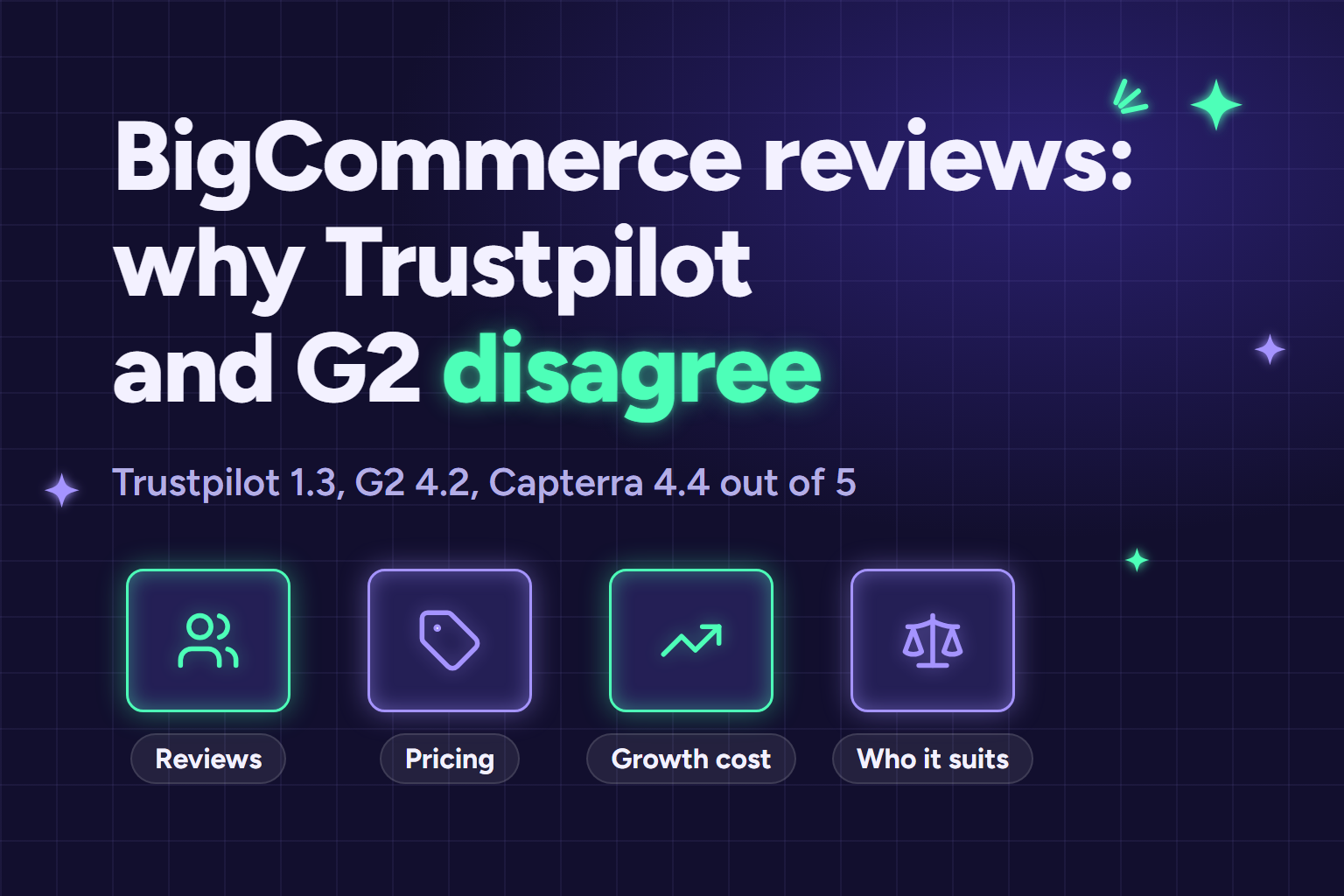
TL;DR: BigCommerce reviews split hard. Trustpilot shows 1.3 out of 5, while G2 shows 4.2 and Capterra 4.4. Both are telling the truth about different people. BigCommerce is a solid platform for multi-store sellers, B2B and large catalogs. Since June 2026 it is no longer cheaper than Shopify at the same tier. The low Trustpilot score is mostly billing, automatic plan upgrades and support complaints. Those risks are real and avoidable if you read the pricing terms before you sign up.
We earn a commission if you sign up for Shopify through our links. We don't earn from BigCommerce. That gives us a reason to favor Shopify, so every figure here links to its source and we say where BigCommerce wins.
BigCommerce review: the short verdict
Our BigCommerce review verdict is that the platform suits stores selling through several storefronts, selling wholesale, or running large catalogs with many variants, and suits a first-time single-store seller less well than Shopify does. Price is no longer a reason to pick it.
BigCommerce lets one Core plan run 3 storefronts, Growth run 5 and Scale run 8, according to Style Factory's July 2026 review. A single product can carry up to 600 variants. Those are real structural advantages, and they matter if your business looks like that.
A beginner with one store and one product line gets little from either. What that beginner does feel is a smaller app marketplace, fewer distinct free themes and no built-in email marketing. Style Factory scores BigCommerce 3.5 out of 5 overall, which matches our read: good at specific jobs, average as a general starting point.
What BigCommerce reviews actually say
BigCommerce reviews on page one of Google come from five very different kinds of publisher: Trustpilot, Reddit, BigCommerce's own reviews page, three editorial reviewers (Style Factory, Vervaunt and PCMag) and Glassdoor, which reviews BigCommerce as an employer. Each measures something different.
Glassdoor tells you nothing about the software. BigCommerce's own page at bigcommerce.com/reviews shows awards it chose, and several of its badges carry no date. That is a vendor page ranking for a review search, which is worth knowing before you treat it as evidence.
Trustpilot's 1.3 out of 5
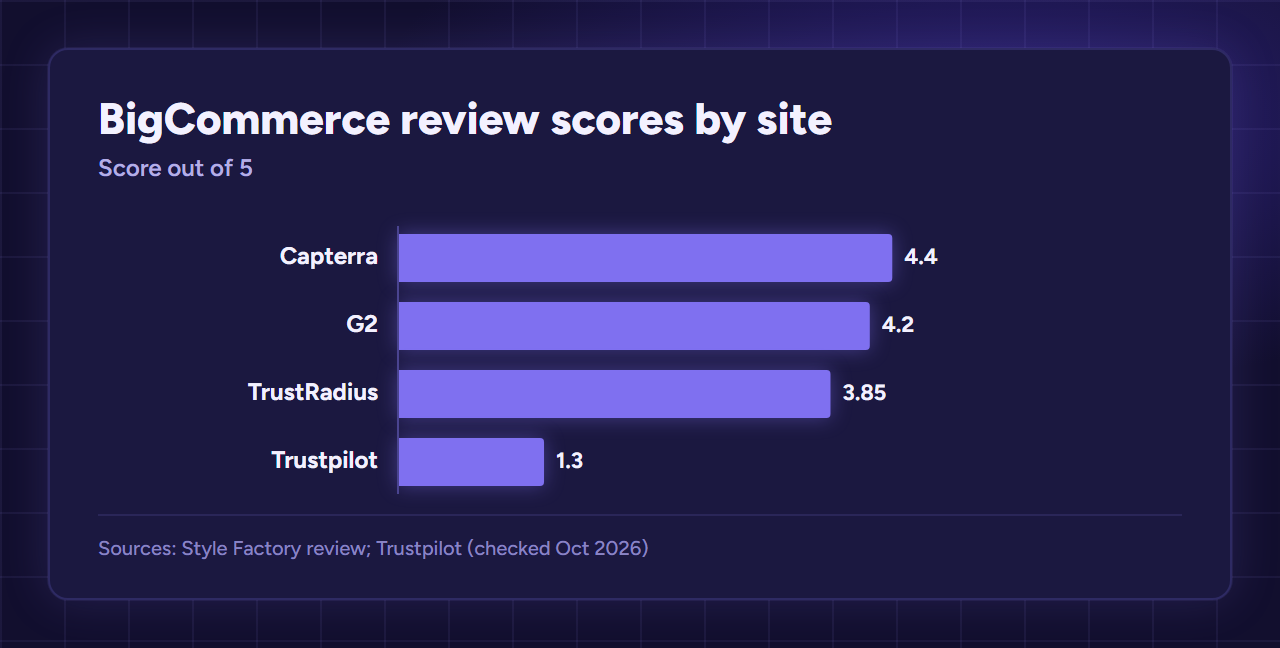
On Trustpilot, BigCommerce held a TrustScore of 1.3 out of 5 from 460 reviews when we checked in October 2026. Of those reviews, 51% gave one star and 28% gave five. Only 17 arrived in the previous 12 months.
The one-star reviews cluster on a few themes. Merchants describe sudden price jumps and fees on third-party payment processing. Others report support tickets left unanswered, trouble canceling or getting refunds, and feeling locked in when they tried to migrate away. Very few complain that the store builder itself does not work.
G2 and Capterra's 4.2 to 4.4
Software review sites rate BigCommerce far higher. As compiled by Style Factory in July 2026, G2 shows 4.2 out of 5 from 581 reviews and Capterra shows 4.4 out of 5 from 339. TrustRadius gives 7.7 out of 10 from 703 reviews.
These reviewers mostly rate features: the catalog tools, SEO settings, checkout and integrations. They tend to be active users partway through a contract, not people in a dispute.
Why the scores disagree
The two kinds of site collect reviews in different ways, so they hear from different customers. Trustpilot notes that BigCommerce has not invited customers to review it recently and has not replied to negative reviews. Every review there is unsolicited, and people rarely volunteer a review when nothing has gone wrong.
That pulls the sample toward billing and cancellation disputes. G2 and Capterra actively recruit current users, which pulls the sample toward people still using the product.
The useful control is Shopify. Its Trustpilot score sits at the same 1.3 out of 5, with a G2 score of 4.4. Two platforms with very different reputations land on the same Trustpilot number. That tells you the 1.3 describes how ecommerce platforms get reviewed on Trustpilot more than it describes BigCommerce alone.
The complaints are still worth reading. Read them for the mechanism behind each one, not for the score.
Which BigCommerce reviews are out of date?
Several BigCommerce reviews that still rank were written before BigCommerce changed its plans and fees on 1 June 2026, so their pricing sections describe a platform that no longer exists. Check the date on any review before trusting its cost section.
PCMag's ranking review is dated 22 October 2024. Its search snippet says BigCommerce charges "zero fees from third-party payment gateways." That is no longer true. BigCommerce now charges an Open Payment Provider fee of 2.0% on Core when you use a processor outside its approved list.
Style Factory's review was updated in July 2026 and reflects the new plans. BigCommerce's own reviews page lists 2026 analyst recognition next to older badges with no visible date. Treat any review that sells BigCommerce as the platform with no transaction fees as written for the old pricing.
BigCommerce pricing in 2026
BigCommerce renamed and restructured its plans effective 1 June 2026: Standard became Core at $39 a month, Plus became Growth at $105, Pro became Scale at $399, and Enterprise became Performance from $1,499 a month billed annually. Annual billing cuts the first three to $29, $79 and $299.
These figures come from the BigCommerce pricing page, checked in October 2026. Annual billing saves about 25%. A free trial lasts 15 days, which is enough to build a test store but not to sell through one for long.
Is BigCommerce still cheaper than Shopify?
BigCommerce is not cheaper than Shopify in 2026. Its Core, Growth and Scale plans cost $39, $105 and $399 a month, and Shopify's Basic, Grow and Advanced plans cost exactly the same in the US. Most comparisons still sell BigCommerce as the budget option, and at these tiers it is not.
The fees line up too. BigCommerce's Open Payment Provider fee is 2.0% on Core, 1.0% on Growth and 0.6% on Scale. Shopify charges the same percentages on Basic, Grow and Advanced when you use a third-party gateway instead of Shopify Payments.
So choose on fit rather than price. If you want the Shopify side plan by plan, our breakdown walks through each tier and its fees in Shopify pricing plans explained.
The Open Payment Provider fee
The Open Payment Provider fee is a percentage of eligible order value that BigCommerce bills you monthly when a sale runs through a payment processor it has not embedded. It sits on top of whatever that processor charges you.
You avoid it entirely with an embedded provider. The list includes Stripe, PayPal Braintree, Adyen, Klarna, Afterpay, Amazon Pay and BigCommerce Payments. If your processor is not on BigCommerce's list, budget 2.0% of eligible sales on Core.
Card processing through BigCommerce's own payments is a separate cost. The pricing page says "2.89% + $0.29 per transaction for all BigCommerce plans," with American Express at 3.50%. Some third-party reviews report lower rates on higher plans. The sources disagree, so check the rate in your own dashboard before you compare.
What you'll pay as your store grows
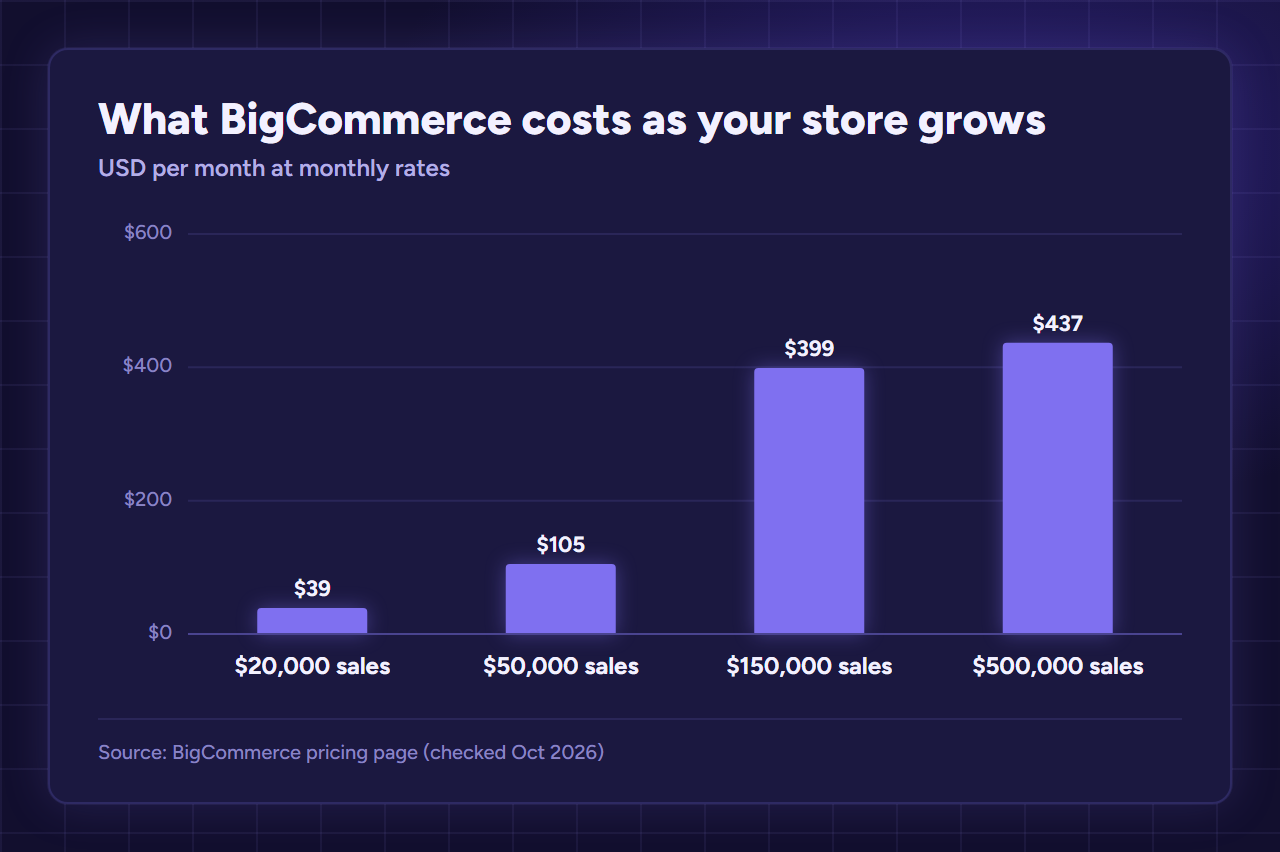
BigCommerce moves your store to a more expensive plan automatically once your trailing 12-month sales pass a threshold: Core covers up to $30K in GMV, Growth up to $100K, and Scale adds a 0.9% charge on GMV above $33,333 a month. This is where most "my bill tripled" reviews come from.
GMV here means gross order value minus 10%, so the thresholds sit a little above the raw sales figure. The upgrade is not optional. A store crossing $30K in GMV moves from $39 to $105 a month, nearly triple, without changing anything it does.
| Annual sales | Plan you end up on | Monthly cost | What triggers the next jump |
|---|---|---|---|
| $20,000 | Core | $39 | GMV over $30K |
| $50,000 | Growth | $105 | GMV over $100K |
| $150,000 | Scale | $399 | GMV over $33,333 a month |
| $500,000 | Scale plus overage | about $437 | GMV reaches $2M a year |
For example, at $500,000 a year, monthly sales are about $41,667. Minus 10%, GMV is $37,500. The overage applies to the $4,167 above $33,333, and 0.9% of that is about $37.50. Your bill is about $437 a month at monthly rates.
The jump itself is predictable from the published thresholds. What catches merchants out in the reviews is that BigCommerce makes the move for them, often before they have looked at the terms again.
BigCommerce pros and cons
BigCommerce pros and cons line up by business type: its strengths are multiple storefronts on one plan, deep product catalogs and wholesale features, while its weaknesses are a small theme choice, a clunky page builder, a smaller app marketplace and missing built-in tools.
Where BigCommerce beats Shopify
BigCommerce wins when one business needs several shops. Core includes 3 storefronts, Growth 5 and Scale 8, and extra storefronts cost $30, $50 or $100 each depending on plan. On Shopify, running separate stores usually means separate subscriptions.
Large catalogs are its other strength. A product can carry up to 600 variants built from up to 250 options, which suits furniture, auto parts and anything sold in many sizes and finishes. BigCommerce also leans into B2B selling, and its reviews page highlights 2026 analyst recognition for B2B.
Where it falls short
BigCommerce offers 12 free themes, and Style Factory counts only about 5 distinct designs among them. Paid themes run $99 to $400. The page builder is the weakest part of the product in most editorial reviews.
The app marketplace holds about 1,200 to 1,300 apps, depending on who is counting. That covers the essentials but not the long tail. There is no native email marketing, no point of sale and no automatic backups, so each becomes another app or another subscription.
Support runs 24/7 by chat and email on every plan. Phone support starts at Growth.
Is BigCommerce good for small stores?
Is BigCommerce good for a small single store? It works, but most of what makes it stand out goes unused. Multiple storefronts, 600 variants and B2B tools help larger or more complex businesses. A small store mostly feels the thinner theme and app choice.
A small store also meets the first automatic upgrade early. Pass about $33,000 in annual sales and the plan moves from $39 to $105 a month. That is a fine problem to have, but plan for it in your margins.
For a single small store the more useful question is often whether Shopify is worth it at your sales level. Compare on the apps and themes you would actually use, since price no longer separates the two.
BigCommerce reviews complaints worth taking seriously
BigCommerce reviews complaints on Trustpilot fall into three groups that describe real platform risk: automatic plan upgrades, fees on third-party payment processors, and billing or cancellation disputes. Each one is avoidable if you know the terms before you sign up.
Automatic upgrades: These follow the published thresholds above. Work out your trailing 12-month GMV before choosing a plan, and expect to move up as you grow. Set a calendar reminder to check it each quarter.
Fees on third-party processors: These are the Open Payment Provider fee. Pick an embedded provider such as Stripe or PayPal Braintree and the fee is $0.
Cancellation and billing: Annual billing saves money but commits you for the year. Read the cancellation and refund terms before paying annually, and take screenshots of the plan you agreed to.
Complaints about slow support are harder to plan around. Phone support starts at Growth, so a Core merchant with an urgent problem has chat and email only.
Leaving BigCommerce: what to check before you sign up
Leaving BigCommerce is a recurring theme in negative reviews, because merchants who try to migrate later find their product data, customer records and search rankings harder to move than expected. Checking three things before you sign up protects you whichever platform you end up on.
First, confirm that you can export products, customers and orders as CSV files. Do a test export during the trial, not after a dispute.
Second, note how your product and category URLs are structured. If you ever move, every old URL needs a 301 redirect to its new address or you lose search traffic. Keeping a list from day one makes that job much smaller.
Third, start on monthly billing until you are sure. Paying $39 instead of $29 on Core costs $120 more over a year. That is cheap insurance against being tied to a platform you want to leave.
Who should choose BigCommerce, and who shouldn't
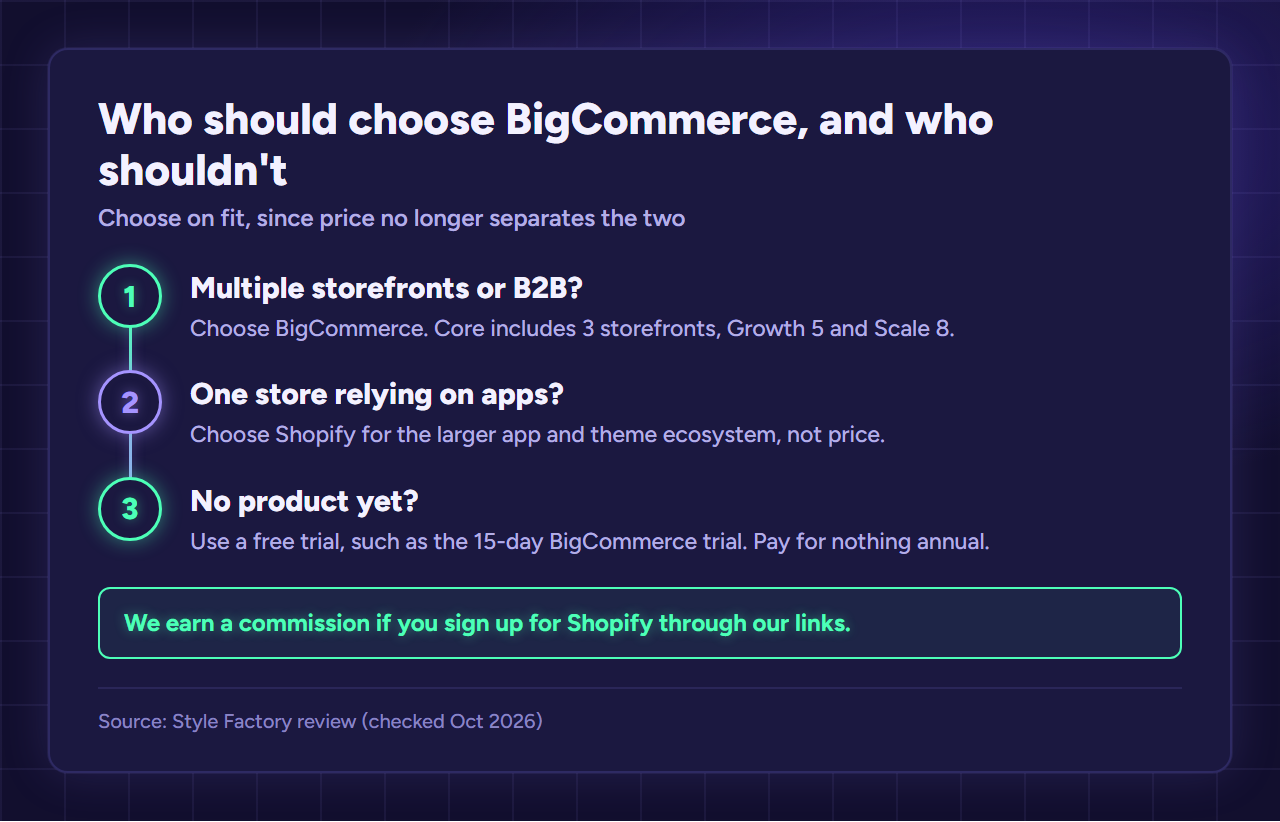
BigCommerce is the right choice for sellers running several storefronts from one back office, wholesale or B2B businesses, and stores with very large variant counts, and the wrong choice for most single-store beginners who want the widest choice of themes and apps.
Choose BigCommerce if you need 3 or more storefronts, sell to businesses as well as consumers, or have products with hundreds of variants. Its plan structure gives you that without extra subscriptions.
Choose Shopify if you run one store and expect to rely on apps for email, reviews and marketing. We earn a commission if you sign up for Shopify through our links, so weigh this recommendation knowing that. The reason is the larger app and theme ecosystem, not price.
Choose neither yet if you have no product. Use the 15-day BigCommerce trial or Shopify's trial to build a test store, and pay for nothing annual until you have made a sale. If neither BigCommerce nor Shopify fits, our comparison covers eight Shopify alternatives on fees and limits.
FAQ
Reviews and reputation
Are BigCommerce reviews trustworthy? Most are, but they measure different things. Trustpilot collects unsolicited reviews, mostly from unhappy customers. G2 and Capterra survey active users about features. Read both, and check the date on editorial reviews.
Why is BigCommerce rated so low on Trustpilot? Its 1.3 out of 5 comes mostly from billing, plan upgrade, support and cancellation complaints. BigCommerce has not invited reviews or replied to negative ones there. Shopify scores the same 1.3, so the number reflects the platform category as much as the company.
Is BigCommerce legit? Yes. It is an established ecommerce platform that tens of thousands of merchants use, by its own count. The complaints concern pricing terms and service, not fraud.
Pricing and fees
Is BigCommerce cheaper than Shopify in 2026? No. Since 1 June 2026 its Core, Growth and Scale plans cost $39, $105 and $399 a month, the same as Shopify's Basic, Grow and Advanced in the US. Its fee on third-party processors matches Shopify's surcharge too.
Does BigCommerce charge transaction fees? Only when you use a payment processor it has not embedded. That Open Payment Provider fee is 2.0% on Core, 1.0% on Growth and 0.6% on Scale. Embedded providers such as Stripe and PayPal Braintree carry no fee.
What happens when I go over my plan's sales limit? BigCommerce moves you up automatically. Core covers up to $30K in trailing 12-month GMV and Growth up to $100K. Scale charges 0.9% on GMV above $33,333 a month.
Choosing a platform
Is BigCommerce good for beginners? It is usable, but a beginner with one store gets little from its main strengths. Shopify's larger app and theme choice usually suits a first store better. Start with a free trial either way.
Can I move from BigCommerce to Shopify later? Yes, but plan for it. Export products, customers and orders as CSV, and set up 301 redirects for every old URL. Migration is easier when you keep a URL list from the start.
Leave a Reply