TL;DR: In the bigcommerce vs shopify decision for 2026, price no longer separates the two. BigCommerce's Core, Growth and Scale plans cost $39, $105 and $399 a month, the same as Shopify's Basic, Grow and Advanced in the US. Both also add 2%, 1% or 0.6% on sales through a gateway outside their own list. What differs is which gateways are free: on Shopify only Shopify Payments, on BigCommerce 20+ providers including Stripe and PayPal. BigCommerce adds staff accounts on its cheapest plan and a higher variant limit; Shopify has the larger app store and no sales cap. If you already run a store on either, a matched price is no reason to move.
We earn a commission when readers sign up for Shopify through links on easycommerce.club, and we earn nothing from BigCommerce. That gives us a reason to call Shopify the better deal, which is why the cases where BigCommerce wins get their own section. The pages ranking for bigcommerce vs shopify have stakes too. Most are written by Shopify agencies, a certified BigCommerce partner, a Shopify technology partner, or BigCommerce itself.
BigCommerce vs Shopify at a glance
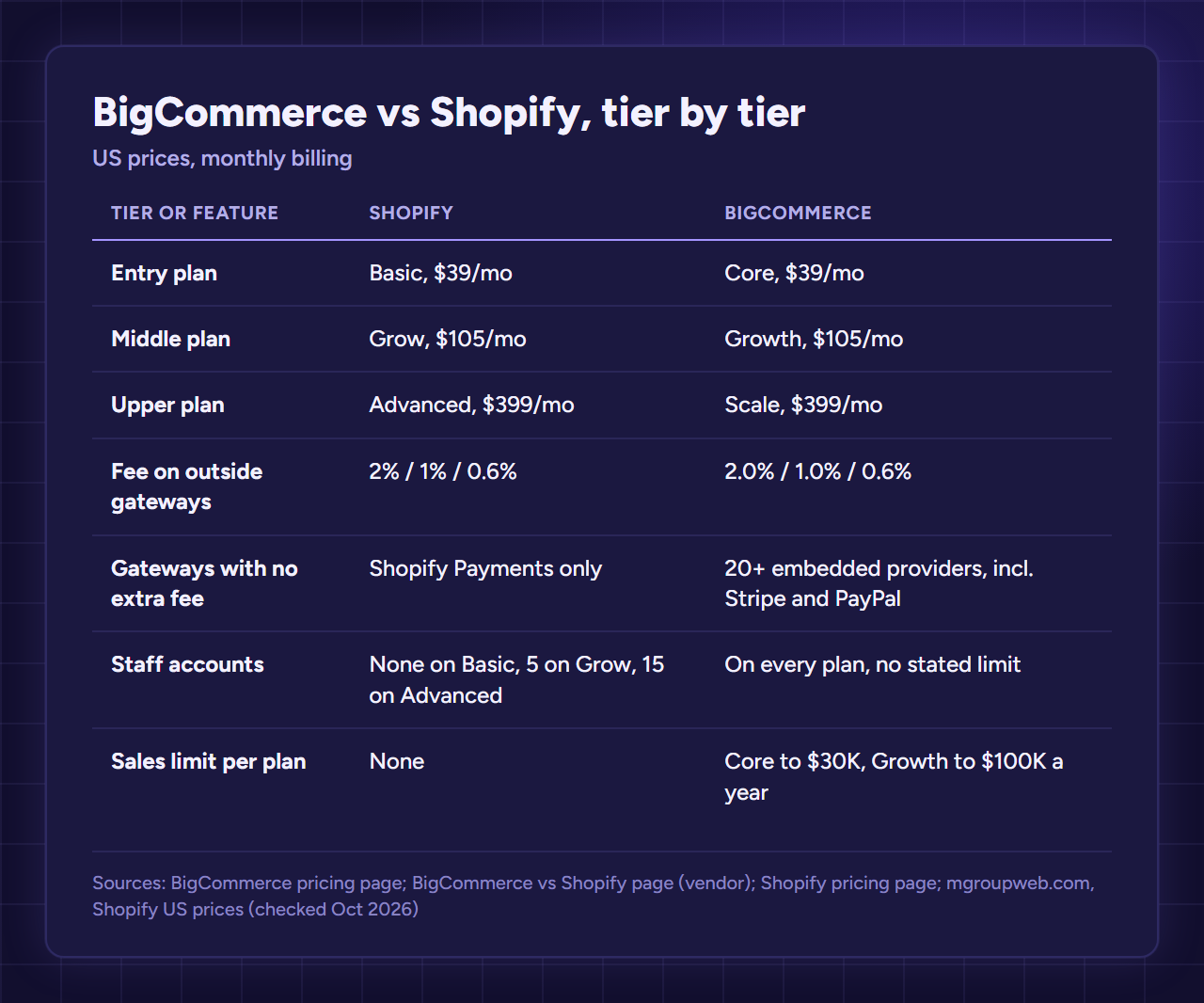
BigCommerce vs Shopify now lines up tier for tier. Both charge $39, $105 and $399 a month and the same 2%, 1% and 0.6% fees on outside gateways. They differ on which gateways are exempt, how many staff can log in and how many variants a product can have.
BigCommerce renamed its plans and changed its sales limits on June 1, 2026. Most comparisons you will find still quote the old Standard, Plus and Pro plans with $50K, $180K and $400K limits.
| Shopify | BigCommerce | |
|---|---|---|
| Entry plan | Basic, $39/mo ($29 annual) | Core, $39/mo ($29 annual) |
| Middle plan | Grow, $105/mo ($79 annual) | Growth, $105/mo ($79 annual) |
| Upper plan | Advanced, $399/mo ($299 annual) | Scale, $399/mo ($299 annual) |
| Enterprise | Plus, from $2,300/mo | Performance, custom quote from $1,499/mo |
| Fee on outside gateways | 2% / 1% / 0.6% (0.2% on Plus) | 2.0% / 1.0% / 0.6% (none on Performance) |
| Gateways with no extra fee | Shopify Payments only | 20+ embedded providers, incl. Stripe, PayPal, Adyen, Braintree |
| Staff accounts | None on Basic, 5 on Grow, 15 on Advanced | On every plan, no stated limit |
| Variants per product | 100 | Up to 600 variant SKUs (vendor figure) |
| Sales limit per plan | None | Core to $30K, Growth to $100K in trailing 12-month sales |
| Free trial | 3 days, then $1/mo for 3 months | 15 days |
At the enterprise end, Shopify Plus starts at $2,300 a month. BigCommerce quotes Performance individually, starting at $1,499 a month.
Is BigCommerce cheaper than Shopify?
No. Since its June 2026 repricing, BigCommerce's Core, Growth and Scale plans cost exactly what Shopify's Basic, Grow and Advanced cost in the US. That is $39, $105 and $399 a month. Paid annually, the entry plans drop to $29 a month, the middle plans to $79 and the upper plans to $299.
That reverses the line most comparisons still lead with. For years BigCommerce was sold as the cheaper option with no transaction fees. Neither half holds on current terms, so the sticker price tells you nothing about which one costs less for your store.
Your payment processor and your sales volume decide the bill now. Our pricing guide explains the Shopify side plan by plan, including what Grow and Advanced add over Basic: Shopify pricing plans explained.
Does BigCommerce really have no transaction fees?
Not anymore. BigCommerce now charges an Open Payment Provider fee of 2.0% on Core, 1.0% on Growth and 0.6% on Scale. It applies to eligible order value whenever a sale goes through a gateway outside its embedded provider list.
The fee is billed to you monthly. It sits on top of whatever your processor charges per transaction, so it is a second fee, not a replacement. Performance stores on custom contracts do not pay it.
These rates match Shopify's surcharge for third-party gateways: 2% on Basic, 1% on Grow and 0.6% on Advanced, falling to 0.2% on Plus. Shopify waives that surcharge only when you use Shopify Payments.
Of the eight ranking pages we read in October 2026, seven still say BigCommerce charges no transaction fees on any plan. Only one reports the new fee. If you are choosing BigCommerce to escape Shopify's 2%, check your gateway first, because on Core you may pay the same 2%.
Which payment processor will you use?
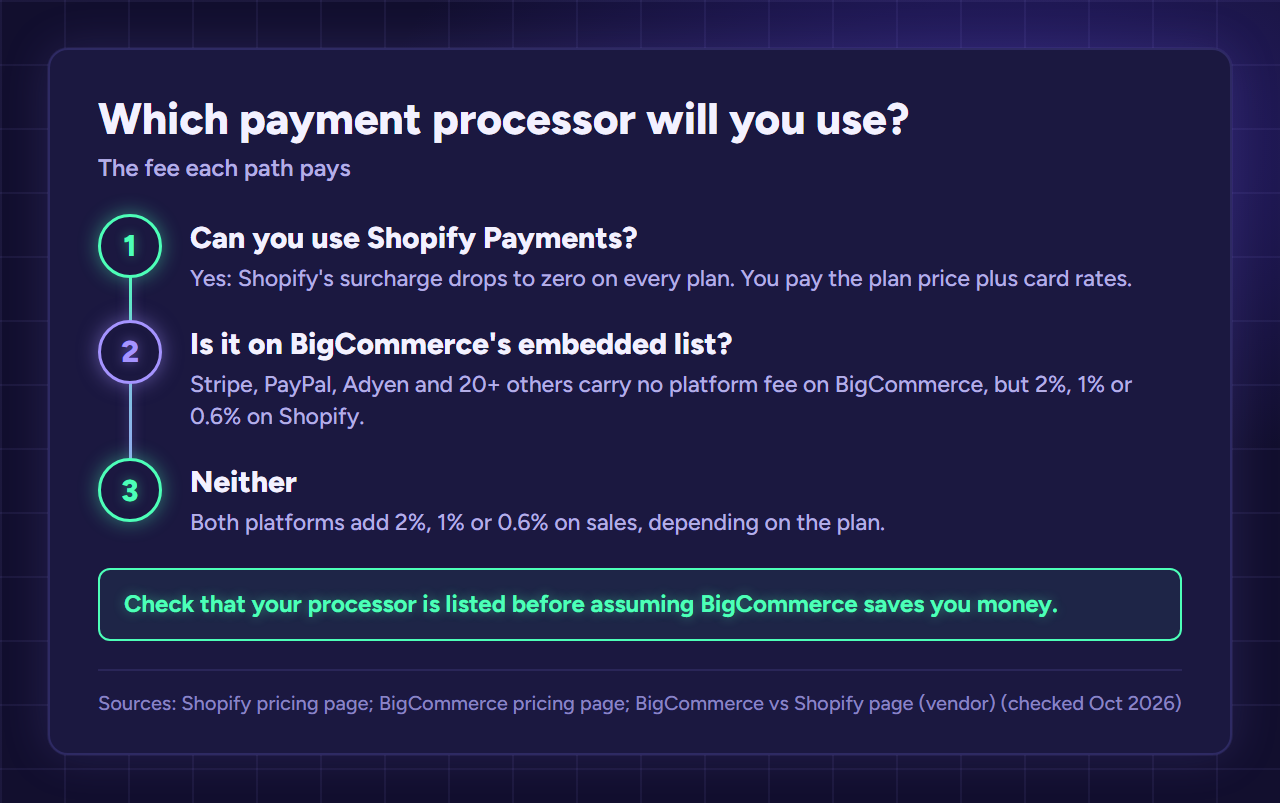
Because both platforms charge the same surcharge on the same tiers, the useful question is which processor you will take payments through. Shopify exempts only Shopify Payments, while BigCommerce exempts more than 20 embedded providers, including Stripe, PayPal, Adyen and Braintree.
If you can use Shopify Payments
If Shopify Payments accepts your business, Shopify's surcharge drops to zero on every plan. You then pay the plan price plus Shopify's own card rates. Secondary sources list those at 2.9% + 30¢ on Basic, 2.7% + 30¢ on Grow and 2.5% + 30¢ on Advanced. Shopify's pricing page no longer shows them, so confirm the rates at signup.
For a store in this position the gateway question disappears. The choice comes down to features, covered further down.
If you're tied to Stripe, PayPal or another processor
Some merchants cannot or will not move processors. You may have a negotiated rate, a product category some processors refuse, or years of history with one provider. On Shopify, any gateway other than Shopify Payments carries the 2%, 1% or 0.6% surcharge. A processor on BigCommerce's embedded list carries no platform fee at all.
That list includes Stripe, PayPal (Braintree, Complete Payments and Wallet), Adyen, Checkout.com, Worldpay, Global Payments, Amazon Pay, Klarna, Affirm and Afterpay, among others. Anything not on it counts as an Open Payment Provider and pays the same rates as on Shopify. Check that your processor is listed before assuming BigCommerce saves you money.
What each platform costs at $2K, $8K and $30K a month
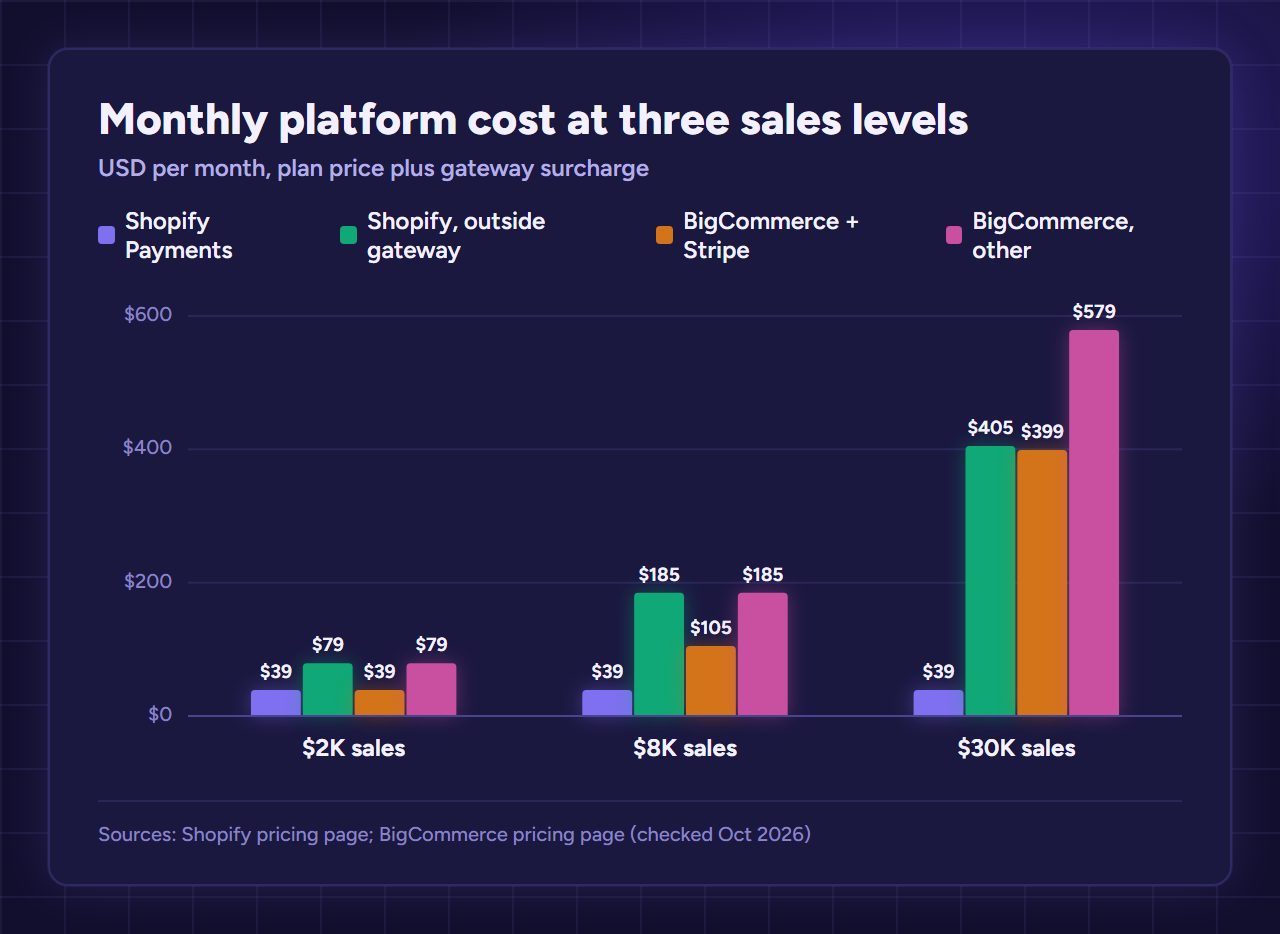
In the bigcommerce vs shopify cost comparison, the answer flips with your processor. With Shopify Payments, Shopify costs less at every sales level below. With Stripe or PayPal, BigCommerce costs less at $2K and $8K a month and about the same at $30K.
The table counts only the plan price and the platform's gateway surcharge, at monthly billing. It leaves out apps, themes and processor fees, which you pay on either platform. Paying annually cuts each plan price by about a quarter.
| Monthly sales | Shopify with Shopify Payments | Shopify with an outside gateway | BigCommerce with Stripe or PayPal | BigCommerce with another gateway |
|---|---|---|---|---|
| $2K | $39 (Basic) | $79 (Basic, $39 + $40) | $39 (Core) | $79 (Core, $39 + $40) |
| $8K | $39 (Basic) | $185 (Grow, $105 + $80) | $105 (Growth, required) | $185 (Growth, $105 + $80) |
| $30K | $39 (Basic) | $405 (Grow, $105 + $300) | $399 (Scale, required) | $579 (Scale, $399 + $180) |
How the totals change as sales grow
At $2K a month, both cost $39 with a fee-free gateway. With an outside one, each adds a $40 surcharge for $79 in total.
At $8K a month you are doing $96K a year, past Core's limit, so BigCommerce moves you to Growth at $105. Shopify Basic with an outside gateway would cost $39 + $160 = $199, so Grow is cheaper at $185. On an outside gateway, Grow beats Basic once sales pass $6,600 a month. A Stripe store saves $80 a month on BigCommerce here.
At $30K a month ($360K a year), BigCommerce puts you on Scale at $399. Scale includes $33,333 of monthly sales before its 0.9% overage starts, so no overage applies yet. A Shopify store on an outside gateway pays $105 + $300 = $405 on Grow, against $399 for a Stripe store on BigCommerce. BigCommerce with a non-embedded gateway is the priciest option here at $579. Grow stays Shopify's cheapest option for outside gateways until about $73,500 a month.
The $30K sales cap on BigCommerce Core
BigCommerce Core covers up to $30K in trailing 12-month sales, which works out to $2,500 a month. Above that, BigCommerce moves you to Growth at $105 automatically. Past $100K a year, about $8,333 a month, you move to Scale at $399.
The old Standard plan allowed $50K a year, so many comparisons overstate how long a small store stays on the entry price. Shopify has no sales limit on any plan, and you decide when to upgrade.
Shopify vs BigCommerce: features that actually differ
Once prices match, Shopify vs BigCommerce comes down to a handful of real differences: staff accounts, variant limits, the size of the app store, built-in B2B tools, in-person selling, and how long you can try each one before paying.
Staff accounts
Shopify Basic includes no staff accounts, so only the owner logs in. Grow includes 5 and Advanced 15. BigCommerce lists staff accounts on every plan, Core included, without a stated cap. If a partner, assistant or bookkeeper needs a login from day one, that is a $66 monthly difference: Shopify Grow at $105 against BigCommerce Core at $39.
Product variants
Shopify caps standard plans at 100 variants per product. BigCommerce says it supports up to 600 variant SKUs per product, with 250 values per option; that is the vendor's own figure. A shirt in 8 colors and 15 sizes already needs 120 variants. On Shopify that means an app or splitting the product into several listings.
Apps and themes
Shopify's app store lists more than 8,000 apps, and BigCommerce says it has over 1,200. The gap matters most when you need one niche integration, such as a particular print-on-demand supplier or subscription tool, and only Shopify has it. List your must-have apps and check both stores before choosing.
B2B and selling in person
BigCommerce builds B2B selling into the platform, so wholesale and retail can run from one store. If you sell wholesale on Shopify, check which B2B features your plan includes before assuming parity. For in-person selling, Shopify runs its own POS, and POS Pro adds $89 a month per location.
Ease of setup
Shopify offers a 3-day free trial with no credit card, then $1 a month for 3 months. BigCommerce offers 15 days free. Several of the comparisons we read call Shopify easier for a first store, but none of them measured it. Load a few of your own products into each admin and judge for yourself.
Who should choose BigCommerce?
Choose BigCommerce if you are staying with Stripe, PayPal or another embedded processor, or need staff logins on the entry plan. It also wins for products with more than 100 variants and for stores selling wholesale alongside retail.
- You take payments through Stripe or PayPal and want to keep it that way. At $8K a month that saves $80 a month against Shopify Grow.
- Two or more people need admin access, and you are not ready for a $105 plan.
- Your catalog has products with more than 100 variants.
- You sell B2B and want those tools without adding apps.
Watch the sales limits, though. A store passing $30K a year moves to Growth automatically, so budget for $105 a month, not $39, once you grow.
Who should choose Shopify?
Choose Shopify if Shopify Payments works for your business or you want the widest choice of apps and themes. It also suits stores that sell in person, and stores that want to stay on the $39 entry plan as sales grow, with no forced upgrade.
- Shopify Payments accepts you, so you pay no gateway surcharge on any plan.
- You need apps that only exist on Shopify.
- You plan to sell in person with Shopify POS.
- You want to stay on Basic at $39 while sales grow.
Do not pick Shopify only because it is called easier if your products need more than 100 variants; the workarounds cost time and app fees. And if you are locked into an outside gateway on thin margins, the 2% surcharge on Basic can cost more than BigCommerce at the same volume.
If you want full control and do not mind hosting it yourself, our comparison of Shopify and WooCommerce goes through the trade-offs: Shopify vs WooCommerce.
Should you switch platforms?
Usually not. Prices are matched in the bigcommerce vs shopify comparison, so moving from one to the other rarely pays for itself. The exception is when gateway fees, the variant cap or missing staff accounts cost you money every month.
Switching means migrating products, customers and orders. It means setting up 301 redirects for every URL that changes, and rebuilding the apps and theme customizations you rely on. Rankings can dip for a while as Google processes the redirects.
A move makes sense when the arithmetic is clear. Examples are a Shopify store paying the 2% surcharge on Stripe, a catalog stuck at 100 variants, or a BigCommerce store pushed onto a plan it would not choose. Work out the monthly saving, then weigh it against the one-time cost and the weeks of disruption.
If neither platform fits, our guide to Shopify alternatives covers eight other platforms on price and limits: eight Shopify alternatives.
FAQ
Cost and fees
Is BigCommerce cheaper than Shopify?
Not on plan prices. Both charge $39, $105 and $399 a month on their three main tiers in the US. BigCommerce can cost less overall if you use Stripe or PayPal, because those carry no platform fee there.
Does Shopify charge transaction fees and BigCommerce not?
Both charge them now. Shopify adds 2%, 1% or 0.6% when you use a gateway other than Shopify Payments. BigCommerce adds 2.0%, 1.0% or 0.6% when you use a gateway outside its embedded provider list.
What happens when my BigCommerce store passes its sales limit?
BigCommerce moves you up automatically. Core covers up to $30K in trailing 12-month sales and Growth up to $100K; past that you go to Scale. Scale includes $33,333 of sales a month, then charges 0.9% on the excess.
Features and switching
Which is better for B2B, BigCommerce or Shopify?
BigCommerce has the edge for small wholesale sellers, because B2B selling is built into the platform. On Shopify, check what your plan includes before committing.
Isn't Shopify easier to use?
Several ranking comparisons say so, but none of them measured it. Shopify's 3-day trial and BigCommerce's 15-day trial both give you enough time to build a test store. Load a few real products into each and decide from that.
Which platform is better for SEO?
Neither has a meaningful edge for a small store. Both let you edit titles, meta descriptions and URLs, and both support redirects. Your content, product pages and links will matter far more than the platform.
Can I move from BigCommerce to Shopify without losing rankings?
Mostly, if you map every old URL to its new one with 301 redirects before launch. Shopify uses fixed /products/ and /collections/ paths, so most of your URLs will change. Expect a short dip while Google reprocesses the site.
Sources and a note on the numbers
We checked every price and fee in this article on October 25, 2026. The sources are the BigCommerce and Shopify pricing pages, except where a note below says only a secondary source was available.
- BigCommerce plans, sales limits and Open Payment Provider fee: bigcommerce.com/essentials/pricing
- BigCommerce embedded providers, variant limit and app count: bigcommerce.com/compare/bigcommerce-vs-shopify (vendor figures)
- Shopify plans, gateway surcharge, staff accounts, trial and POS: shopify.com/pricing
- Shopify card rates and the BigCommerce trial length: websitebuilderexpert.com (secondary; Shopify no longer lists card rates)
Sources disagree in three places. Most comparisons still say BigCommerce charges no transaction fees and quote its old $50K, $180K and $400K limits. Reported Shopify Plus variant limits vary widely, so we give only the standard 100. Shopify also shows different prices by region, and the figures here are US prices. BigCommerce last changed its plans in June 2026, so verify current terms before you sign up.
Leave a Reply