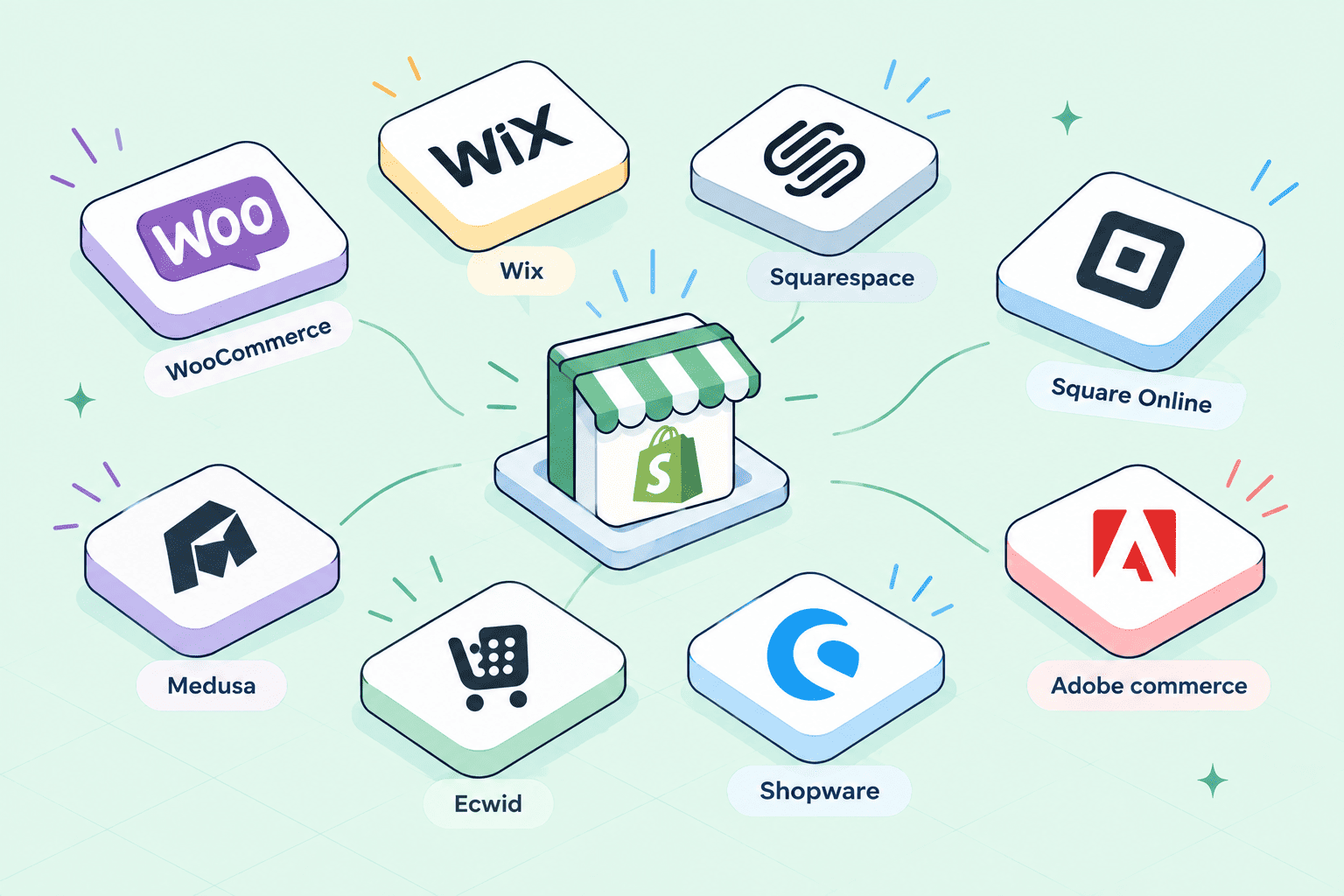
TL;DR: The strongest Shopify alternatives in 2026 are BigCommerce for B2B and large catalogs, WooCommerce for control and content, Wix or Squarespace for small simple stores, Square Online for existing Square users, and Medusa if you have developers. But most people searching for Shopify alternatives are frustrated about cost, and migration usually does not fix that. The platform fee is rarely the biggest line on the bill. Read the section on when not to switch before you read the list.
Who writes these lists, and why it matters
Look at what currently ranks for this search.
The results include an article published by BigCommerce, one by Jumpseller, one by Shopware, and one by Salesforce. Those are all Shopify competitors, writing lists of alternatives to Shopify, in which they appear. That is normal content marketing and none of them are lying. But an article that ends with “and the best option is us” is answering a different question than the one you asked.
We have a conflict too, in the other direction. Shopify is our affiliate partner. So the honest thing is to tell you where Shopify genuinely loses, which is what the rest of this article does, and let you weigh the source accordingly.
The one source on that page with no platform to sell is Reddit, sitting at number two. That is worth a look for exactly this reason.
Before you switch: the cost nobody puts in the comparison table
Platform comparisons list monthly fees. The decision is rarely about monthly fees.
Migration costs weeks of work and carries real revenue risk. Products and orders export reasonably well. Everything else is manual: theme rebuild, app replacements, URL redirects so you do not lose rankings, payment and shipping reconfiguration, and testing.
Two things do not transfer at all. Your reviews, which were doing real conversion work, and your SEO history, which you can partly preserve with careful redirects and partly cannot.
That is why the platform decision is the hardest one to reverse, and why “it is $10 cheaper” is not a reason to move. It is a reason to move only if the difference compounds over years and something else is also wrong.
When you should not leave Shopify
Most people arrive at this search for one of three reasons, and two of them are better solved without migrating.
“It costs too much.” Check what you are actually paying for. On a typical store the plan is $39 and the apps are $80 to $200. Migrating cuts the $39. Auditing your app stack cuts more, faster, with no risk. Do that first.
“I need a second admin login and Grow is $105.” This one is real. Basic dropped to zero staff accounts in 2026, and the jump to a second seat is steep. It is still usually cheaper than a migration, but it is a legitimate grievance.
“I hate the transaction fee.” Shopify charges no transaction fee on Shopify Payments. The 2% on Basic applies only if you use a third-party gateway. If that is your complaint, switching payment providers costs an afternoon and switching platforms costs a month.
The reason to genuinely leave is a capability ceiling: B2B pricing Shopify cannot do natively, a content operation that needs WordPress, a catalog structure that fights the platform, or a developer team that wants to own the stack.
Best Shopify alternatives, by what you actually need
BigCommerce, for B2B and large catalogs
The strongest like-for-like alternative. Native B2B features that Shopify needs apps for: company accounts, price lists, quoting. Multi-storefront is built in rather than bolted on. Open APIs and headless support without an enterprise contract.
One thing changed in 2026 that its own marketing is slow to mention. From 1 June 2026 BigCommerce renamed its plans and added an Open Payment Provider Fee on all self-serve plans, at rates that vary by tier. The long-standing “zero transaction fees” pitch now applies only if your processor is on BigCommerce’s embedded list, which includes Stripe, PayPal, Adyen, Klarna, Checkout.com, Weorldpay, and BigCommerce Payments among others. Anything outside that list is an Open Payment Provider and carries the fee. The Performance tier, on contracted terms, is exempt.
The new lineup mirrors Shopify almost exactly. Core is $39 monthly or $29 annual, Growth is $105 or $79, Scale is $399 or $299. Those are the same numbers as Shopify Basic, Grow, and Advanced. Performance starts around $1,499. Whatever else BigCommerce is now, it is no longer the cheaper option.
Watch the Scale overage model. Scale applies a continuous 0.9% charge on GMV above $33,333 a month, replacing the old fixed per-block charges. Your bill rises with revenue rather than in steps, which is easier to forecast but harder to cap.
WooCommerce, for control and content
Free software on WordPress. You own everything and you are responsible for everything.
The honest cost picture: the plugin is free, but a real store lands somewhere between $1,000 and $3,000 a year once hosting, a theme, plugins, security, and maintenance are counted. Some estimates run higher. On cheap shared hosting you can technically start near $3 a month, and you will feel it.
Choose it if content is central to your business, if you already run WordPress, or if you want no platform between you and your data. Do not choose it to save money unless you are comfortable being your own sysadmin, because the time cost is the real price.
Wix and Squarespace, for small simple stores
Both are website builders with commerce attached rather than commerce platforms with pages attached. That distinction predicts where they stop working.
Squarespace Core runs about $23 a month, Wix Core about $29. Squarespace reorganised its lineup in 2026 into Basic, Core, Plus and Advanced. Neither charges a platform transaction fee.
They suit a small catalog where presentation carries the sale: art, jewelry, premium single-product brands. They stop suiting you at inventory complexity, multi-channel selling, or serious catalog size. Squarespace in particular has no third-party app marketplace and no headless option, so there is no escape hatch when you outgrow it.
Square Online, if you already use Square
If Square is your point of sale, this is the obvious answer and barely a decision. Inventory syncs between in-person and online without integration work. There is a free tier with a real storefront.
For anyone not already on Square it is an unremarkable choice.
Medusa, if you have developers
Open source, headless, JavaScript. Free software, and your costs are hosting plus engineering time.
This is a real alternative for a team that wants to own the stack, and a bad idea for anyone hoping to avoid a $39 monthly fee. The engineering cost dwarfs any license saving until you are quite large.
Ecwid, for adding a store to an existing site
A commerce widget you embed in a site you already have. Free tier available. Good when you have a working WordPress or Wix site and want to add products without rebuilding.
Capability is the trade. No advanced segmentation, no B2B pricing, limited personalization.
Shopware and Adobe Commerce, at the complex end
Both aim above the small-store market. Shopware is open source with a commercial edition and is strongest in Europe. Adobe Commerce, formerly Magento, starts making sense for complex B2B or hybrid B2B and B2C manufacturers.
Neither belongs on a shortlist for a store doing under a few million a year. They appear on alternatives lists mostly because the companies behind them publish those lists.
What Shopify still does better
An alternatives article that only lists reasons to leave is not useful. Here is the other side, and it is why most stores stay.
The app ecosystem is genuinely the largest. When you need a specific capability, someone has already built it for Shopify. On smaller platforms you are more often choosing between a worse app and a developer.
Checkout converts well and you cannot break it. Shopify’s checkout is tested against enormous volume. On WooCommerce, checkout is yours to optimise and yours to break.
Costs are predictable. You know what next month looks like. WooCommerce hosting bills, plugin renewals, and maintenance are lumpier than the average estimate suggests.
Nothing to maintain. No hosting, no security patching, no version upgrades that break a plugin. This is invisible until you have lived without it.
Distribution is expanding. Shopify’s Agentic Storefronts syndicate catalogs to ChatGPT, Gemini, Copilot, and the Shop app, included on paid plans since March 2026. No competitor currently matches that reach.
The honest summary is that Shopify is the safest default for most stores, and the alternatives win on specific axes rather than overall. Pick an alternative because you need what it does differently, not because you are unhappy with a bill you have not itemised.
Shopify alternatives free: what actually exists
Free means one of two things here, and they are very different.
Genuinely free plans with a storefront. Square Online and Ecwid both have them. Real product pages, real checkout, no monthly fee. You pay payment processing and accept feature limits. For testing whether something sells, these work.
Free software you host yourself. WooCommerce and Medusa. The license is free and everything else is not. Budget $1,000 a year minimum for WooCommerce done properly.
What does not exist is a free version of Shopify. The trial is 3 days, followed by $1 a month for three months, then $39. The Starter plan that used to be the cheap entry point was closed to new stores in August 2026.
If you are searching for websites like Shopify for free because $39 is genuinely out of reach right now, the honest sequence is: start on a free tier or a marketplace, prove something sells, then move to a paid platform with revenue behind you. Not the other way around.
Real monthly cost, compared
Sticker prices mislead because the platform fee is rarely the largest line. Here is roughly where each lands for a small working store, everything included.
| Platform | Plan | Realistic all-in monthly |
|---|---|---|
| Wix | ~$29 | $35 to $100 |
| Squarespace | ~$23 | $35 to $100 |
| Shopify | $39 | $100 to $500 |
| BigCommerce | Varies by tier | $100 to $500 |
| WooCommerce | $0 licence | $125 to $575 |
| Square Online | Free tier available | Processing only, plus add-ons |
Two observations that matter more than the ranking.
WooCommerce is frequently the most expensive option in this table, despite being the free one, because hosting and plugins accumulate. It is chosen for control, not for cost.
The gap between Shopify and its nearest alternatives is smaller than the plan prices suggest. Most of what you pay on any of these platforms is apps and processing, and those costs follow you when you move.
The one comparison worth running yourself
Take your last full month. Write down your platform fee, every app subscription, your payment processing, and any transaction surcharge.
Now work out which of those lines actually changes if you switch. In most cases the platform fee changes, processing stays roughly the same, and apps mostly get replaced by equivalent apps at similar prices.
If the number that changes is under $50 a month, you are considering weeks of migration work to save less than a freelancer costs for a day. If it is $300 a month because you are paying a transaction surcharge at volume, that is a real case.
The same arithmetic applies to the capability argument. If Shopify cannot do something you need and an app can do it for $40 a month, that is not a migration trigger. If no app can do it, it is.
If you decide to move, do it in this order
Migration goes badly when people start with the theme. Start with the things that break silently.
Export everything first. Products, orders, and above all your customer list. Do this before you touch anything else.
Map every URL. List your current pages and their replacements on the new platform, then set permanent redirects for each. This is the step that determines whether you keep your rankings, and it is the step people rush.
Rebuild before you cut over. Get the new store fully working on a temporary domain while the old one keeps selling. There is no reason to lose revenue during setup.
Replace apps deliberately, not one for one. Migration is a good moment to drop the three apps you installed and forgot. Match capabilities, not subscriptions.
Plan for the reviews. They do not transfer. Start collecting on the new store immediately, and consider screenshotting your old rating for an about page.
Cut over in a quiet week, then watch search traffic daily for a month. A dip is normal. A dip that does not recover means a redirect is wrong.
Can you come back if it does not work out?
Yes, and it is worth knowing before you go, because it changes how much the decision weighs.
Your Shopify account does not vanish. Pausing a store is cheaper than paying a full plan, and your products, orders, and customer data stay where they are. If you migrate away and regret it, coming back means rebuilding the storefront again, not starting from zero on data.
The parts that do not survive a round trip are the same ones that do not survive the first trip. Reviews, some URL equity, and any app-specific data that never had an export path.
There is one asymmetry to keep in mind. Whatever you build on WooCommerce or Medusa is yours and portable in principle. Whatever you build inside a closed platform’s proprietary features is not. That argues for keeping your customer list exported and current wherever you are, which is good practice regardless of platform.
The practical upshot: the decision is reversible, but each reversal costs you roughly what the first move did. Make it once, deliberately.
Best Shopify alternatives: the short version
BigCommerce suits B2B, large catalogs, or multi-storefront. Check the 2026 payment provider fee against your processor first.
WooCommerce suits content-led businesses and anyone wanting full control, with eyes open about the real annual cost.
Wix or Squarespace suit small, design-led catalogs where you will not outgrow them.
Square Online is the obvious pick if you already run Square in person.
Medusa or Shopware make sense if you have engineers and a reason.
Staying on Shopify is right if your complaint is cost and you have not audited your apps, if you need something an app already solves, or if you are under a year in and still finding out what sells. Migration is a solution to a ceiling, not to a monthly bill.
Our Shopify pricing breakdown covers what the plans actually cost once processing and apps are counted, and the Shopify vs WooCommerce comparison goes deeper on that specific pairing.
FAQ
Choosing questions
What is the best Shopify alternative overall?
BigCommerce, for most stores that genuinely need to leave. It is the closest like-for-like hosted platform, with stronger native B2B and multi-storefront support.
Are there free Shopify alternatives?
Yes. Square Online and Ecwid have free tiers with real storefronts. WooCommerce and Medusa are free software but cost real money to run once hosting is counted.
What do shopify alternatives Reddit threads recommend?
Reddit threads on this question skew heavily toward WooCommerce for control and BigCommerce for scale, with frequent warnings that migration takes longer than expected. Worth reading precisely because nobody there is selling a platform.
Cost and switching questions
Is BigCommerce cheaper than Shopify?
No longer. Its June 2026 pricing update put Core at $39/$29, Growth at $105/$79, and Scale at $399/$299, which match Shopify’s Basic, Grow, and Advanced exactly. It also added an Open Payment Provider Fee on self-serve plans for processors outside its embedded list. Choose BigCommerce for its B2B and multi-storefront capability, not to save money.
How long does migrating off Shopify take?
Plan for weeks, not days. Products and orders export cleanly. Themes, apps, redirects, and testing do not, and reviews generally do not transfer at all.
Will I lose my Google rankings if I switch?
Partly, unless you map every URL to its new equivalent with permanent redirects. Even done well, expect a temporary dip. This is the cost most switching guides leave out.
I’m building EasyCommerce Club to be the ecommerce resource I wish I’d had starting out, plain-language guides, essential information.
Leave a Reply