TL;DR: Knowing how to find winning dropshipping products starts with arithmetic, not browsing. At a median TikTok cost of $0.50 per click and a 2% conversion rate, one order costs about $25 in ads, so a product needs more than $25 of gross profit per unit before it is worth testing. Candidates that clear that bar still need agreement from at least three of four free demand signals. Then run a fixed $300 to $500 test with a kill rule written in advance.
What is a winning dropshipping product?
A winning dropshipping product is one that stays profitable after you pay to acquire the customer. That is the whole definition.
Everything else people list, the wow factor, the impulse appeal, the problem it solves, matters only because it moves that equation. A product with enormous wow factor and $6 of gross profit is not a winner. It is a hobby with a shopping cart attached.
This framing matters because it flips the order of work. Most beginners find a product first, then hope the numbers work. The sequence that actually works is the reverse. Set the economics you need, then go looking for products that clear the bar.
Why does the 3x markup advice fail in 2026?
The 3x markup advice fails because a $30 product with $20 of gross profit cannot cover a $25 cost per order at 2026 ad rates.
Here is the advice you will find on nearly every competing article: source at $10, sell at $30, aim for a 30% margin or better.
Now put real 2026 numbers against it.
Cost per click on TikTok runs around $0.50 at the median, and closer to $1.72 on Facebook. A decent ecommerce conversion rate sits near 2%. Do the division. At a median TikTok cost per click of $0.50 and a 2% conversion rate, one order costs about $25 in ads, so any product with less than $25 of gross profit per unit loses money on paid traffic.
That $30 product with $20 of gross profit loses you $5 on every sale. It does not lose money because the product is bad. It loses money because the gross profit never had a chance of covering a $25 acquisition cost.
Here is what break-even actually requires at different acquisition costs:
| Cost per click | Conversion rate | Cost per order | Gross profit you need |
|---|---|---|---|
| $0.50 | 3% | $17 | Over $17 per unit |
| $0.50 | 2% | $25 | Over $25 per unit |
| $1.00 | 2% | $50 | Over $50 per unit |
| $1.72 | 2% | $86 | Over $86 per unit |
Gross profit here means selling price minus product cost, shipping, and payment processing. Not selling price minus product cost alone.
Why this changes how to find winning dropshipping products
Two conclusions fall out of that table.
Cheap products are structurally hard in 2026. A $25 item cannot carry a $25 acquisition cost no matter how good the creative is. This is why so much sub-$30 dropshipping quietly fails while the seller blames their ads. Import costs push the same way. Since the US de minimis exemption ended for all countries on 29 August 2025, every parcel clears customs regardless of value, and $15 products reportedly pick up $3 to $8 in duties and processing.
And higher-priced products get easier, not harder, as long as demand is real. A $120 product with $60 of gross profit absorbs a $25 acquisition cost comfortably. It also tolerates a worse conversion rate, which buys you room to learn.
None of this means cheap products never work. It means they only work through channels you are not paying per click for: organic video, SEO, email, or repeat purchase. If you plan to buy traffic on day one, price accordingly.
Winning product criteria that survive contact with ad costs
With the economics fixed, these are the winning product criteria worth screening against. A product does not need all six. Three or four is a realistic bar.
Gross profit above your break-even. Non-negotiable, and it comes first because it eliminates most candidates in seconds.
A visible, demonstrable benefit. The product has to be explainable in a few seconds of video. Not because video is trendy, but because paid traffic gives you no time to educate.
Low return probability. Anything sized, fitted, fragile, or electronic carries return risk. A 10% return rate on thin margins erases the account.
Compact and light. Shipping weight eats gross profit directly and slows delivery, which drives disputes.
Not already saturated. If the same creative has been running for eight months across dozens of stores, the easy money is gone.
Some repeat or expansion potential. Consumables, accessories, or products with a natural second purchase let you make money on the second order, where there is no acquisition cost.
That last one is underrated. If you cannot win on the first order, you can sometimes win on the second. But only if the product supports one.
How to validate a dropshipping product
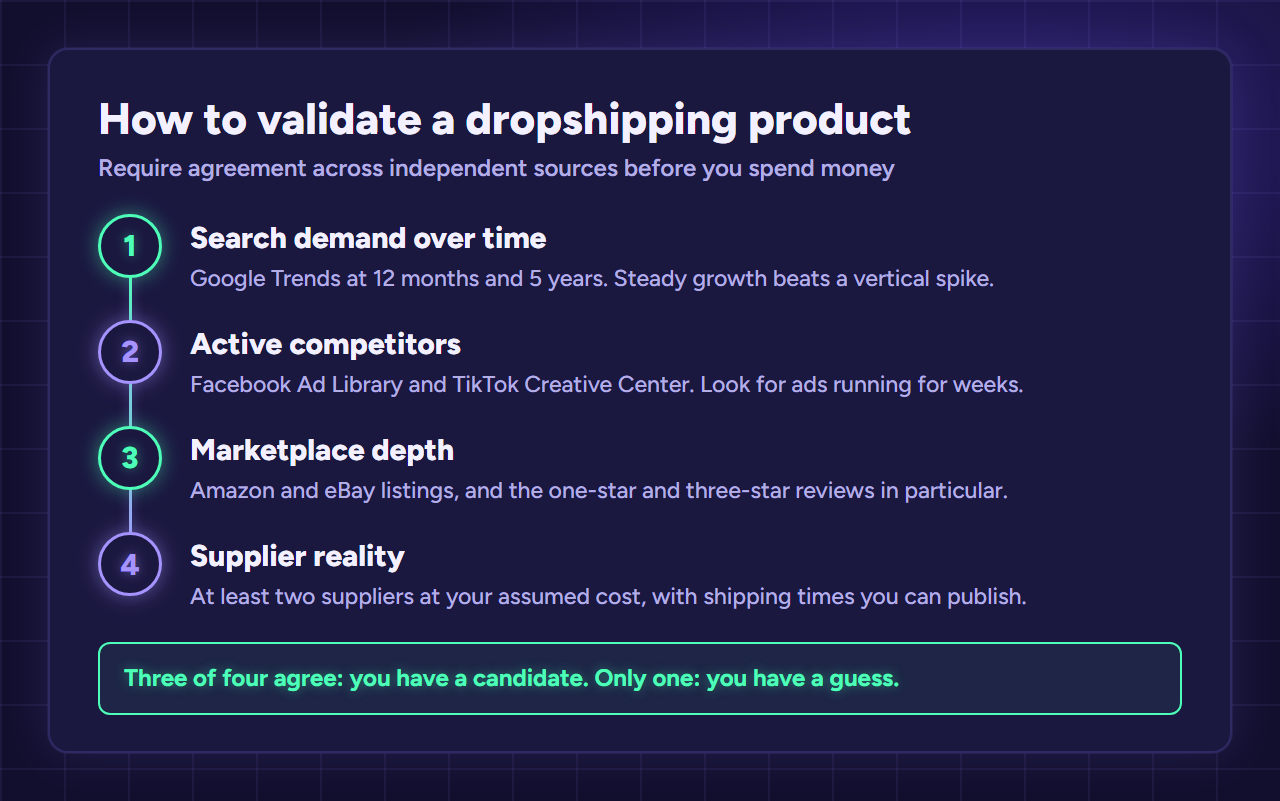
One signal proves nothing. Any product can look good on a single platform for a week. The rule is to require agreement across at least three independent sources before you spend money.
Search demand over time. Google Trends shows whether interest is building, flat, or collapsing. Look at the 12-month and 5-year views, not the 7-day view. A vertical spike is usually a fad you are already late to. Steady growth over six months is the signal you want.
Active competitors spending money. Facebook Ad Library and TikTok Creative Center both show what is running right now, and our guide on how to spy on competitor Shopify stores covers the legal ways to dig further. Competitors are not a warning sign. They are proof someone has already validated that people will pay. What you are looking for is ads that have been running for weeks, because nobody keeps losing money for weeks.
Marketplace depth. Check whether the product sells on Amazon and eBay, and read the one-star and three-star reviews specifically. Those reviews tell you the failure modes: what breaks, what arrives wrong, what people expected and did not get. That is your return-rate preview and your product-description checklist in one place.
Supplier reality. Confirm at least two suppliers can actually fulfill it, at the cost you assumed, with shipping times you can publish honestly. A product with one supplier is a single point of failure.
If three of these four agree, you have a candidate. If only one does, you have a guess.
Free product research methods
You do not need paid tools to do any of the above. Every source in the validation section is free.
Google Trends is free. Facebook Ad Library is free and requires no account. TikTok Creative Center is free. Amazon and eBay reviews are free. Supplier catalogs on AliExpress and similar platforms cost nothing to browse.
Paid research tools do one thing well: they compress the time it takes to surface candidates. They do not validate better than the free sources, because most of them pull from the same underlying data. If your budget is tight, spend it on testing rather than on discovery. Finding candidates is the cheap part.
Two free methods most people skip:
Read your competitors' negative reviews, not their positive ones. A recurring complaint across several sellers is a product gap. If everyone's version of a product arrives with a flimsy strap, a version with a better strap has an angle before you have written a single ad.
Work backwards from creative, not from products. Search ad libraries for ads with heavy engagement in a category you understand, then ask what problem that ad is solving. Then find products that solve it. This finds validated demand first and matches a product to it, rather than finding a product and hoping demand exists.
Where candidates actually come from
Discovery is the easy half, but it helps to have more than one intake source. Four work reliably.
Your own irritations. Products you have wanted and could not find well-made are a genuinely good starting point, because you already understand the buyer.
Adjacent products to something already selling. If a store in a category is working, the accessories and consumables around that category inherit some of its validated demand.
Marketplace movers. Best-seller and new-release listings on large marketplaces show what is gaining traction, though by the time something is ranked highly there it is often late.
Ad libraries, browsed sideways. Rather than searching for a product, browse what is running in a category you understand and note the problems the ads are addressing.
The intake source barely matters. What matters is that everything from every source goes through the same filter. A candidate from a paid tool gets no more benefit of the doubt than one you thought of in the shower.
A product testing checklist
Testing without a written rule for stopping is how people spend $800 finding out nothing. Decide these before you launch.
Budget per product. Pick a fixed number and hold to it. TikTok requires a $50 daily campaign minimum, so a five-day test on one campaign costs at least $250. A realistic first test needs $300 to $500 per product to produce data worth reading. Below roughly $200 you are not testing, you are sampling noise.
Duration. Three to seven days. Shorter and the platform has not finished learning. Longer and you are funding a decision you already have the data to make.
The metric you will judge on. Cost per purchase against your break-even number from earlier. Not clicks, not video views, not add-to-carts. Those are diagnostics for why something failed, not the verdict.
Your kill rule, written down in advance. For example: stop if cost per purchase exceeds break-even by 50% after the full budget is spent. Writing it before you launch is the point. Deciding mid-test, while watching money leave, is how a $300 test becomes a $900 one.
What a failure tells you. Each failure pattern points to a different fix. Separating them is what makes the next test cheaper.
| What you see | Likely cause | What to change first |
|---|---|---|
| Clicks, no add-to-carts | The landing page does not match the ad | Rewrite the page to match the ad's promise |
| Zero add-to-carts at any traffic level | Wrong product or wrong audience | Change the audience once, then drop the product |
| Add-to-carts, no purchases | Price, shipping cost, or trust on the product page | Show shipping cost and delivery time earlier, then test price |
Test one variable at a time. Running three products with three creatives each and one budget teaches you almost nothing about any of them.
A worked example, start to finish
Abstract frameworks are easy to agree with and hard to apply. Here is the whole process against one hypothetical candidate.
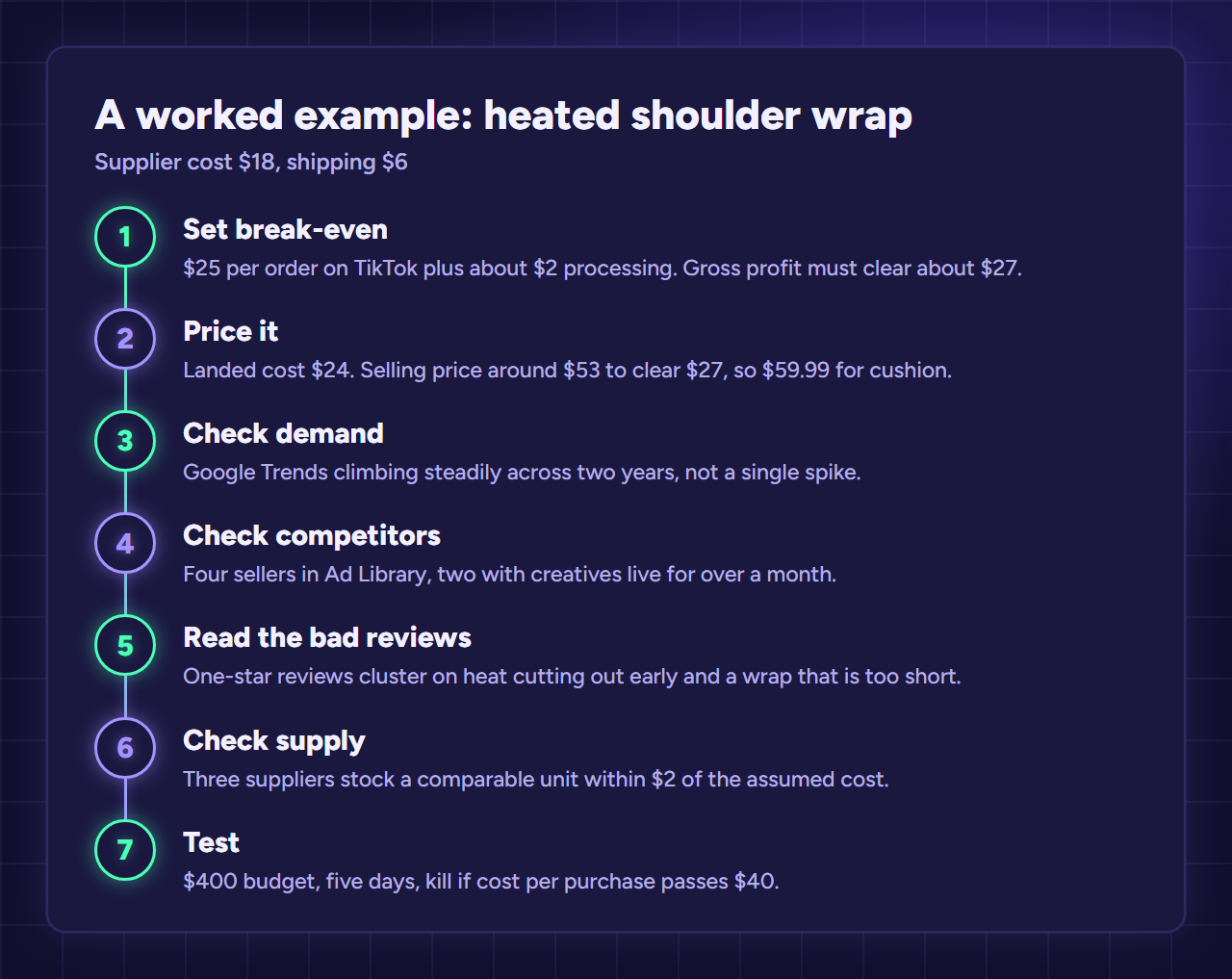
The candidate. A weighted, heated shoulder wrap for neck tension. Supplier cost $18, shipping $6.
Step 1, set break-even. Planning to buy traffic on TikTok. Assume $0.50 per click and a 2% conversion rate, so budget $25 per order. Add payment processing at 2.9% plus 30¢ on Shopify Payments (Shopify pricing plans explained), about $2 on a $60 sale. Gross profit needs to clear about $27 per unit.
Step 2, price it. At $18 product plus $6 shipping, the landed cost is $24. To clear $27 of gross profit the selling price has to be around $53, and $59.99 gives some cushion. The question becomes whether people pay $60 for this, not whether it is a nice product.
Step 3, check demand. Google Trends shows the category climbing steadily across two years with a predictable winter lift, not a single spike. That is one signal.
Step 4, check competitors. Ad Library shows four sellers running this category, two with creatives live for over a month. Money has been spent repeatedly, which means it is working for somebody. Second signal.
Checking the failure modes before committing
Step 5, read the bad reviews. Marketplace one-star reviews cluster on two complaints: the heat cuts out early, and the wrap is too short for larger frames. That is a return-rate warning and a product-selection instruction. Source the longer version with a longer heat cycle. Third signal.
Step 6, check supply. Three suppliers stock a comparable unit within $2 of the assumed cost. No single point of failure.
Step 7, test. $400 budget, five days, kill if cost per purchase passes $40.
The verdict. Three signals agree and the economics work at a defensible price, so this one earns a test. Notice that most of the work happened before any money was spent, and that the arithmetic in step 1 set the price rather than the other way around.
The same process rejects most candidates at step 2, which is exactly what it is for.
Why do winning products fail after launch?
Products that pass validation usually fail later for one of three reasons: returns and disputes, delivery complaints, or supplier drift. A product can pass every check above and still fail in month two.
Return and dispute rates. These lag your sales by weeks, so a product looks profitable right up until the refunds land. Anything with sizing, fit, or electronics carries this risk. Watch it from the first orders rather than waiting for the monthly total.
Delivery time complaints. Long shipping is survivable when disclosed clearly and fatal when it is not. Undisclosed three-week delivery generates chargebacks, and chargebacks threaten your payment processing itself.
Supplier drift. The unit cost you validated is not permanent. Suppliers raise prices, substitute materials, and go out of stock during exactly the week your ads are working. Re-check your cost monthly on anything you are scaling.
The discovery channel that changed in 2026
One thing worth factoring in that older guides do not mention.
Shopify's Agentic Storefronts went live in March 2026, syndicating product catalogs to ChatGPT, Google AI Mode, Microsoft Copilot, Perplexity, and the Shop app. Eligible stores were enabled by default.
This does not change what makes a product profitable. It does slightly change what makes one discoverable. AI shopping surfaces read structured product data rather than watching your video, which means specific, complete, accurate product fields now carry weight they did not carry two years ago. Vague titles and thin descriptions cost you in a channel that did not exist before.
It is early and nobody should pick products based on it. But when you are choosing between two similar candidates, the one you can describe precisely has a small edge.
Once you have a validated product, our launch guide covers the build step by step in how to launch a Shopify store, and our margin breakdown goes deeper on the unit economics behind the table above in high margin dropshipping products.
FAQ
Timeline and budget questions
How long does it take to find a winning product?
Plan for a few weeks, not a weekend. Finding candidates takes hours and validating one takes days. Confirming it with a paid test takes another week and a few hundred dollars, and most sellers test several products before one clears break-even. Turning that product into steady profit takes longer, as our realistic dropshipping timeline explains.
What profit margin do I need for dropshipping?
You need more gross profit per unit than your cost per order, about $25 at median TikTok rates. Percentage margin is the wrong target. At a $25 cost per order, a 50% margin on a $30 product still loses money.
How many products should I test at once?
One at a time if your budget is under about $1,000. Testing several in parallel splits your data and makes every result harder to read, which costs more than the time it saves.
Method and tooling questions
Are paid product research tools worth it?
Paid research tools are worth it only for saving discovery time, because they do not validate products better than free sources. Free product research methods reach the same conclusions more slowly. If you are choosing between a research subscription and a bigger test budget, the test budget teaches you more.
How do I know if a product is saturated?
A product is likely saturated when the same creative angles have run for many months across many sellers. By then margins have already been competed away. Ads live for a few weeks, by contrast, signal healthy demand, and ad libraries show you how long each one has been running.
Does how to find winning dropshipping products change if I am not running ads?
Yes: without paid ads your cost per order is close to zero, so cheap products become viable again. The break-even table assumes you are buying clicks, and organic video, SEO, or an existing audience removes that cost. The trade-off is time. Organic channels take months to produce the volume a paid test produces in a week. Our guide on how to start dropshipping with no money covers that route.
What is the single most common product research mistake?
The most common product research mistake is picking the product before doing the arithmetic. Almost every failed test traces back to a product whose gross profit could never have covered the cost of acquiring a customer.
Leave a Reply