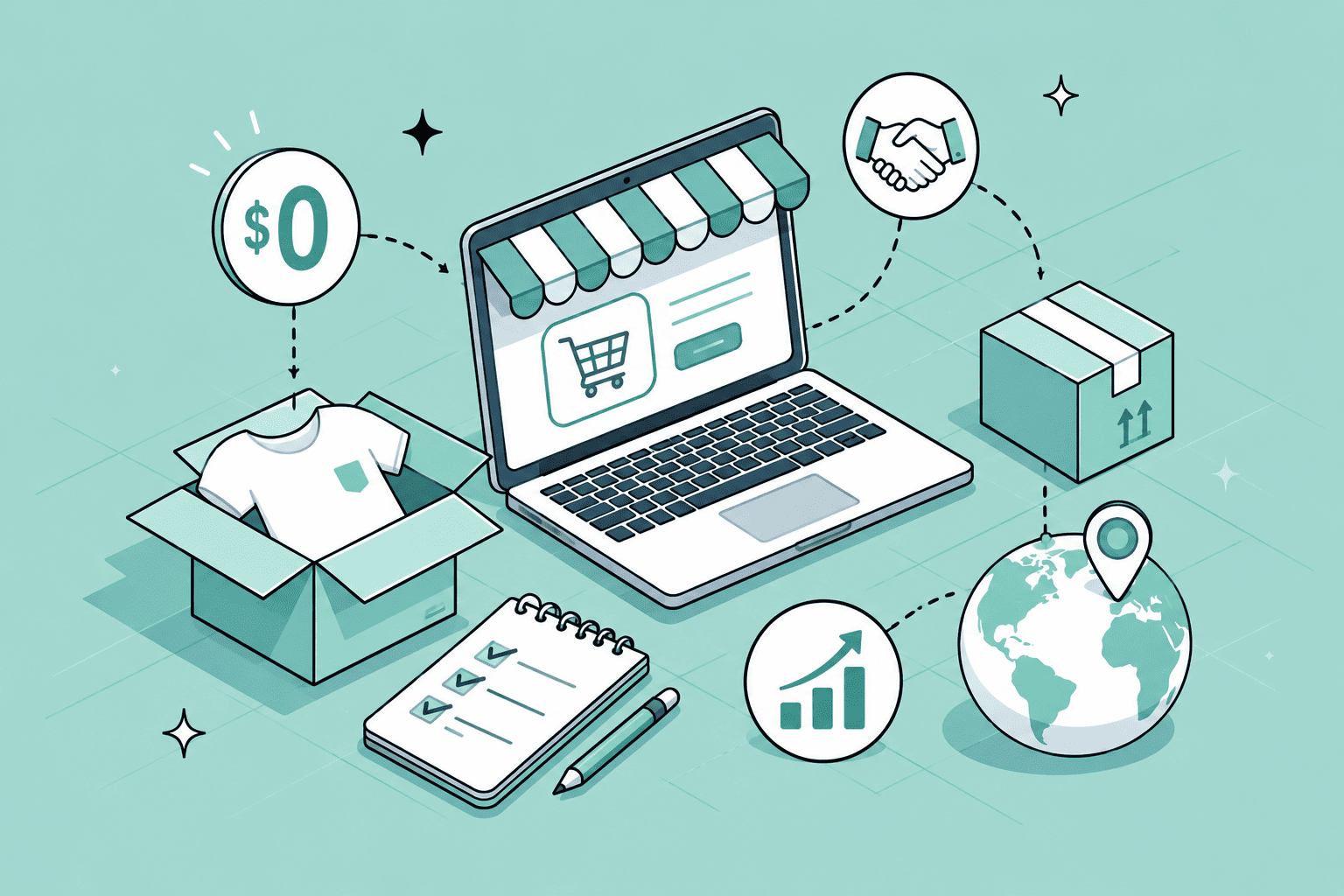
How to Start Dropshipping With No Money
TL;DR: You can start dropshipping with genuinely $0 by selling on TikTok Shop, Facebook Shops, or eBay, where listing is free. What you can’t do for free is build an independent Shopify store with a real brand behind it. That takes roughly $20 to $50 for the first month once you factor in a starter plan and one or two apps. Most guides skip that distinction. This one doesn’t.
The “no money” claim, and where it breaks down
Search “dropshipping with no money” and nearly every result says yes, unconditionally. A few platforms genuinely are free to list on. TikTok Shop, Facebook Shops, and eBay all let you create a seller account and list products without a subscription fee. If your goal is to test whether you can make a single sale, start there.
But most of these guides are selling something else underneath the “free” headline. Usually a course, a coaching program, or the platform itself. The pattern repeats across dozens of “start with $0” articles: a confident yes in the headline, five steps of generic advice, then a pitch for a paid tool or coaching program buried in the last section. One outlier take is worth reading directly: Drop Ship Lifestyle argues you can’t build a real, long-term business without spending something, because free platforms cap your control over branding, checkout, and customer data. That’s a fair point, and it’s the part most “start with $0” articles leave out entirely, since acknowledging the limit would undercut the pitch that follows it.
The honest version: free gets you a listing. It doesn’t get you a store. Those are different products with different ceilings, and conflating them is why so many people quit in month two feeling misled, having built real momentum on a platform they don’t actually control.
What’s actually free vs. what isn’t
Genuinely free to start:
- TikTok Shop and Facebook Shops. No subscription, though TikTok Shop takes a commission per sale that scales with your revenue.
- eBay. Free basic listings, with selling fees that apply once you make a sale, typically a percentage of the final price plus a payment processing cut.
- Manual order fulfillment. Placing supplier orders yourself instead of paying for automation software costs time, not money, though it doesn’t scale past a handful of daily orders before the manual work becomes the bottleneck.
Where the “no money” framing quietly breaks:
- A Shopify store isn’t free. As of 2026, the entry-level Basic plan runs $39 a month if billed monthly, or $29 a month if you commit to annual billing. The old $5/month Starter plan (checkout-link only, no real storefront) was discontinued for new signups in 2026, so it’s no longer a real budget option even though some older guides still mention it.
- Automation tools like AutoDS or DSers charge monthly once you outgrow manual order entry, typically starting around $10 to $20 a month for entry tiers.
- Domain names, even the cheap ones, run $10 to $15 a year, and a business email address tied to that domain often adds a small recurring cost through your email provider.
If your target is a branded Shopify store rather than a marketplace listing, budget $20 to $50 for month one. That’s not “no money.” It’s low money, and the distinction matters because it sets realistic expectations before you start.
The realistic path (5 steps)
1. Pick a platform based on your actual budget, not the one with the best marketing. If you have genuinely $0, start on TikTok Shop or eBay. If you have $20 to $50, a Shopify free trial gets you a real store without upfront cost. See our Shopify free trial guide for exactly what’s included and how long you get.
2. Choose one product, not ten. New sellers routinely overload their first store with 20 or more products, hoping one sticks. That spreads your marketing time thin across items you haven’t tested and makes it harder to build any expertise in what you’re selling. Pick one item you can explain in a sentence, source from one supplier, and market on one channel. Learn more about high margin dropshipping product here.
3. Source from a supplier that doesn’t charge upfront. AliExpress and CJdropshipping are the default choices most guides mention, and both work: list without paying until a customer orders, then forward the order and pay the supplier’s price only after the customer has already paid you. The trade-off is shipping time, often 1 to 3 weeks from overseas warehouses, which shows up in customer complaints if you’re not upfront about it.
Spocket takes a different approach worth knowing about even on a $0 budget: its supplier network is weighted toward the US and EU, so shipping times run closer to 2 to 5 days on many products instead of weeks. The catch is Spocket itself isn’t free. Its plans start once you’re past the trial, so it fits the $20 to $50 path better than the pure $0 path. If faster shipping matters more to your niche than the absolute lowest cost (which it often does for anything perishable, seasonal, or gift-timed), it’s worth comparing against AliExpress before you commit to a supplier.
4. Market for free before you pay for ads. Content marketing, meaning short-form video, organic TikTok and Instagram posts, or answering questions in niche communities, costs time rather than money. Paid ads come later, once you’ve validated that people actually want the product. Spending on ads before you’ve confirmed demand is the fastest way to burn a small budget with nothing to show for it.
5. Reinvest the first profits instead of trying to scale immediately. The sellers who make it past month one are the ones who put their first sales back into the business. A better theme, a second product test, or their first small ad budget, rather than trying to look “established” on day one with a polished store and no orders yet.
What starting with no money actually costs you
Not in dollars. In time and control. Free platforms mean you’re renting an audience (TikTok’s, eBay’s, Facebook’s) instead of owning one. You can’t fully customize checkout, you’re competing inside someone else’s marketplace, and if the platform changes its policies, your store goes with it overnight.
This isn’t hypothetical. TikTok Shop has adjusted its commission structure and seller requirements multiple times since launch, and sellers who built their entire operation around one platform’s current rules have had to scramble when those rules shifted. eBay’s search algorithm rewards specific seller behaviors (fast shipping, low return rates, high ratings) that you have limited ability to influence directly, unlike an owned store where you control the entire customer experience. Facebook Shops ties your storefront to your Facebook Page’s standing, so a policy strike against the page can take the shop down with it, even if the strike had nothing to do with your products.
The practical version of “renting an audience”: you’re building sales history, reviews, and customer relationships inside a system you don’t control and can’t export. If you ever want to leave, your reviews don’t come with you, your customer list is either inaccessible or heavily restricted, and your search ranking on that platform resets to zero on wherever you land next.
That trade-off is fine for testing an idea. It’s a real limitation if you’re trying to build something you can eventually sell or scale into a full brand. A marketplace listing has a ceiling; an independent store doesn’t, because you own the customer relationship and the data that comes with it from day one.
A realistic first-month budget, side by side
If you want to compare paths directly: the $0 path gets you a TikTok Shop or eBay listing, per-sale fees only, and no control over checkout or branding. The $20 to $50 path gets you a Shopify free trial or entry plan, a domain, and one or two apps, with full control over your storefront and customer data from day one. Neither is wrong. They answer different questions: whether people will buy the product at all, versus whether you can build something that’s actually yours.
| $0 path (marketplace) | $20–50 path (Shopify) | |
|---|---|---|
| Platform fee | None upfront | Free trial, then $$29–39/mo |
| Domain | Not needed (uses platform’s) | $10–15/year |
| Checkout control | None, platform-owned | Full |
| Branding | Limited to platform templates | Full custom store |
| Supplier options | AliExpress, CJdropshipping | Same, plus Spocket (US/EU, faster shipping) |
| Best for | Testing if a product sells at all | Building something you can scale or sell later |
Worked example: a real first-month budget
Say you’ve picked a single product, a $22 gadget you plan to sell for $45. Here’s what the two paths actually look like once real numbers are attached, not just categories.
On the $0 path: you list it on TikTok Shop. No subscription, but TikTok Shop’s commission runs a few percent per sale. So a $45 sale nets you somewhere around $40 to $42 after the platform’s cut, before you’ve paid the supplier the $22. Your real margin on that first sale, after supplier cost and platform fees, lands closer to $18 to $20. You’ve spent nothing to get there beyond your own time setting up the listing and the order fulfillment.
On the $20 to $50 path: you start a Shopify free trial, buy a $12 domain, and add a single app for reviews or upsells at roughly $10 to $15 a month once the trial ends. Your total out-of-pocket for month one, assuming you convert to a paid plan partway through, lands around $27 to $37 depending on which plan you pick and how long the trial covers you. Sell that same $22 product for $45 and your margin per sale is close to $23, since you’re not paying a marketplace commission on top of processing fees.
The Shopify path costs more upfront and earns more per sale. The marketplace path costs nothing upfront and earns less per sale but proves demand faster, since TikTok Shop and eBay both put your listing in front of an existing audience without any marketing effort on your part. Which one makes sense depends on whether you’re still validating the product or already confident enough to invest in owning the storefront.
FAQ
Can you really start dropshipping with $0? Yes, on marketplace platforms like TikTok Shop, Facebook Shops, or eBay, none of which require a subscription to list. You’ll still pay per-sale fees once something sells.
Is a free trial the same as a free store? No. A Shopify free trial removes the subscription cost during the trial window, but you’ll still need a domain and likely one or two paid apps to run a real store once the trial ends.
What’s the minimum realistic budget? $20 to $50 covers a starter Shopify plan or trial period, a domain, and basic apps for the first month.
Do I need to buy inventory upfront? No. That’s the core of dropshipping. Suppliers ship directly to your customer once an order comes in, so you never hold stock or risk unsold inventory.
Can I start on a marketplace and move to Shopify later? Yes, and it’s a common path. Validate demand on a free platform first, then migrate to a branded Shopify store once you know the product sells. The main friction is rebuilding whatever reviews and search ranking you earned on the marketplace, since those don’t transfer.
How much can I realistically make in the first month with no money? Most people selling on free platforms with no ad budget see their first sales come from organic reach, meaning content that gets found rather than paid promotion, and that typically means a handful of sales rather than dozens. Treat month one as validation, not income. Learn more about average dropshipping income here.
Do I need a business license to start? Not usually for testing at a small scale on a marketplace, though this varies by country and state. Once you’re processing regular sales, especially through a Shopify store with its own payment processor, check your local requirements since ignoring this can create tax problems later even if it costs nothing today.
EasyCommerce Club is where I break down ecommerce like a friend would.
Leave a Reply