TL;DR: Dropshipping vs print on demand is a gross versus net question: dropshipping earns more per sale, print on demand keeps more. On the same $30 sale, dropshipping clears $16.80 gross profit, then loses $8.20 after a typical $25 ad cost. Since the US ended the $800 de minimis exemption on 29 August 2025, overseas parcels also pay duty. Pick print on demand with more time than money; pick dropshipping with an ad budget and tolerance for risk.
The one difference that drives everything
Both models look identical on the surface. You do not hold inventory. A supplier ships directly to your customer. You never touch the product.
The difference is what you are selling.
In dropshipping, you sell a product thousands of other sellers can also list. The item is a commodity. Anyone can source the same unit from the same supplier tomorrow and undercut your price.
In print on demand, you sell your own design applied to a blank product. Your competitors can copy the blank. They cannot copy the design without copying you.
Every other difference between the two models is downstream of that one. Pricing power, competition, marketing costs, and how long the business lasts all follow from whether your product is yours.
Why do the margin numbers you see disagree so wildly?
They disagree because each source measures a different margin, usually gross for one model and net for the other, without saying which.
One site reports print on demand at 30 to 50% and dropshipping at 15 to 30%. Another reports both at 10 to 30%. One dataset built from nearly 6,000 real dropshipping products reports a median gross margin above 80% for dropshipping against 30 to 55% for print on demand, which is the exact opposite of the consensus.
None of them are lying.
Gross margin is your selling price minus what the product costs you. Net margin is what remains after advertising, apps, platform fees, refunds, and everything else. On the first measure dropshipping wins easily. On the second it often loses.
A $6 item from a supplier sold at $30 has an 80% margin on product cost alone. That number is real and completely useless on its own, because it ignores shipping, duty, and the $25 you spent on ads to find the buyer.
A print on demand t-shirt with a $9 base cost sold at $24 keeps $15 before payment processing. Lower on paper. But if you sold it through marketplace search or an audience you already had, you spent nothing to acquire that customer and the gross margin is close to the net margin.
Whenever you see these two models compared, check which number is being quoted. Most articles that declare a winner are quietly comparing one model's gross margin to the other's net.
Print on demand vs dropshipping profit margins, side by side
Here is the comparison with both measures kept separate.
| Dropshipping | Print on demand | |
|---|---|---|
| Typical gross margin | 40 to 75% | 30 to 55% |
| Typical net margin with paid ads | 10 to 25% | 15 to 30% |
| Net margin without paid ads | Rarely viable | 30 to 50% |
| Gross profit on a $30 sale (worked example below) | $16.80 | $11.80 |
| Price control | Weak, price war risk | Strong, design is unique |
The row that decides most cases is the third one. Dropshipping without paid traffic is difficult because you are selling a commodity nobody searches for by name. Print on demand without paid traffic is a normal, working business model, because designs can be found through marketplace search and social discovery.
The US import change that broke the old comparison
This is the part most comparison articles have not updated, and it matters more than any margin table.
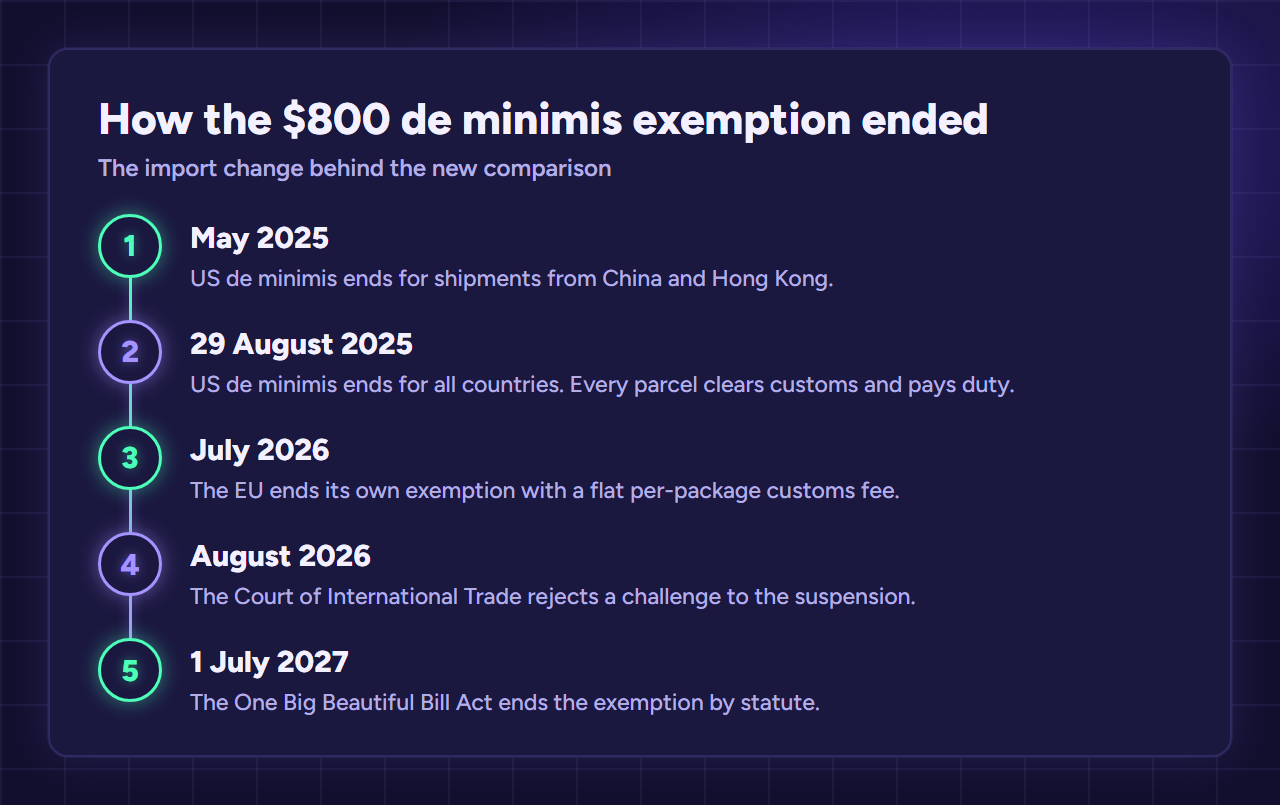
The United States eliminated the $800 de minimis exemption. It ended for shipments from China and Hong Kong in May 2025, then for all countries on 29 August 2025. Before that, any parcel under $800 entered duty-free with minimal paperwork. That exemption was the foundation of ship-direct-from-China dropshipping.
Since 29 August 2025, every parcel entering the US clears customs and pays duty regardless of value, including parcels under $800. Sub-$800 parcel volume into the US fell by roughly 54% after the suspension took effect. Reports of Amazon sellers sourcing overseas describe $15 products now carrying $3 to $8 in additional duties and processing fees.
Two points on how durable this is. The One Big Beautiful Bill Act, passed in July 2025, terminates the exemption by statute from 1 July 2027, so it does not depend on any executive order surviving. And in August 2026 the Court of International Trade rejected a challenge to the suspension, ruling that withdrawing a duty-free exemption is legally distinct from imposing a new tariff. That held even though separate reciprocal tariffs issued under emergency powers were struck down.
The European Union is moving the same way, ending its own exemption with a flat per-package customs fee from July 2026. The UK is phasing its threshold out over a longer period.
What this actually means for the two models
For dropshipping from overseas suppliers, landed cost per order went up and delivery got slower and less predictable. On a $15 to $30 product, a few dollars of duty plus a processing fee is a meaningful share of the gross profit that made the model work.
For print on demand fulfilled by a US-based partner, nothing changed. The blank was already in the country, and the order never crosses a border.
This does not make dropshipping unworkable. Higher-priced items absorb the duty far better than cheap ones, and domestic or nearshore suppliers avoid the issue entirely. But the cheap-import-arbitrage version of dropshipping, which is what most beginner guides still describe, has lost its structural advantage.
The same $30 sale, run through both models
Percentages hide what actually happens. Here is one order, line by line.
Dropshipping a $30 product sourced at $6.
Start with $30 in revenue. Subtract $6 for the product and $4 for shipping from the supplier. Add an assumed $2 in duty and customs processing, which did not exist before the rule change. Reported costs run $3 to $8 on $15 products, so this is the kind case. Payment processing takes about $1.20. Gross profit is $16.80, a healthy-looking 56%.
Now subtract the cost of finding the buyer. At a $25 acquisition cost, this order loses $8.20. At a very good $12 acquisition cost, it clears $4.80.
Print on demand, a $30 hoodie with a $17 base cost.
Start with the same $30. Subtract $17 for the blank, the printing, and domestic shipping. Payment processing takes $1.20. Gross profit is $11.80, a less impressive 39%.
If that sale came from marketplace search or your own audience, $11.80 is also roughly what you keep. If you paid $12 to acquire the customer, you are at break-even.
What the comparison shows. Dropshipping produced 42% more gross profit per order ($16.80 against $11.80) and still lost money at a $25 acquisition cost. Print on demand produced less gross profit and kept more of it.
This is why the two models suit different people rather than one being better. Dropshipping is a bet that you can acquire customers for less than your gross profit. Print on demand is a bet that you can be found without paying for it.
Change either assumption and the answer flips. A dropshipper with an organic audience beats both columns. A print on demand seller running expensive ads on a $22 t-shirt is in the worst position of anyone here.
How each model actually fails
Both have a characteristic failure, and they look nothing alike.
Dropshipping fails fast and expensively. You test a product, it does not convert, and you have spent $400 learning that. Repeat that four times and you are out $1,600 with nothing to show. The failure is loud and immediate, which is either useful feedback or a reason to quit depending on your temperament.
Print on demand fails slowly and quietly. You upload eighty designs over three months and get eleven sales. Nothing broke. There was no dramatic loss. You simply invested a lot of hours into a catalog nobody is searching for. This failure is easier to survive financially and much harder to diagnose, because there is no ad account showing you where it went wrong.
The practical implication is about what you can afford to lose. If losing $1,600 would genuinely hurt, print on demand is the safer place to learn. If three months of unpaid work would demoralize you more than a lost $1,600, dropshipping gives you answers sooner.
Print on demand startup costs versus dropshipping
Both models are cheap to start compared with holding inventory. They are not equally cheap.
Print on demand can genuinely start at close to zero. Printful and Printify both have free tiers. Marketplaces let you list designs without a store at all. Your real cost is design work, whether that is your time or a few hundred dollars paid to a designer. If you sell through a Shopify store, add the Basic plan at $39 a month, or $29 a month billed annually.
Dropshipping costs more to start honestly. A store is $39 a month. The unavoidable cost is testing: several hundred dollars per product to find out whether it converts, and most products fail. Budgeting $500 to $2,000 before your first profitable product is realistic, and treating that as a research expense rather than a loss is the right mindset. Our full breakdown of what it costs to start a Shopify store itemizes the rest.
The difference is what failure costs. A print on demand design that nobody buys costs you the hours you spent making it. A dropshipping product that nobody buys costs you the ad spend you used to find that out.
Traffic is the real dividing line
Margin arguments distract from the question that actually decides which model fits you.
Dropshipping usually needs paid traffic. You are selling something with no brand and no search demand, so you have to interrupt people to sell it. That means running ads, which means the arithmetic of acquisition cost. At TikTok's median cost per click of about $0.50 and a typical 2% ecommerce conversion rate, one order costs roughly $25 in ads. Our margin guide works through why that number eliminates most cheap products in high margin products for dropshipping. Our cost breakdown goes deeper on how acquisition cost interacts with gross and net margin in the real costs and profits of Shopify dropshipping.
Print on demand can work without paid traffic. Designs are discoverable. Someone searching a marketplace for a gift about their profession, hobby, or hometown will find a listing that matches. That search demand exists whether or not you advertise.
This is why print on demand is often the better fit for someone with time but no budget, and dropshipping the better fit for someone with a budget who wants a faster read on whether an idea works.
The trade-off is speed. Paid traffic tells you within a week. Organic discovery takes months to build volume.
Shipping, returns, and quality
Print on demand with a domestic partner typically delivers in three to seven days. Overseas dropshipping has commonly run around two weeks, and customs processing has added variability on top.
Returns split differently too. Print on demand items are made for one customer, so most sellers only accept returns for defects or printing errors. That limits refund exposure but can frustrate buyers who ordered the wrong size. Dropshipped goods carry ordinary return risk, and undisclosed long delivery times generate chargebacks, which threaten your payment processing rather than just your margin.
Quality control is a shared weakness. You are not inspecting anything in either model. The practical difference is that print on demand involves a smaller set of partners with more consistent output, while dropshipping quality varies by supplier and can change without warning.
Dropshipping vs print on demand for beginners
Choose print on demand if you have design ability or can direct a designer, more time than money, and you want to fail cheaply while you learn. It is also the safer choice if most of your customers are in the US, because of the import change above.
Choose dropshipping if you have a testing budget of at least several hundred dollars, you want to learn paid advertising, and you are willing to sell products priced high enough to absorb both a duty and a $25 acquisition cost.
Choose neither if you are hoping for a passive business. Both require ongoing work. The work is just different: designs and listings on one side, creative testing and margin management on the other.
Can you run both?
Yes, and combining them is common once one is working.
A common pattern is a dropshipping store adding branded print on demand items, so a store selling a piece of equipment also sells apparel around the same interest. The apparel rarely drives the business, but it carries better margins and gives repeat customers something to buy.
The reverse works too. A print on demand brand with an established audience can add sourced products that suit the same buyers, using an audience that already exists rather than paying for a new one.
Do not start with both. Splitting attention across two models before either works is the most reliable way to end up with two stores that do not.
Should you switch if you already picked the wrong one?
Switch only when the model itself failed, and even then you replace a catalog and a supplier, not the whole business.
Plenty of people arrive at the dropshipping vs print on demand question after starting one of them and stalling. Switching is cheaper than it feels.
Almost nothing you built is model-specific. Your store, your domain, your email list, your understanding of the audience, and your ad account all carry over. What you replace is the catalog and the supplier relationship, which is a weekend of work rather than a restart.
Before switching, check that the model is what failed. A dropshipping store with no sales after $200 of ads has not tested anything, and switching to print on demand will not fix an untested hypothesis. A print on demand shop with sixty designs and no sales after four months has real evidence.
The honest signal for switching is a mismatch between the model and your resources. If you keep running out of ad budget before a product finds traction, dropshipping is asking for money you do not have. If you keep abandoning design batches because the work bores you, print on demand is asking for patience you do not have.
Pick the constraint you can actually live with, then commit to it for long enough to get a real answer.
FAQ
Profitability questions
Is print on demand more profitable than dropshipping?
On net margin, usually yes, mostly because it does not require paid advertising. On gross margin, dropshipping is often higher. Which matters depends entirely on whether you are buying traffic.
Which model makes money faster?
Dropshipping, when it works. Paid ads can produce sales in days, where organic print on demand discovery takes months. Dropshipping also loses money faster when it does not work. See our realistic timeline for making money dropshipping.
How much do I need to start?
Print on demand can start near zero on a marketplace, or $39 a month on Shopify Basic. Dropshipping realistically needs $500 to $2,000 including product testing.
Practical questions
Did the tariff changes kill dropshipping?
No, but they removed its cheap-import advantage. Low-priced goods shipped from overseas now carry duties and customs processing that eat a real share of the margin. Higher-priced products and domestic suppliers are much less affected.
Do I need design skills for print on demand?
Not necessarily, but you need design judgment. You can hire the execution. Knowing what a specific audience actually wants on a shirt is the part that cannot be outsourced easily.
Which is better for building a brand I could sell later?
Print on demand, in most cases. A catalog of designs with an audience is an asset. A store selling commodity products depends on ad performance that a buyer cannot be sure will continue.
Leave a Reply