TL;DR: Is dropshipping worth it in 2026? Yes, if you run it as a small business with thin margins and real work, not a shortcut. The market keeps growing, but at median TikTok ad rates each paid order costs around $25. That only pays on products with roughly 45 to 50% gross margin, a fast supplier and a niche brand.
How big is the dropshipping market in 2026?
Estimates put the dropshipping market between $290 billion and $366 billion for the same year, and every one shows growth. Projections for the near future range from $343 billion to over $430 billion. That's not one source being wrong. It's different research firms using different definitions of what counts as "dropshipping revenue." Some include print-on-demand and marketplace resale. Others count only direct-to-consumer stores using traditional suppliers like AliExpress.
What's consistent across every source, regardless of the exact number, is direction. The market is growing, not shrinking, and it's projected to keep growing through the early 2030s. The "dropshipping is dead" narrative that circulates on social media isn't supported by the revenue data. What's actually died is the specific, low-effort version of dropshipping that worked a decade ago. Generic products, minimal branding, and ad platforms that were far cheaper to buy attention on than they are now.
Why the exact number matters less than the trend
It's worth treating any single dollar figure in a dropshipping headline with some skepticism for the same reason. When you see "the dropshipping market is worth $X billion" presented as a clean, precise fact, be skeptical. That number usually traces back to a market-research firm's proprietary methodology that isn't fully disclosed. The direction of the trend (growing) is far more reliable than any specific number attached to it. That direction is really the only claim worth building a decision around.
A more useful question than "how big is the market" exists. It's whether the market is growing faster or slower than the number of sellers entering it. That data is harder to find precisely. But the practical signal shows up in ad costs. Rising cost-per-click across Facebook and Google over the past several years tells the story. Seller supply has grown at least as fast as buyer demand, if not faster. That's the real mechanism behind why the easy version of dropshipping got harder, regardless of which market-size figure you trust.
What is the real dropshipping failure rate?
Most dropshipping stores fail, but no primary source publishes a verified dropshipping failure rate. The most repeated estimate is that roughly 10 to 20% of stores stay profitable long term. Treat that as a reported range, not a measured fact, and be skeptical of any article that states one precise figure. Our breakdown of the dropshipping success rate traces where the usual "90% fail" claim comes from. The sellers who do succeed usually didn't succeed on their first product or even their first store.
The pattern that shows up repeatedly in seller accounts and industry writing isn't "dropshipping doesn't work." It's "generic, low-differentiation dropshipping stopped working once ad costs rose and customers got pickier about shipping times and brand trust." A store selling the same trending gadget as a thousand other TikTok Shop sellers faces different odds. A differentiated one does better. Multi-week shipping and no brand identity hurt conversions badly. A store with a specific niche performs very differently. Faster shipping through a supplier like Spocket, and content that builds trust before the sale, make the difference.
The realistic framing: dropshipping isn't a lottery ticket with fixed odds. It's a business model where the failure rate is heavily influenced by how seriously you treat the parts that matter. Niche selection, supplier quality, and whether you're building something with any differentiation at all.
Why the failure rate gets exaggerated
Part of why the failure rate gets exaggerated in both directions is survivorship bias. It works in opposite ways depending on who's telling the story. Course sellers and coaching programs have an incentive to understate how hard it is. A lower perceived barrier sells more seats. Skeptics on forums and social media have the opposite incentive. "I tried it and lost money" gets more engagement and validation than a quiet, unremarkable success. The truth sits in the middle. Hard enough that most casual attempts don't pan out. Achievable enough that a meaningful number of sellers who treat it seriously do make it work.
Who actually succeeds
The sellers who make it past the first 6 months share a few traits that show up consistently. That holds true whatever the exact numbers underneath them.
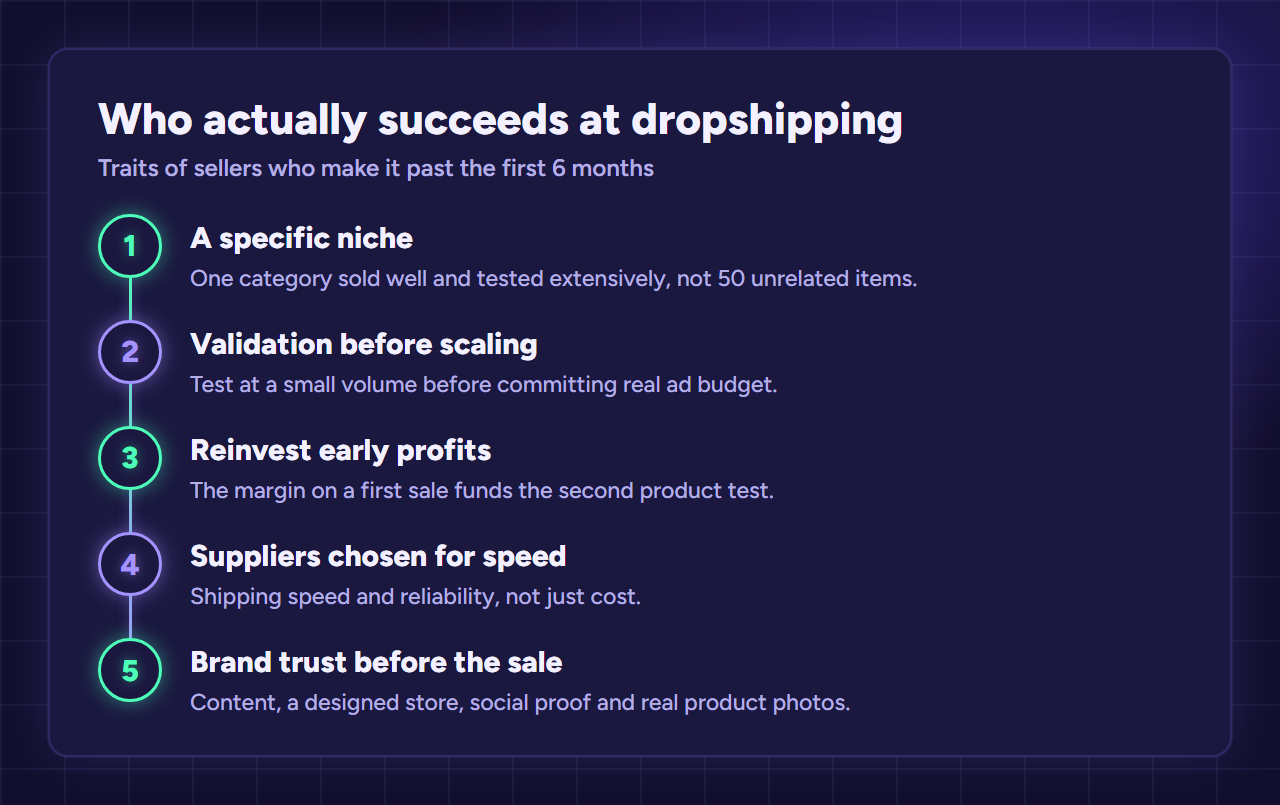
They pick a specific niche, not a general store
A store selling one category well, tested extensively, outperforms a generalist store selling 50 unrelated items to see what sticks. Niche focus also compounds. Once you understand one customer segment deeply, sourcing the next product for that same audience gets faster and cheaper. Starting from zero with each new item, by contrast, means redoing that research work every time.
They treat the first few months as validation, not scaling
Testing whether a product actually sells at a small volume before committing real ad budget to it. That beats betting a large ad spend on a product that's never sold a single unit organically. Automation tools like AutoDS can help here once you've validated a product. They handle order fulfillment and inventory syncing automatically rather than requiring manual entry for every sale. That matters less in the validation phase, when order volume is still low. It matters more once a product proves itself and order volume climbs.
They reinvest early profits rather than trying to extract income immediately
The margin on a first sale funds the second product test, not a withdrawal. This single habit separates people who build something sustainable from people who take a small early win and spend it. Spending too early leaves nothing to reinvest before the business has any real momentum.
They pick suppliers based on shipping speed and reliability, not just cost
Customers increasingly won't tolerate a multi-week wait, even for a cheap product. Negative reviews from slow shipping compound faster than they used to. One bad review visibly discourages the next several potential customers. This is where automation and supplier choice intersect. A tool like AutoDS lets you manage multiple supplier relationships (AliExpress, CJdropshipping, and others) from one dashboard. Switching to a faster supplier for a specific product doesn't mean rebuilding your entire fulfillment process from scratch.
They build some form of brand trust before the sale
That trust can come from content marketing, a genuinely designed store, or social proof. The alternative, relying purely on paid traffic to a generic product page, builds nothing. A store that looks like a real business converts noticeably better than a bare-bones template with stock photos. An About page, real product photography, and consistent branding all signal that someone real is behind the store.
None of these are secret tactics. They're the difference between running dropshipping as a real, if small, business. The alternative is running it as a copy-paste attempt at quick income. That's exactly the distinction the market data can't capture in a single failure-rate number.
Is dropshipping dead, or did it just change?
Dropshipping isn't dead, but the low-effort version from its 2015 to 2019 peak is. Three things shifted the landscape since that era.
Ad costs rose as more sellers competed for the same attention
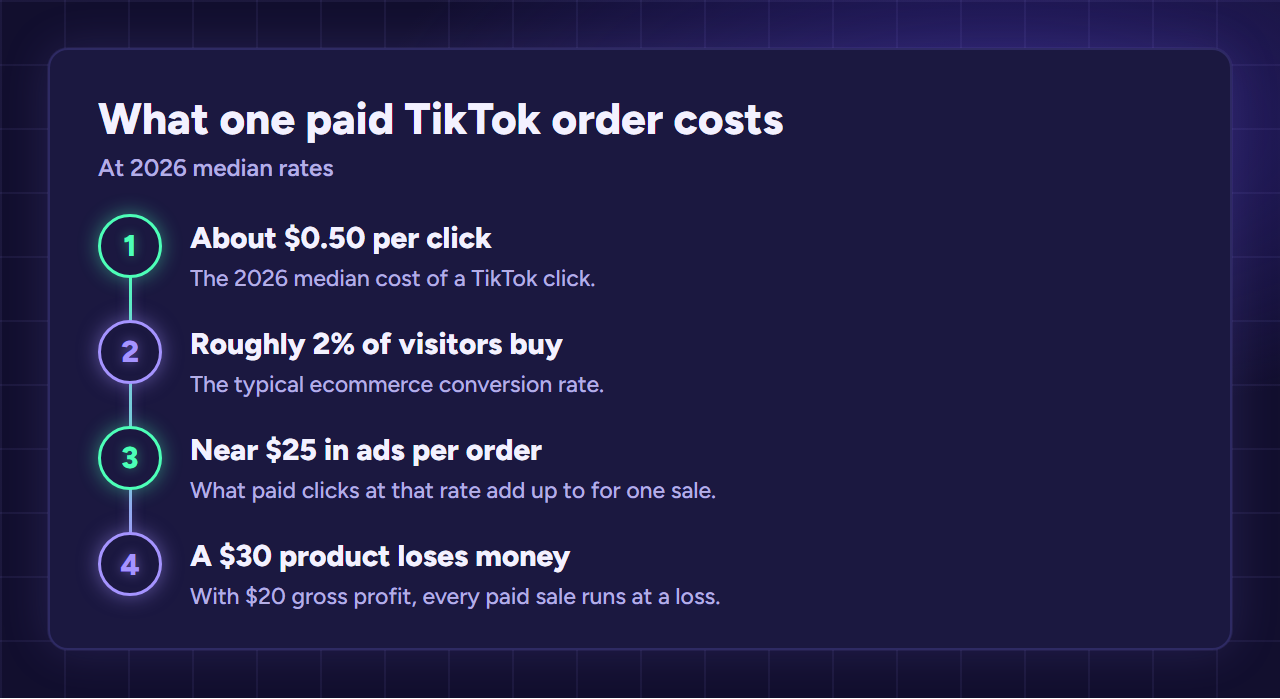
This shrunk the margin that used to exist between a $2 product and a profitable ad-driven sale. What used to cost a few cents per click in a niche's early days now routinely costs several dollars. That's what happens once enough sellers have entered that niche and bid the price up. At 2026 median rates, a TikTok click costs about $0.50 and a Meta click about $1.72. Roughly 2% of ecommerce visitors buy, so one TikTok order costs near $25 in ads. A $30 product with $20 gross profit loses money on every paid sale.
Customer shipping expectations rose sharply
Amazon normalized 1 to 2 day delivery. That makes a multi-week AliExpress shipping window a much bigger conversion killer than it was a decade ago. A shipping time that used to be an accepted trade-off for a cheap price now works against you. It's a reason customers abandon their cart entirely. This shift accelerated once faster alternatives like Spocket's US and EU supplier network became widely known as an option.
Saturation compressed the novelty window
The easiest, most obvious trending products get copied by hundreds of sellers within days of going viral. A product that goes viral on TikTok today might have dozens of near-identical stores selling it within a week. That pushes ad costs up further and margins down for anyone entering late without any differentiation.
None of these three trends make dropshipping impossible. They make the low-effort version of it much harder. But they leave room for sellers willing to solve two problems. Shipping speed is one lever, through suppliers like Spocket rather than pure AliExpress. Differentiation is the other, through an actual niche and brand rather than a copy-paste store.
There's a fourth shift worth naming that gets less attention than the first three. The tooling available to solo sellers has genuinely improved. Order automation through platforms like AutoDS, and faster-shipping supplier networks like Spocket, mean something concrete. A single person can now run tasks that used to require a small team. Product-research tools have gotten more accessible too, lowering the operational bar further. That doesn't offset higher ad costs or faster saturation on its own. But it does mean something real. The operational bar for running a serious dropshipping business is lower than it was in the 2015 to 2019 era. Meanwhile, the marketing bar has risen. The net effect isn't simply "harder than before." It's "harder to win on volume and low effort, easier to run well once you've picked the right product."
Then versus now, side by side
A fifth change gets less attention than any of these: US import duty. Since 29 August 2025, every parcel entering the US clears customs and pays duty, whatever its value. That hits stores shipping from overseas suppliers to US buyers hardest. Sellers report $15 products picking up $3 to $8 in duties and processing.
| Factor | 2015 to 2019 | 2026 |
|---|---|---|
| Cost per click | A few cents in a new niche | About $0.50 on TikTok, $1.72 on Meta (median) |
| Ad cost per order | Low enough for a $2 product to pay | Around $25 on TikTok at median rates |
| Accepted delivery time | Multi-week waits tolerated for a low price | Amazon's 1 to 2 days is the benchmark |
| Head start on a viral product | Room to sell before copycats arrived | Dozens of near-identical stores within a week |
| US duty on low-value parcels | Exempt under de minimis | Charged on every parcel since 29 August 2025 |
| Solo seller tooling | Mostly manual order entry | Order automation (AutoDS) and US or EU suppliers (Spocket) |
The verdict: is dropshipping worth it for you?
Dropshipping is still worth it if you're willing to treat it as a real, if small, business. Pick one niche, prioritize supplier shipping speed, and expect the first few months to be about validation rather than income. Reinvest early profits instead of trying to extract them. In numbers, that means products with roughly 45 to 50% gross margin, since thinner margins can't absorb ads, fees and returns at scale. Our list of high-margin dropshipping products shows how to check a product's margin before you list it. It's not worth it if your plan is to copy a trending product and run ads with no differentiation. That approach expects the market data's overall growth to carry an individual store to profitability on its own. It usually doesn't.
Here's an honest way to decide for yourself. Think back to the "who actually succeeds" traits above. If they felt achievable and even appealing, rather than like a chore, that's a good sign. It suggests you'd actually tolerate the work involved rather than burning out on it. Testing multiple products, treating month one as pure validation with no income, researching supplier shipping times in detail. Does that sound tedious or manageable? If it sounds tedious, dropshipping specifically may be a worse fit for you. A different business model that matches your interests better could be the smarter path. That's true whatever the market data says about growth.
If your answer to "is dropshipping worth it" is yes, our guide walks through starting dropshipping with little to no money and the realistic first-month costs. If realistic earnings matter more than upfront cost, our breakdown covers dropshipping average income. For the timeline, see how long it actually takes to make money dropshipping.
FAQ
Is dropshipping worth it today
Is dropshipping dead in 2026?
No. Every market-size estimate shows growth, not decline. What's dead is the specific low-effort, no-differentiation version that worked a decade ago.
Is dropshipping still profitable in 2026?
Yes, for stores with the margin to pay for ads. Sellers generally need about 45 to 50% gross margin to absorb advertising, fees and returns at scale. Beginners often run net margins under 10%, so a thin product can look busy and still lose money.
What's the real success rate for dropshipping?
No verified figure exists. The most repeated estimate is that roughly 10 to 20% of stores stay profitable long term, but no primary source publishes it. Treat any precise dropshipping success rate 2026 statistic with the same skepticism. Successful sellers usually needed more than one product or store to get there.
Why do so many dropshipping stores fail?
Most stores fail from one of three causes: no product differentiation, slow overseas shipping that hurts customer trust, or scaling before validating. The last one means treating the first product test as a scaling decision rather than a validation step.
Starting out and succeeding
Is dropshipping harder now than it used to be?
Harder to win with ads, easier to run. Ad costs are higher and generic products saturate faster. But faster-shipping supplier options and better tools for product validation exist now, which weren't available in the 2015 to 2019 era.
Do I need a lot of money to succeed at dropshipping?
No, but you need enough to test more than one product. A realistic first-month ad test budget runs $500 to $1,000. Most sellers who succeed didn't get there on their very first attempt. Budgeting for several small tests beats spending everything on one product launch.
What's the single biggest factor in whether a dropshipping store succeeds?
Differentiation. A store with a specific niche, a faster-shipping supplier, and some form of brand trust consistently outperforms a generic store. That's true even when the generic store is selling whatever's trending that week. It still loses if it has no distinguishing factor of its own.
Leave a Reply