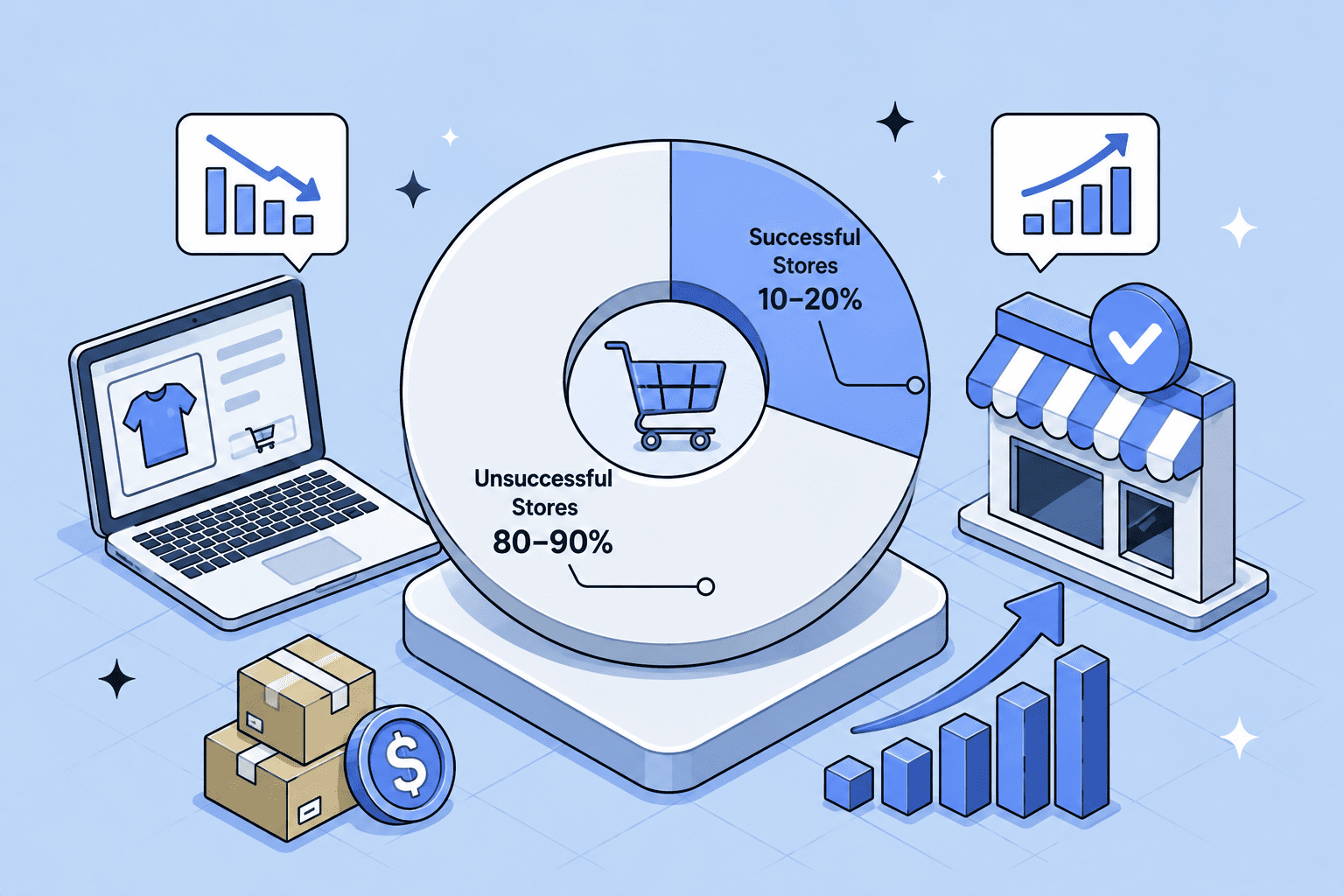
If you search for the dropshipping success rate, you’ll get a number in about four seconds. You’ll also get a different number on the next site, and a third one after that.
I looked at what the top results currently say. One puts the success rate at 10 to 20%. Another says 95% of new stores fail in the first year and only 1 to 5% ever build something sustainable. A third reports an 80 to 90% failure rate. A fourth claims over 90% of stores fail within four months. A fifth says 95% close within the first month.
Those can’t all be true. They’re not even close to each other, and none of them link to a study you can open and read.
So instead of adding a sixth invented number, I want to show you what’s actually measured, what those measurements imply about your odds, and how to build a scoreboard you can trust.
The Short Answer on the Dropshipping Success Rate
Nobody knows the dropshipping success rate, because nobody measures it. What we do have is solid data on business survival, store conversion, and the cost of buying a customer. Put those three together and you get a realistic picture: the model works, the margins are tight, and most stores that close were never really operated.
Where the “90% Fail” Statistic Comes From
Nowhere, as far as I can tell.
The most honest admission I found came from a source that quotes the 10 to 20% figure and then explains its own methodology: there are no officially published figures, and communities like Reddit and Quora consistently estimate the range. Another site that built a whole article around “why over 90% of dropshippers fail” concedes in its own FAQ that there is no definitive statistic.
That’s the pattern. A number gets estimated in a forum thread, quoted by a blog, cited by a second blog that links to the first, and within a couple of years it reads like research. Trace any of these back and the trail goes cold before it reaches a dataset.
Circular citation: when source A cites source B, source B cites source C, and source C cites source A. The number never touches original data, but the chain of links makes it look verified.
There’s a second problem underneath the sourcing one. Even a well-funded researcher couldn’t measure this cleanly, because two things resist definition.
What counts as a store? Anyone can spin up a Shopify trial, install a supplier app, and abandon it a week later without running a single ad. Should that count as a failed business? It’s in the denominator of every failure statistic you’ve read.
What counts as success? One sale? A profitable month? $1,000 a month in take-home profit? Replacing a salary? Each definition produces a wildly different percentage from the same underlying data. When a site tells you “20% succeed” without defining success, the number is decorative.
Three Numbers That Are Actually Measured
Here’s what I’d anchor on instead. None of these are dropshipping-specific success rates, and that’s the point. They’re real measurements from named datasets, and together they tell you more than any invented percentage.
1. About 1 in 5 New Businesses Closes in Year One
LendingTree’s analysis of US Bureau of Labor Statistics Business Employment Dynamics data found that 22.1% of new private-sector businesses close within their first year. By year five, 48.6% have closed. By year ten, 65.3%.
This is real government data covering every new employer business in the country, so it’s the closest thing we have to a baseline. Retail and food service businesses are commonly cited as having above-average closure rates compared to this all-industry figure, though I don’t have a single named source with an exact retail-specific percentage to cite here, so treat that as a general industry pattern rather than a hard number.
What it tells you: roughly four in five new businesses of any kind survive their first year, and about half make it five years. Dropshipping is almost certainly worse than that baseline given the near-zero barrier to entry. But it’s a long way from 95% dying in month one.
2. The Average Shopify Store Converts at 1.4%
Littledata’s benchmark across roughly 2,800 Shopify stores puts the average session-to-order conversion rate at 1.4%. Stores above 3.2% land in the top 20%. Stores above 4.7% land in the top 10%.
The same dataset puts the average Shopify order value at $85 and the average add-to-cart rate at 4.6%.
Worth knowing before you panic about your own number: the 1.4% average includes a lot of new and unoptimised stores dragging it down, and different benchmark sources measure different things. IRP Commerce and Dynamic Yield report figures closer to 2% and 2.7% on different samples. A reasonable working band for ecommerce overall is 1.4% to 3%.
3. The Median Cost to Buy a Purchase on Meta Is Around $48
Superads, working from roughly $3 billion of ad spend, reports a 13-month median cost per purchase across all industries of about $48. Mako Metrics puts ecommerce cost per acquisition at around $45, which is close enough to corroborate.
That figure also moves a lot. In the Superads series it ranged from $55.54 in March 2026 down to $25.50 in June 2026. Your acquisition cost is set partly by an auction you don’t control.
The Math That Explains the Failure Rate
Now put two of those numbers next to each other, because this is the part most success-rate articles skip.
The average Shopify order is $85. Say you’re running a healthy 50% gross margin after product cost and shipping, which is generous for the AliExpress end of dropshipping. That leaves you $42.50 of gross profit on an average order.
The median cost of buying one purchase through Meta ads is around $48.
| Amount | |
| Order value (Littledata Shopify average) | $85.00 |
| Gross profit at 50% margin | $42.50 |
| Meta cost per purchase (all-industry median) | $48.00 |
| Payment processing (2.9% + 30¢) | $2.77 |
| Result before apps, subscription, or your time | –$8.27 |
That’s the whole story, in one table. An average store selling at an average order value, buying customers at an average cost, loses money on every sale before it pays for Shopify or a single app.
To be clear about what this is: three different datasets measuring three different populations, combined into illustrative arithmetic. It is not a forecast for your store. What it does show is that the “90% fail” claim doesn’t need a conspiracy or a saturated market to explain it. Average inputs produce a loss, and a loss compounds until the founder stops funding it.
It also shows you exactly which three levers matter, because there are only three ways to flip that table positive.
Raise average order value
At $150 and 50% margin you’re making $75 gross against a $48 acquisition cost. That’s a business. Bundles, volume tiers, and post-purchase upsells all move this number, and it’s usually the fastest lever to pull.
Raise gross margin
At $85 and 65% margin you clear $55.25, which beats $48 but leaves almost nothing for overhead. Margin comes from product selection and sourcing rather than from marketing, which is why niche choice matters so much. I’ve written up what higher-margin categories actually look like separately.
Lower acquisition cost
This is the one everyone tries first and it’s the hardest, because you’re bidding against better-funded advertisers with more pixel data. Organic channels, email, and repeat purchases move it. Better ad creative moves it. Wishing moves it about as much as you’d expect.
Notice that none of these are “work harder.” They’re structural choices you mostly make before launch, when you pick what to sell and how to price it.
The Only Dropshipping-Specific Dataset I’d Cite
There’s one number in this space that comes from an actual sample rather than a forum. TrueProfit’s analysis of more than 1,200 dropshipping stores found beginner sellers earning up to $2,000 a month, with intermediate sellers in the $2,000 to $10,000 range.
Read that with one caveat. Those are stores that installed a profit-tracking app, which means they were already run by someone serious enough to want to know their numbers. The abandoned trials aren’t in that sample. It tells you what engaged stores earn, not what the average person who watched a YouTube video earns.
That’s still useful. It’s the difference between “what happens if I try” and “what happens if I actually run this thing.” For the full breakdown of what those figures look like after costs, see my post on realistic dropshipping income.
Even the Market Size Numbers Disagree
One more thing that should calibrate how much you trust any dropshipping statistic.
Market size is far easier to estimate than success rate. Analysts do it with revenue data and published methodologies. Here’s what four firms say the global dropshipping market is worth in 2026:
| Source | 2026 market size |
| Grand View Research | $583.5 billion |
| SellersCommerce (citing GVR) | $543.5 billion |
| Market Data Forecast | $523.9 billion |
| Straits Research | $604.9 billion |
That’s a spread of about $80 billion, roughly 15%, on the easy question. The variation comes down to whether a firm counts platform revenue or the full value of goods moving through dropshipping channels.
If the straightforward metric has that much disagreement between professional research firms, treat any confident single-digit success rate with real suspicion.
A Scoreboard That Beats a Success Rate
Since the industry number is useless, here’s the one I’d use instead. Four checkpoints, in order, with a decision at each.
Checkpoint 1: First sale from a stranger. Not your mum, not a friend. Someone who found you through an ad or a search and paid. This proves the offer and the checkout work. If you can’t get here after a few hundred dollars of testing, the problem is the product or the audience, not the funnel.
Checkpoint 2: Contribution margin above zero. Gross profit per order minus acquisition cost minus payment fees. This is the table above, run on your real numbers. Get here and you have a business that grows when you spend more. Stay below it and every extra dollar of ad spend digs a deeper hole.
Checkpoint 3: Three consecutive profitable months. One good month is a winning product. Three is a repeatable system. This is the point where I’d say the store has actually succeeded, whatever the internet’s percentage says.
Checkpoint 4: Profit that survives you taking a week off. Fulfilment, support, and ads all running without daily intervention. This is where a store becomes an asset rather than a job.
Most people who “fail at dropshipping” quit somewhere between checkpoint one and checkpoint two, often within a few weeks. That’s not a verdict on the model. It’s a verdict on the timeline they expected, which is worth reading about separately in my post on how long it actually takes to make money.
So Is Dropshipping Worth Trying?
I think it is, if you go in with the right frame.
The model is genuinely low-risk on capital. You’re not buying inventory, and your fixed costs are a platform subscription and a domain. If you’re still working out the platform side of that, my Shopify pricing breakdown covers what each plan actually costs.
But it’s not low-risk on time or on ad spend, and the arithmetic above is unforgiving of a badly chosen product. The people who make it work tend to treat the first few hundred dollars as tuition rather than as a bet, and they pick products where the numbers can clear $48 with room left over.
The honest answer to “what’s my success rate?” is that it depends almost entirely on decisions you make before you launch. That’s more useful than a percentage, and it has the advantage of being true.
FAQs
What is the dropshipping success rate? There’s no measured figure. The commonly quoted 10 to 20% range traces back to forum estimates rather than research, and published claims range from 5% to 20% success depending on the source. A better anchor is BLS data showing 22.1% of all new US businesses close in year one.
Do most dropshipping stores fail? Most probably do, but the statistics overstate it because they count abandoned trials as failed businesses. A more meaningful question is what happens to stores that run for 90 days with real ad spend behind them, and nobody publishes that number.
Why do dropshipping stores fail? Usually unit economics. At an average $85 order value and a median $48 cost per purchase on Meta, an average store loses money on every sale. Most failures are a pricing and product-selection problem rather than a marketing one.
What is a good conversion rate for a dropshipping store? Littledata’s Shopify benchmark puts the average at 1.4%, the top 20% above 3.2%, and the top 10% above 4.7%. Anything above 1.4% means you’re already ahead of the platform average.
How much do dropshippers actually make? TrueProfit’s sample of more than 1,200 stores found beginners earning up to $2,000 a month and intermediate sellers in the $2,000 to $10,000 range. Those are revenue-side figures from engaged stores, so treat them as a ceiling for the group rather than an average for everyone.
Is dropshipping still worth it in 2026? Yes, if you pick products with enough margin to survive paid acquisition. The model itself is fine. The failure mode is selling an $85 average order at a 30% margin and hoping ads come in cheap.
Sources and a Note on the Numbers
Business survival figures come from LendingTree’s analysis of US Bureau of Labor Statistics Business Employment Dynamics data. Conversion rate, average order value, and add-to-cart benchmarks come from Littledata’s Shopify benchmark of roughly 2,800 stores. Meta cost-per-purchase figures come from Superads, with corroboration from Mako Metrics. Dropshipping store income figures come from TrueProfit’s analysis of 1,200-plus stores. Market size figures come from Grand View Research, Market Data Forecast, Straits Research, and SellersCommerce.
The per-order table combines medians from three separate datasets measuring different store populations. It’s illustrative arithmetic to show how the levers interact, not a projection for any individual store. Run it on your own numbers before making decisions.
The success-rate claims quoted at the top of this post are real published figures from real sites. I’ve described what they say without endorsing any of them, because none link to primary research. Where this post disagrees with the consensus, that’s my opinion, offered for reference.
I’m building EasyCommerce Club to be the ecommerce resource I wish I’d had starting out, plain-language guides, essential information.
Leave a Reply