TL;DR: Is Shopify worth it? Yes, if selling products is your business, you can use Shopify Payments, and you keep apps in check, because a working small store really costs $150 to $400 a month rather than the $39 plan price. No, if one product needs more than 100 variants, if content is your main channel, or if you want the cheapest way to sell a few items. Its 1.3 on Trustpilot and 4.4 on G2 reflect who writes the reviews more than how good the software is.
The two ratings, and why both are true
Look up reviews of Shopify and you get contradictory answers depending on where you look.
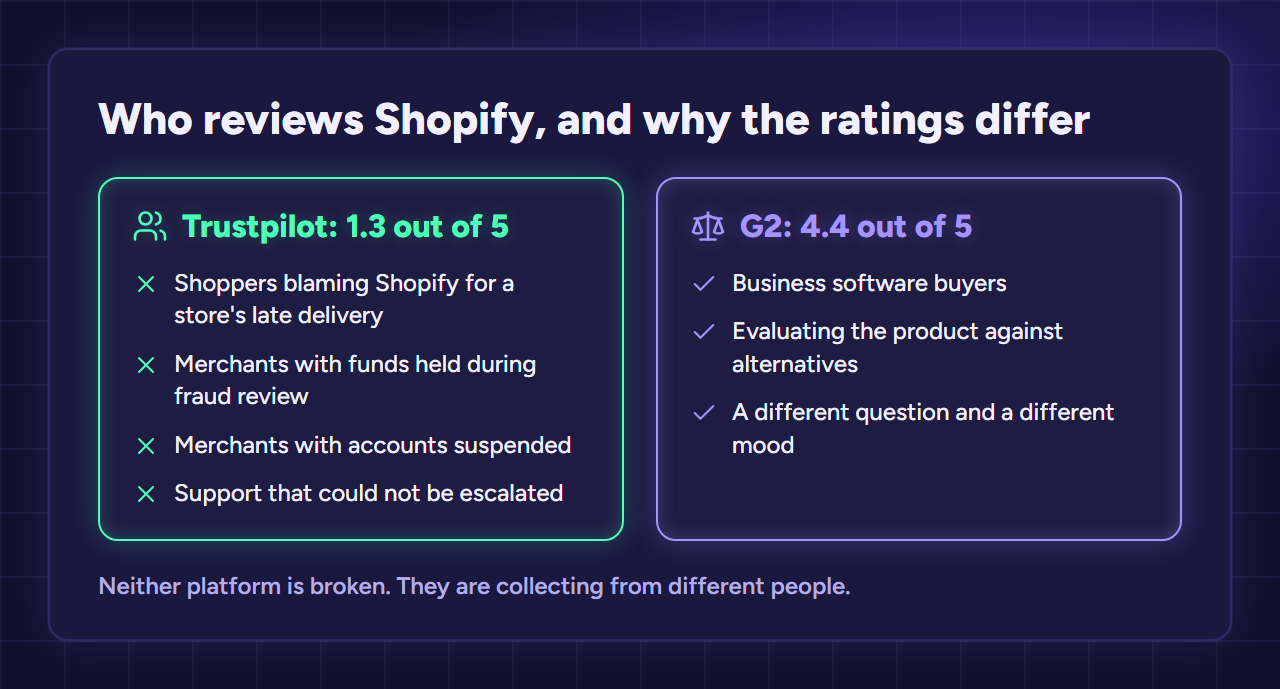
Trustpilot: roughly 1.3 out of 5, from over 4,000 reviews as of mid-2026. Shopify also holds an F rating with the Better Business Bureau against more than 1,600 complaints.
G2: roughly 4.4 out of 5, from over 6,000 reviews. Capterra runs positive too.
Neither platform is broken. They are collecting from different people.
Trustpilot attracts two populations. The first is consumers who bought something from a store that happens to run on Shopify, had a bad delivery experience, and reviewed Shopify instead of the merchant. Shopify hosts millions of stores including dishonest ones, and the platform absorbs the blame. The second is merchants with a specific and serious grievance: funds held during fraud review, accounts suspended, support that could not be escalated.
G2 attracts business software buyers evaluating the product against alternatives, which is a different question and a different mood.
The useful read is this. The technical product is genuinely good and the second Trustpilot group is genuinely real. Shopify's weakest area is not the software. It is what happens when your money gets held and you need a human.
Is Shopify worth it for your situation?
Shopify is worth it for a business that sells a straightforward catalog through Shopify Payments, and not worth it for configurable products, content-first sites, or ideas that cannot yet carry $39 a month.
| Your situation | Worth it? | The number that decides it |
|---|---|---|
| Selling products, Shopify Payments available, simple catalog | Yes | $39 a month on Basic, 2.9% + 30¢ per online sale |
| One product needs more than 100 variants | No | 100 variants per product on every plan |
| Two people need admin access | Only if $105 a month is fine | Basic has no staff accounts, so you need Grow |
| Outside Shopify Payments coverage | Depends on volume | 2% gateway surcharge on Basic, $100 a month at $5,000 in sales |
| Content and SEO are the main channel | No | The blog is basic; WordPress fits better |
| Testing an idea on a tight budget | Not yet, apart from the promo | $1 a month for three months, then the full price |
If you want granular control over checkout behavior, count that as a "no" too.
Shopify pros and cons, honestly
What it genuinely does well
Reliability you never think about. Managed hosting, CDN, SSL, PCI DSS compliance, automatic backups. When an ad takes off or a TV mention lands, the store holds. That is precisely what the subscription buys, and it is invisible until you have run a store without it.
It is not going anywhere. Founded 2006, publicly traded since 2015, over 2.5 million stores across 175 countries. This is not a service that disappears with your store inside it.
The app ecosystem is the largest in ecommerce. Whatever a store needs, someone built it for Shopify first.
Checkout converts and you cannot break it. Tested against enormous volume.
Multi-channel selling is properly built. Marketplaces, social, point of sale, and since March 2026 the AI assistants through Agentic Storefronts, which syndicate catalogs to ChatGPT, Google AI Mode, Microsoft Copilot, Perplexity, and the Shop app at no extra cost on paid plans.
Tax handling is better than most. Shopify is unusually good at EU VAT OSS requirements, which competitors often handle poorly.
What genuinely frustrates people
App costs exceed the plan fee, often within months. The most common complaint by a wide margin. Consultants who work with hundreds of stores report merchants running 15 to 20 apps where 5 to 7 would do. Your $39 plan is rarely a $39 bill.
The 100-variant limit per product. A hard ceiling that catches anyone selling configurable or heavily optioned products. No Shopify plan allows more than 100 variants per product, while Wix allows up to 1,000. If your product has four options with five choices each, you are already over.
Multi-user access is expensive. Basic includes zero staff accounts in 2026. A second person in the admin means Grow at $105 a month.
Reporting is gated. Advanced analytics sit on higher plans, which frustrates small stores that need the data more than the revenue justifies the tier.
Content and SEO are weak spots. The blog is basic. Stores serious about content end up running WordPress alongside, or paying for a page builder.
Support quality varies. 24/7 chat and phone exist on paid plans. Frontline responses are often fine, complex issues frequently need escalation, and escalation is where the Trustpilot complaints cluster.
Updates occasionally break things. Themes and apps sometimes need attention after platform updates. Normal for actively developed software, still your problem on a Saturday.
The lock-in question
Worth thinking through before you commit, because it compounds.
Four things tie you in. Proprietary data models that do not export cleanly. App dependencies with no equivalents elsewhere. Custom theme work written in Liquid, which is Shopify-specific. And reliance on Shopify's APIs and roadmap for core functionality.
None of that is unique. Every hosted platform locks you in to some degree, and WooCommerce trades lock-in for maintenance burden rather than eliminating it.
What is worth noting is the direction. The longer you stay and the more you customize, the more expensive leaving becomes. That is an argument for deciding deliberately at the start rather than for avoiding Shopify.
The practical mitigation costs nothing: export your customer list regularly. It is the one asset that matters most and the one that always exports cleanly.
What Shopify actually costs
The plan price is the smallest part of the bill. Shopify Basic costs $39 a month, or $29 a month billed annually, and Shopify Payments charges 2.9% + 30¢ per online card sale on that plan.
| Line | Typical monthly |
|---|---|
| Basic plan | $39, or $29 billed annually |
| Apps | $80 to $200 |
| Payment processing | 2.9% + 30¢ per online sale |
| Third-party gateway surcharge | 2% on Basic, if applicable |
| Premium theme | $180 to $500, one time |
A store doing $5,000 a month typically pays $39 in plan, around $160 in processing, and $80 to $200 in apps. That is $279 to $399 in total, and the plan is only 10% to 14% of it.
There is a genuinely cheap way in. The trial is 3 days with no card, followed by $1 a month for three months on a paid plan. That is about $3 for three months of a working store, which is enough time to find out whether anything sells before the real price arrives.
The old $5 Starter plan closed to new stores in August 2026, so anyone quoting it is working from stale information. A surprising number of current reviews still do. If you were counting on it, here is what to use now that the Starter plan is gone.
Who should not use Shopify
Specific cases, rather than general hedging.
Complex product configurators. The 100-variant limit is real and there is no plan that removes it.
Content-first businesses. If your traffic will come from articles and guides, you are fighting the platform. WordPress with WooCommerce fits better, and our Shopify vs WooCommerce comparison weighs that trade.
Anyone needing deep checkout control. Shopify's checkout is excellent and closed. You get what they built.
Very small sellers. A few products through social links used to fit the Starter plan. With that gone, $39 is a lot of overhead for someone doing $200 a month. A marketplace or a free-tier builder makes more sense until the volume justifies it.
Sellers outside Shopify Payments coverage doing meaningful volume, because the 2% surcharge on Basic is $100 a month at $5,000 in sales.
Shopify reviews: how to read them
Since the ratings contradict each other, a few filters help.
Check whether the reviewer is a merchant or a shopper. A one-star review complaining about a late parcel is about a store, not the platform.
Weight complaints about money held above complaints about features. Feature gaps you can research. Funds held during fraud review is the failure mode that actually ends businesses, and it is the one recurring seriously in merchant reviews.
Discount any review quoting a $5 plan. It is out of date, and if a reviewer has not noticed a pricing change from August 2026, their other figures are probably stale too.
Read Reddit for the middle. Review sites collect extremes. Threads from working merchants tend to land on "good platform, watch your app spend", which is closer to the truth than either rating suggests.
Is Shopify worth it in 2026 specifically?
In 2026 Shopify is still worth it for stores that are already selling, but less so for beginners, because this year removed the cheap Starter plan and Basic's staff accounts while adding Agentic Storefronts at no extra charge.
Three things changed this year and they cut both ways.
Against it. Basic lost its staff accounts, so the real cost of a two-person store went from $39 to $105. The Starter plan disappeared, removing the cheap entry point entirely.
For it. Agentic Storefronts arrived in March 2026, syndicating product catalogs into ChatGPT, Google AI Mode, Microsoft Copilot, Perplexity, and the Shop app at no extra charge. No competitor currently matches that distribution, and it is included rather than upsold.
Neutral but worth knowing. Shopify's built-in AI tooling now covers product descriptions and some support automation, which reduces the app stack slightly for stores that were paying for those separately.
On balance, 2026 made Shopify more expensive at the bottom and more valuable at the top. If you were choosing between Shopify and a cheaper builder purely on price, the gap widened. If you were choosing on capability, it widened the other way.
The funds-holding problem, and what to do about it
This is the complaint that ends businesses, and it deserves more than a line in a pros and cons table.
Shopify Payments runs fraud and risk checks. When something trips them, payouts can be paused while the account is reviewed. For a store spending on ads daily, revenue stopping while costs continue is a serious problem within a week.
What triggers it. Sudden revenue spikes, which is exactly what a working ad campaign looks like. High dispute or chargeback rates, which long shipping times produce. Product categories flagged as higher risk. Mismatches between your business details and your bank account. A pattern of refunds.
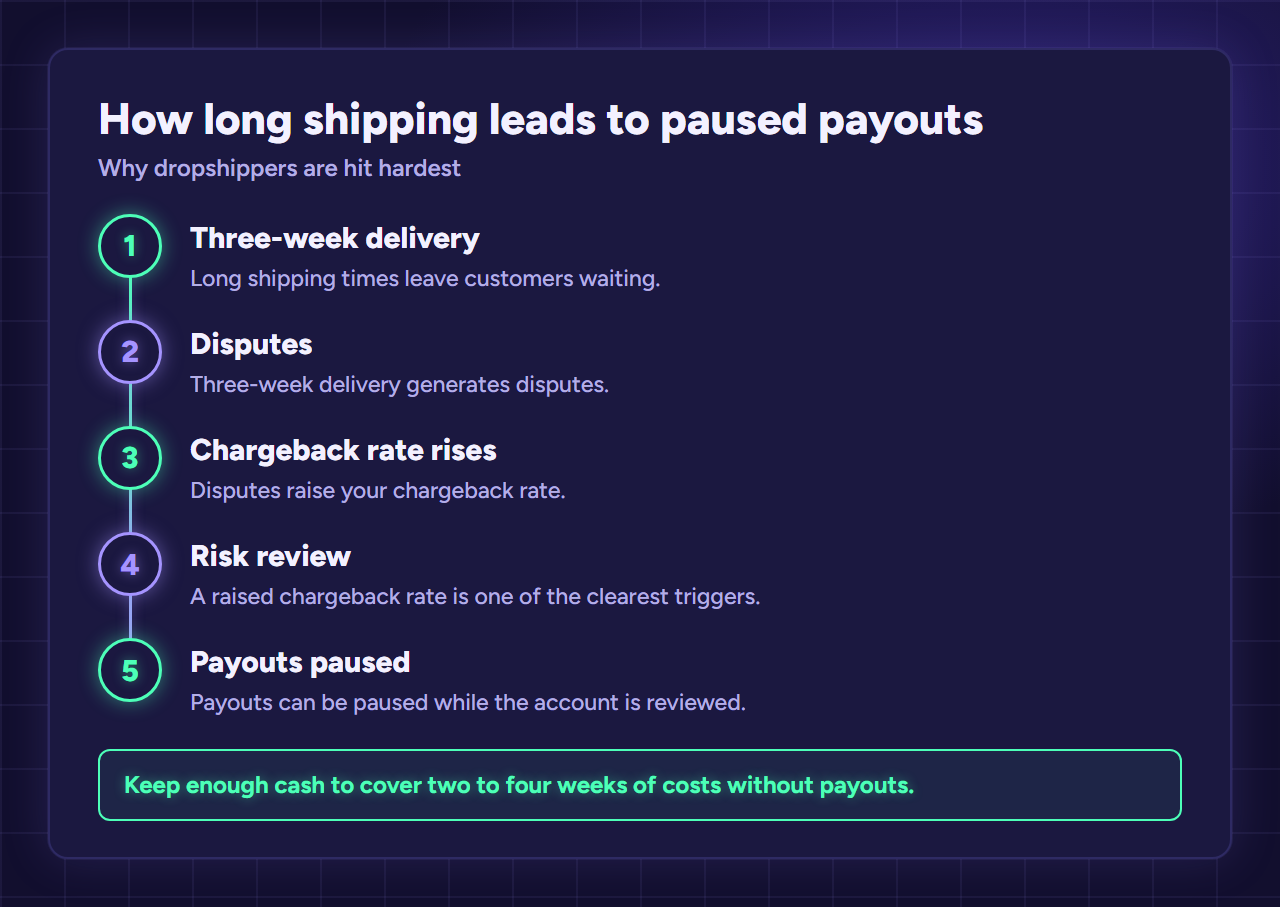
Why dropshippers are hit hardest. Three-week delivery generates disputes. Disputes raise your chargeback rate. A raised chargeback rate is one of the clearest triggers. The model creates the conditions.
What reduces the risk. State delivery windows clearly and notify customers when orders slip, which cuts disputes at the source. Keep your business registration, bank details, and store information consistent and current. Respond to any verification request immediately rather than a week later. Do not scale ad spend from $50 to $2,000 a day overnight if you can ramp instead.
What to do in advance. Keep enough cash to cover two to four weeks of operating costs without incoming payouts. This is unglamorous and it is the difference between an inconvenience and a closure.
None of this is unique to Shopify. Every payment processor does risk review, and Stripe and PayPal generate the same complaints. What is specific to Shopify is that the processor and the platform are the same company, so a payments problem and a store problem arrive through the same support queue.
Who Shopify is quietly best for
The obvious answer is "online stores", which is not useful. Some fits are better than others.
Brands selling a focused catalog at real prices. Twenty to two hundred products, $40 and up, with a brand worth building. This is the center of what Shopify is designed around and everything works.
Anyone selling in person and online. Point of sale that shares inventory with the store is genuinely hard elsewhere.
Businesses selling across borders. Multi-currency, market pricing, duties, and VAT OSS handling are stronger than most competitors offer without enterprise pricing.
Stores that expect to grow past a website builder. The headroom means you make the platform decision once instead of twice.
Anyone whose time is worth more than their platform fee. The whole value proposition is that you never think about servers, certificates, or security patches. If an hour of your time is worth more than $39, that trade is already paying.
The common thread is that Shopify is priced and built for a business, not for an experiment. That is why the removal of the cheap entry tier fits the direction rather than contradicting it.
What the first three months actually look like
Reviews describe features. Here is the shape of the experience, which is what people are really asking about.
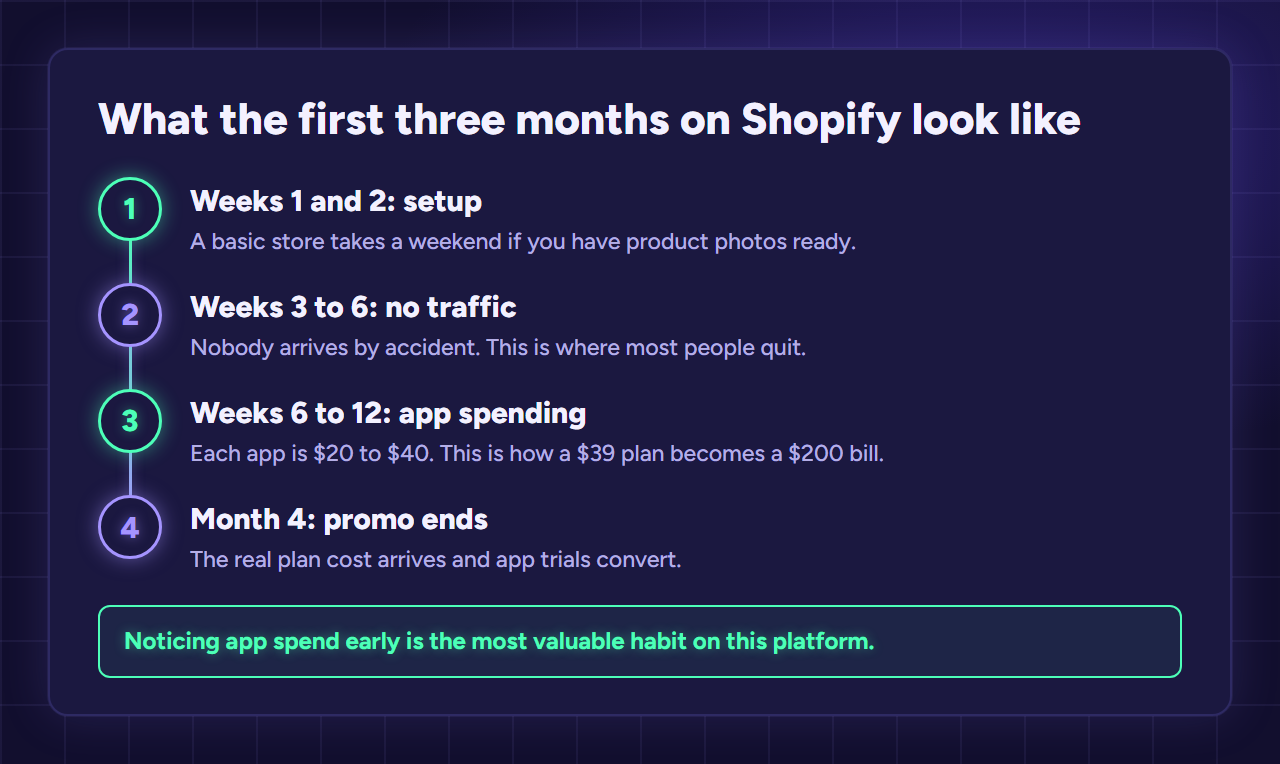
Weeks one and two. Setup is genuinely fast. A basic store with a free theme, a handful of products, payments, and shipping takes a weekend if you have product photos ready, and our step-by-step Shopify launch guide walks through it. Most of the time goes into writing product descriptions, not into the platform. Expect the dashboard to feel larger than you thought, because it is.
Weeks three to six. The store is live and nothing is happening. This is normal and it is where most people quit. Nobody arrives at a new store by accident, so this period is entirely about whether you have a traffic plan. The platform is no longer the variable.
Weeks six to twelve. If something is working, this is when the app spending starts. A review app, an email tool, an upsell app, a supplier integration. Each is $20 to $40 and each is individually justifiable. This is exactly how a $39 plan becomes a $200 bill, and noticing it early is the single most valuable habit on this platform.
Month four. The promotional pricing ends and the real plan cost arrives. Any app trials you started also convert around now. Budget for this cliff rather than being surprised by it.
The pattern worth internalizing: Shopify makes the first two weeks easy and has almost no bearing on weeks three to six, which are the ones that decide whether the business works. Choosing a platform is a small decision dressed up as a large one.
The verdict
Shopify is the safest default for a business whose purpose is selling products, and the wrong tool for several specific situations that are easy to identify in advance.
The 1.3 on Trustpilot is not a reason to avoid it, but the reason behind part of that number is worth respecting. Funds held during fraud review and support that is hard to escalate are real risks, and they are worse for stores with unusual products, sudden revenue spikes, or long shipping times. Dropshippers should read that sentence twice.
If you want to test it properly rather than read about it, the trial plus the promotional period costs about $3 for three months. Building a real store and running a few orders through it tells you more than any review, including this one.
Our Shopify pricing breakdown covers the full cost of starting a Shopify store. Our alternatives comparison puts Shopify against BigCommerce, WooCommerce, Wix, and the rest.
FAQ
Verdict questions
Is Shopify worth it for beginners?
Usually yes, if selling is the goal. It removes hosting, security, and checkout problems entirely, which is worth more to a beginner than to an expert. The $39 is the issue, not the platform.
Why does Shopify have terrible Trustpilot reviews?
Because two groups post there: shoppers blaming Shopify for a merchant's shipping failure, and merchants with funds held or accounts suspended. The second group is a genuine warning. The first is a misunderstanding of who they bought from.
Is Shopify worth it for dropshipping?
Yes, with a caveat. It remains the strongest platform for it, with the deepest supplier app integrations. But the support and funds-holding complaints hit dropshippers hardest, because long shipping times generate the disputes that trigger reviews.
Cost and limitation questions
What is the real monthly cost?
Expect $150 to $400 all-in for a working small store: $39 plan, $80 to $200 apps, plus processing at 2.9% + 30¢. The plan is the smallest line.
What is the 100-variant limit?
It is a hard cap of 100 variants on any single product. No plan removes it. Anyone selling configurable products should check their option math before committing.
Is Shopify cheaper than Wix?
Yes, once Wix's platform fee is counted. Wix charges a 4% platform transaction fee on Core and 2% on Business, on top of 2.9% + 30¢ processing. At $1,000 a month in sales, that makes Shopify about $30 a month cheaper. The full Wix vs Shopify comparison covers where Wix still wins.
Can I still get the $5 Starter plan?
No. It closed to new stores in August 2026. Any review still quoting it was written before the change and should be treated as out of date throughout.
Leave a Reply