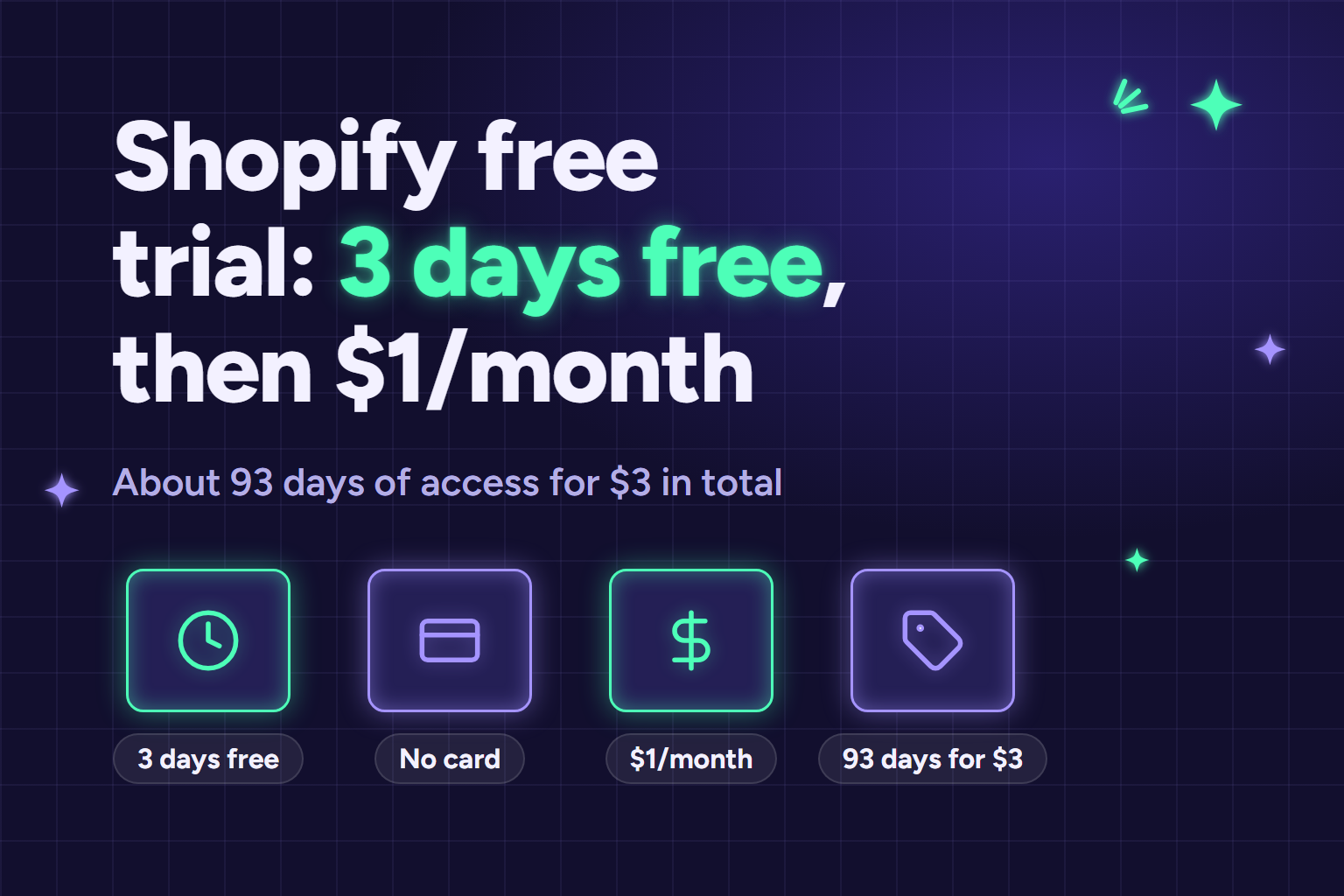
TL;DR: The Shopify free trial is 3 days and needs only an email, no credit card. After day 3, you add a payment method and typically pay $1/month for 3 months on Basic, Grow or Advanced. That puts about 93 days of access at $3 in total. The 90-day and 14-day Shopify free trial offers you still see quoted are outdated; both ended years ago.
What is the Shopify free trial right now?
The Shopify free trial is 3 days of full store-building access that starts with just an email, no credit card. You can build your store, add products, customize a theme and install apps; everything works except live checkout. If you searched "how long is Shopify free trial," the answer is those 3 days plus an optional paid stretch.
When the 3 days end, Shopify asks for a payment method to continue. If you add one, the current offer is $1/month for the next 3 months, then regular plan pricing kicks in. That $1/month period is a promotion, not a permanent trial extension. It can vary by region or account. Confirm the exact offer in your own signup flow rather than trusting every article you've read.
| Phase | Length | What you pay | Card needed | Live checkout |
|---|---|---|---|---|
| Free trial | 3 days | $0 | No | No |
| Promotional period | 3 months | $1/month on Basic, Grow or Advanced | Yes | Yes, once a payment provider is set up |
| Standard Basic pricing | Ongoing | $39/month, or $29/month billed annually | Yes | Yes |
Here is the plan pricing you'll eventually land on. Shopify's entry-level Basic plan runs $39/month billed monthly, or $29/month billed annually. The old $5/month Starter plan (checkout-link only, no real storefront) was discontinued for new signups in 2026. Shopify Basic includes no staff accounts, so a second admin login requires Grow at $105/month. Grow drops to $79/month billed annually.
Why you'll see conflicting numbers everywhere
Search "Shopify free trial" and you'll find claims of 90 days, 14 days, and 3 days, sometimes on one page. Shopify ran a genuine 90-day free trial from March to June 2020, as pandemic relief for businesses moving online. Before that, the standard trial was 14 days for years. Both of those are gone. The current offer is 3 days free, then the $1/month promotion if you continue.
Older articles simply haven't been updated since Shopify changed its offer. Many still sit near the top of Google, because the pages rank well even when the claim inside is stale. A few sites take it further and advertise a 60 or 90-day trial deliberately. It's bait for an affiliate link, since "free for 3 months" gets more clicks than "free for 3 days." Neither kind of page is lying maliciously in most cases. The first is just outdated, and the second is optimizing for clicks over accuracy.
If you see a site promising 60 or 90 days as the base free offer, treat that specific claim as outdated. There is a legitimate way to stretch the trial close to 90 days now, just not as a flat free offer. See the extension option below. Watch for third-party pages that route you through an affiliate link with misleading claims about what's free. The only place to confirm the live offer is Shopify's own signup page. Even well-intentioned comparison sites can lag behind Shopify's actual current terms by months.
Can you extend the Shopify free trial?
Yes, but only by paying. Three months at $1/month after the 3 free days gives you about 93 days for $3 total. That paid period is the only Shopify trial extension on the standard signup path. Shopify advertises it far less than the 3 free days.
You may see a "$3 extension to about 93 days" described as something extra. It is the same $1/month offer counted twice. Three months at $1 is the $3, and 3 days plus 3 months is the 93 days. Treat the exact price and duration as something to confirm at signup rather than a fixed guarantee. If trial length matters more to you than cost, add a payment method before day 3 ends. That way the $1/month period starts without a gap.
Separately, Shopify runs a 1 Million Black Businesses (1MBB) program, a partnership with Operation HOPE. Eligible Black-owned businesses in the US and Canada get an extended low-cost period plus business support resources. It's commonly framed as Shopify Basic at $1/month for 6 months. This isn't a general-audience offer; eligibility and enrollment steps apply. But if you qualify, it's a meaningfully longer and cheaper runway than the standard trial path.
Step-by-step: getting the trial
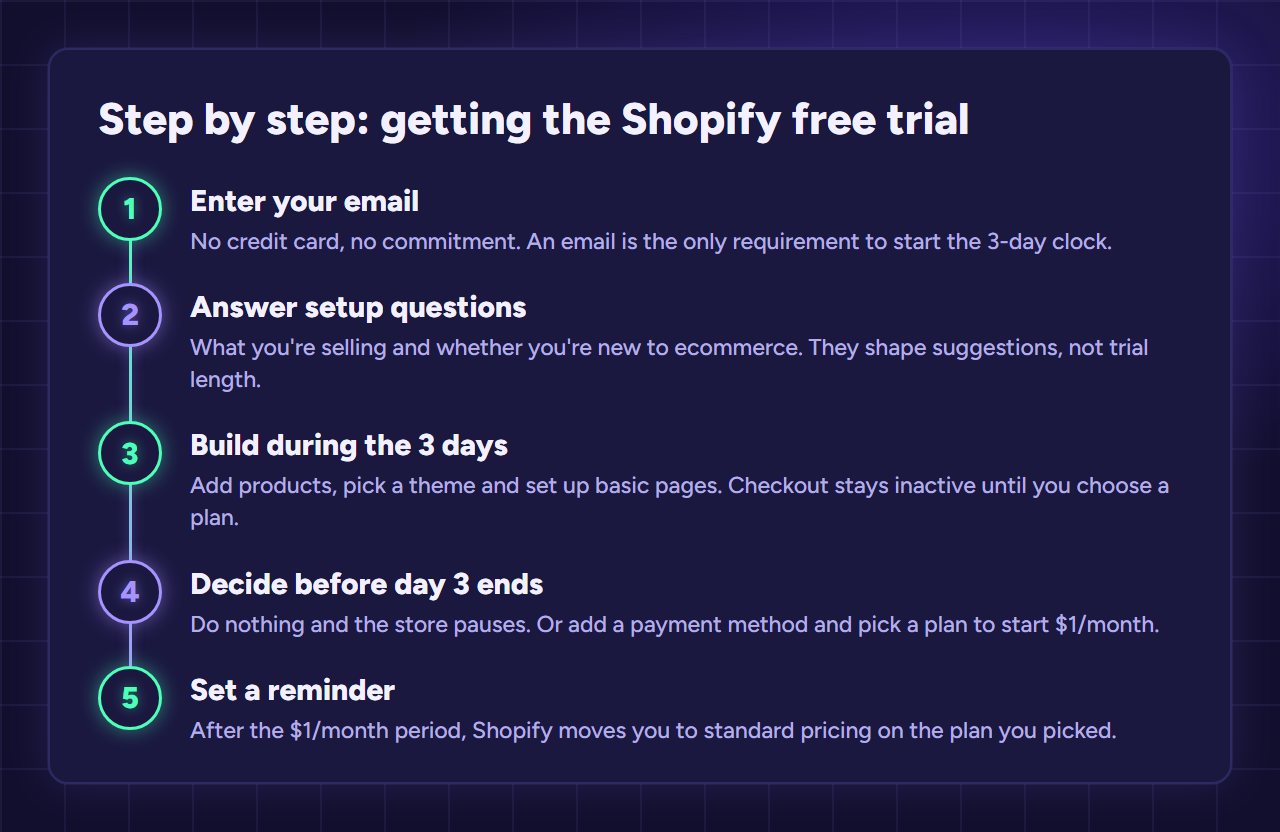
1. Go to Shopify's signup page and enter your email.
No credit card, no commitment. Some people specifically search "Shopify free trial no credit card" worried there's a catch here. There isn't; entering an email is genuinely the only requirement to start the 3-day clock.
2. Answer Shopify's setup questions.
You'll be asked what you're selling and whether you're new to ecommerce. These shape the templates and app suggestions Shopify shows you, not your trial length.
3. Build during the 3 days.
Add your first products, pick a theme, and set up your store's basic pages (About, Contact, shipping policy). Checkout stays inactive until you choose a plan, so you can't take real orders yet. Everything else is live. Our step-by-step guide to launching a Shopify store covers what comes next, from payments to a test checkout.
4. Decide before day 3 ends.
If you're not ready to continue, do nothing. The trial expires and your store pauses. If you want to keep going, add a payment method and pick a plan. That's when the $1/month promotional pricing (if available to your account) kicks in.
5. Set a reminder for when the promotional period ends.
After the $1/month period, Shopify moves you to standard pricing on whatever plan you picked. Missing that transition is a common complaint in Shopify's community forums. People forget to check, then get billed the full rate.
What happens if you don't add a payment method?
If you don't add a payment method, Shopify pauses your store instead of deleting it. It keeps your data, products, and settings for up to 2 years in case you come back and want to reactivate.
A paused store keeps your product catalog, uploaded images, theme customization, and content pages exactly as you left them. That includes About and policy pages, or blog posts if you added any. You lose access to the admin dashboard and anything live-facing, since the store isn't public while paused. Come back within the 2-year window, add a payment method, and everything reactivates as-is.
A realistic timeline for the 3-day window
Three days sounds tight, and it is, if you try to do everything at once. Here's roughly how the time actually splits for someone who's never used Shopify before. Expect 2 to 3 hours on day one just picking a theme and getting comfortable with the admin dashboard. Shopify's interface has more sections (Products, Orders, Analytics, Apps, Settings) than it first looks like.
Day two is usually product setup, writing descriptions and uploading images for whatever you're planning to sell. This takes longer than expected if you're doing it product by product rather than bulk importing. Day three is typically decision day. By then you've seen enough to know if it fits. Most people either add a payment method or let the trial lapse.
Moving forward with dropshipping? Pick your first product and supplier before day one starts. That way you're not burning trial hours on product research that doesn't require Shopify access at all.
What the trial doesn't include
- Live checkout. You can build the entire store, but customers can't buy until you're on a paid plan with a payment provider. Testing whether a product converts means moving past the free 3 days.
- A domain. The trial gives you a Shopify-branded URL (yourstore.myshopify.com). A custom domain is a separate purchase, typically $10 to $15 a year, from Shopify or a registrar like Namecheap.
- Guaranteed pricing for everyone. The $1/month promotion has appeared and disappeared before, and regional availability isn't consistent. If it's not available to you, you'll go straight to standard plan pricing after the 3 free days.
- Apps beyond the free tier. Shopify's app store has both free and paid apps, and the trial doesn't unlock paid app features for free.
Is 3 days enough?
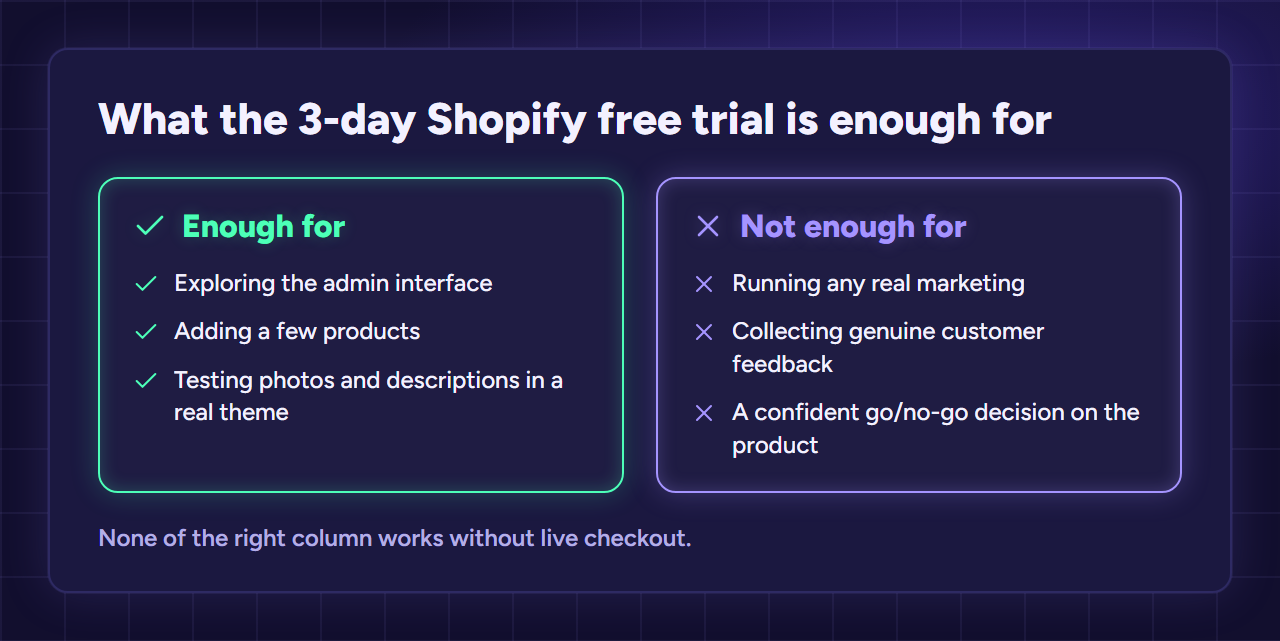
No, 3 days is not enough for most first-time sellers to launch a fully tested Shopify store. Three days is enough to explore the interface, add a few products, and decide if Shopify's workflow suits you. If you're serious about launching, plan to move into the $1/month period almost immediately.
What 3 days is genuinely enough for: confirming the admin interface doesn't feel overwhelming. And testing whether your product photos and descriptions look right in an actual theme rather than just in your head. What it's not enough for: running any real marketing or collecting genuine customer feedback. A confident go/no-go decision on the product isn't possible either, since none of that works without live checkout.
Testing dropshipping? Our guide works out a realistic first-month budget for starting dropshipping with no money. Still deciding whether Shopify is the right starting point? Our beginner's guide covers that first step: what Shopify is.
How this compares to other platforms' trials
Shopify isn't the only option, and its 3-day window is genuinely short compared to some alternatives. WooCommerce, since it's a free WordPress plugin rather than a hosted platform, doesn't have a "trial" at all. You can install it and start building immediately at no cost. You're then responsible for hosting, which typically runs $5 to $15 a month depending on the provider. BigCommerce has offered trials in the 15-day range in the past, longer than Shopify's 3 days but still time-limited.
The trade-off is what you're actually comparing. Shopify's short trial leads to a fully hosted, checkout-ready store the moment you pay, with no hosting decision. WooCommerce's unlimited free window comes with more setup responsibility from day one. Our Shopify vs WooCommerce comparison weighs that trade-off in full.
FAQ
Starting the trial
Do I need a credit card to start the Shopify free trial?
No. The initial 3-day trial requires only an email address. A payment method is only needed if you choose to continue past day 3.
How long is the Shopify free trial?
3 days, followed by an optional 3 months at $1/month if you add a payment method. Older claims of a 14-day or 90-day Shopify trial are outdated. The $1/month period is the closest thing to a Shopify trial extension. It brings total access to about 93 days.
Is there still a 90-day free Shopify trial?
No. That was a temporary pandemic-relief offer that ended June 1, 2020. Any site advertising a flat 90-day trial today is outdated or misleading. The $1/month period can get you close to that length for $3.
Can I sell during the free trial?
No. You can build your full store during the 3 free days. Checkout stays inactive until you're on a paid plan.
After the trial
How much does Shopify cost after the free trial?
After the promotional period, Basic costs $39/month billed monthly, or $29/month billed annually. Grow costs $105/month, or $79/month annually, and it is the cheapest plan with staff accounts. Check the pricing page at signup, since the promotional terms change more often than the plan prices.
What happens to my store if the trial ends and I don't pay?
It pauses. Your products, theme, and settings are preserved for up to 2 years, so you can reactivate later without starting over.
Is the $1/month offer available to everyone?
Not guaranteed. It's a promotional Shopify $1 per month deal that can vary by region and account history. Confirm what's actually offered in your own signup flow before budgeting around it.
Leave a Reply