Dropshipping is the ecommerce model you’ve seen behind every “make $10k/month” thumbnail — and most of what those videos tell you is either wrong or conveniently incomplete. The model itself is real and it works. The hype around it usually doesn’t.
So here’s the straight version. In my first Shopify guide, I covered the store: the website, the cart, the checkout. Dropshipping is one way to run that store — the one where you never touch the products you sell. This guide covers how it works, what it actually costs, and what you can realistically earn, with numbers instead of promises.
Key takeaways
- Shopify dropshipping means selling products through your own Shopify store while a third-party supplier ships orders directly to your customers — you never buy or hold inventory.
- It’s completely legal and legitimate; you’re just responsible for taxes, honest listings, and customer service like any retailer.
- Realistic startup cost is around $400–700, not $0 — the “start for free” promise mostly ignores your ad budget.
- Typical net margins run 15–25%, so a store doing $5,000/month in sales keeps roughly $750–1,250 in profit.
- It still works in 2026, but as a real business with a testing phase — not a get-rich-quick shortcut.
What is dropshipping?
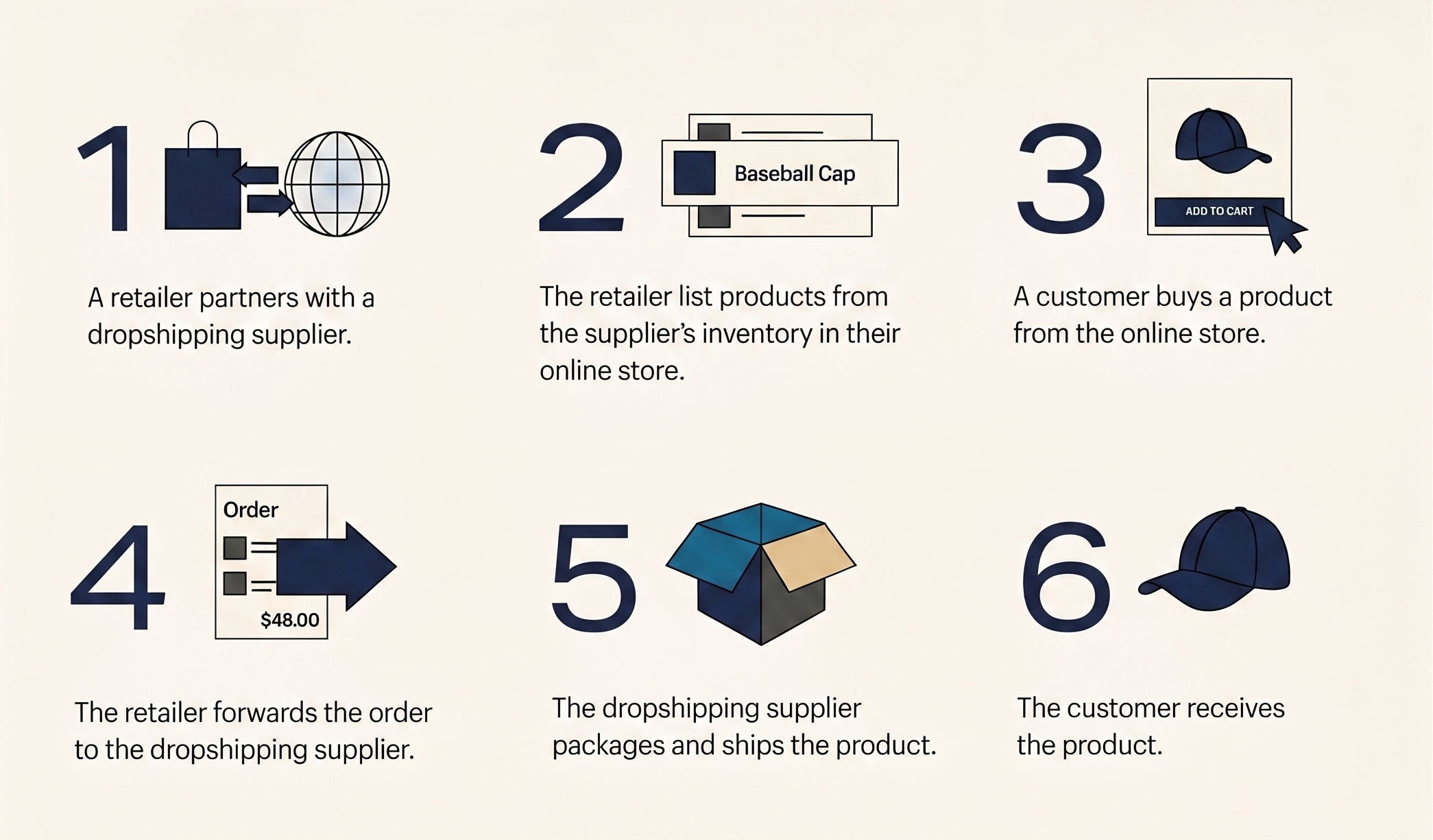
Dropshipping is a fulfillment method where you never keep the products you sell in stock. You list a supplier’s products in your store at a markup, and when someone buys, the supplier ships the order straight to them.
Fulfillment: Everything that happens after a customer pays — picking the product, packing it, and shipping it. In dropshipping, your supplier handles all of it.
Here’s the whole model in one example. You find a supplier that stocks posture correctors for $14 each, and you list one in your store for $39.99. When someone buys:
- The customer pays you $39.99 through your store.
- You pay the supplier their $14 (an app does this automatically).
- The supplier ships the product directly to your customer — they never know a middleman was involved.
Your gross profit is the $26 difference, before advertising, apps, and payment fees take their cut.
The trade-off is control. You carry no inventory risk, but you also don’t control product quality, stock levels, or shipping speed. Everything after the sale rides on your supplier — which is exactly why picking a good one is the whole game.
How does Shopify dropshipping work?
You can dropship on almost any platform, so why is it always “Shopify dropshipping”? One reason: apps.
Shopify’s app store has a whole category of dropshipping apps — DSers, AutoDS, Zendrop, Spocket — that connect your store to suppliers and automate the busywork:
- Product import: push a supplier’s products (photos, descriptions, variants) into your store in one click.
- Order routing: when a customer buys, the app sends the order and shipping address to the supplier automatically.
- Inventory and price sync: if the supplier runs out or changes prices, your store updates itself — so you never sell something you can’t deliver.
- Tracking: shipping numbers flow back into Shopify and out to your customer.
Once that’s set up, the job is smaller than people expect. You pick a niche, connect an app, import a tight set of products, set your prices — and then spend your actual working hours on the two things no app will do for you: marketing and customer service.
How much does it cost to start Shopify dropshipping?
Ignore anyone who says “free.” Here’s a realistic budget:
| Expense | Typical cost |
|---|---|
| Shopify plan | $39/month Basic (intro deals often make month one ~$1) |
| Domain name | $10–20/year |
| Dropshipping app | $0–50/month (most have free tiers to start) |
| Paid theme (optional) | $0–350 one-time |
| Test orders (checking your own product quality) | $30–80 |
| Initial ad budget | $300–500 minimum to gather meaningful data |
Realistic total: roughly $400–700 for your first month or two. You can launch for under $100 if you skip ads and lean on organic TikTok or SEO, but that’s a slower road to your first sale. And the real cost isn’t money — it’s the weeks spent testing products that flop before one finally sticks.
Is Shopify dropshipping profitable?
It can be, but not at the margins the thumbnails imply.
Net margin: What’s left from each sale after all costs — product, shipping, payment fees, apps, and ads. Different from gross margin, which only subtracts the product cost.
Dropshipping net margins typically run 15–25%. A store doing $5,000/month in revenue keeps about $750–1,250. Most beginners who make it work reach $1,000–3,000/month in revenue within a few months of steady effort — and plenty never get there, usually because they quit mid-testing before a product lands.
Three things separate the stores that profit from the ones that stall:
- Product-market fit: one genuinely good product beats fifty average ones.
- Ad cost discipline: if it costs $25 in ads to sell a product with $20 of margin, volume won’t save you.
- Repeat purchases: the stores that last raise their average order value with bundles and sell to the same customer more than once.
I’m putting together a full breakdown of real dropshipping income by stage — I’ll link it here once it’s live.
Pros and cons of Shopify dropshipping
| Pros | Cons |
|---|---|
| Low startup cost — no inventory investment | Thin margins (15–25% net is typical) |
| Fast to launch — a store can be live in a day | Long shipping times with overseas suppliers |
| Location-independent, runs from a laptop | No control over product quality or stock |
| Easy to test products and niches | High competition; identical products everywhere |
| Scales without warehousing headaches | Customer service issues land on you, not the supplier |
| Huge app ecosystem automates the busywork | Ad costs keep rising, squeezing margins |
Dropshipping is best understood as a testing model, not a final destination. Most stores that grow past ~$10K/month eventually move on — private-label deals, some held inventory, or a 3PL for faster shipping — because dropshipping’s weak points (speed and quality control) cap how far a brand can go.
3PL (third-party logistics): A company that warehouses your inventory and ships your orders for you. Faster and more controllable than dropshipping, but you buy stock upfront.
Is Shopify dropshipping legal?
Yes, completely. It’s just a fulfillment arrangement, and retailers have used it for decades. As the seller of record, you’re responsible for three things:
- Honest selling: accurate descriptions, realistic shipping estimates, a clear refund policy.
- Taxes: collecting sales tax or VAT where required, and reporting your income.
- Intellectual property: no counterfeit or trademarked products — this is the fastest way to get your store and payment accounts shut down.
You don’t need an LLC to make your first sales in most countries. Once revenue is steady, registering a business protects you personally and keeps payment processors comfortable.
How to start Shopify dropshipping in 6 steps
The high-level path — I’ll cover each step in depth in a dedicated guide (link coming):
- Choose a niche. Chase passionate audiences and real problems, not just “trending” products. Demand shows up on TikTok and Reddit before it shows up in search volume.
- Pick a supplier and app. Zendrop and Spocket for faster US/EU shipping; DSers or AutoDS for the widest AliExpress catalogs. Order samples of anything you plan to sell.
- Build your store. One clean theme, a focused product line, real trust signals — reviews, clear policies, a contact page. Skip the 500-product general store.
- Price for profit. Aim for at least a 3x markup on ad-driven products, and account for payment fees and returns before setting prices.
- Launch and market. Pick one traffic channel — TikTok organic, Meta ads, or SEO — and get good at it before adding a second.
- Test, cut, and scale. Give each product a small budget, cut the losers fast, and reinvest in what converts.
Shopify dropshipping vs. the alternatives
Vs. Amazon FBA: FBA hands you Amazon’s traffic and Prime shipping, but you buy inventory upfront (usually $2,000+) and Amazon owns the customer. Dropshipping is cheaper to start; FBA is usually faster to first sales.
Vs. print on demand: POD is dropshipping for custom-designed products — shirts, mugs, wall art. Similar margins, but you compete on design and brand instead of sourcing.
Vs. holding your own inventory: buying in bulk gets you better unit costs, faster shipping, and quality control — at the price of upfront capital and risk. Most dropshippers move here once they’ve proven a product sells.
Dropshipping’s real strength is validation: it’s the cheapest way to learn whether people will actually buy something before you commit real money.
Final thoughts: Is it right for you?
Shopify dropshipping is a low-risk way to learn how ecommerce works: you list a supplier’s products, they ship, and you focus on finding customers. It’s legal, it’s legitimate, and it still works in 2026 — for people who pick a real niche, respect their margins, and stay in through the testing phase.
Same advice as my Shopify guide: start small. The trial costs almost nothing, most apps have free tiers, and you can have a test store live this weekend. Learn as you go, and scale when something clicks.
Costs and margins here reflect typical 2026 numbers and vary by niche, country, and supplier. Shopify prices are US pricing — check Shopify’s official pricing page for the latest.
I’m building EasyCommerce Club to be the ecommerce resource I wish I’d had starting out — plain-language guides, essential information.