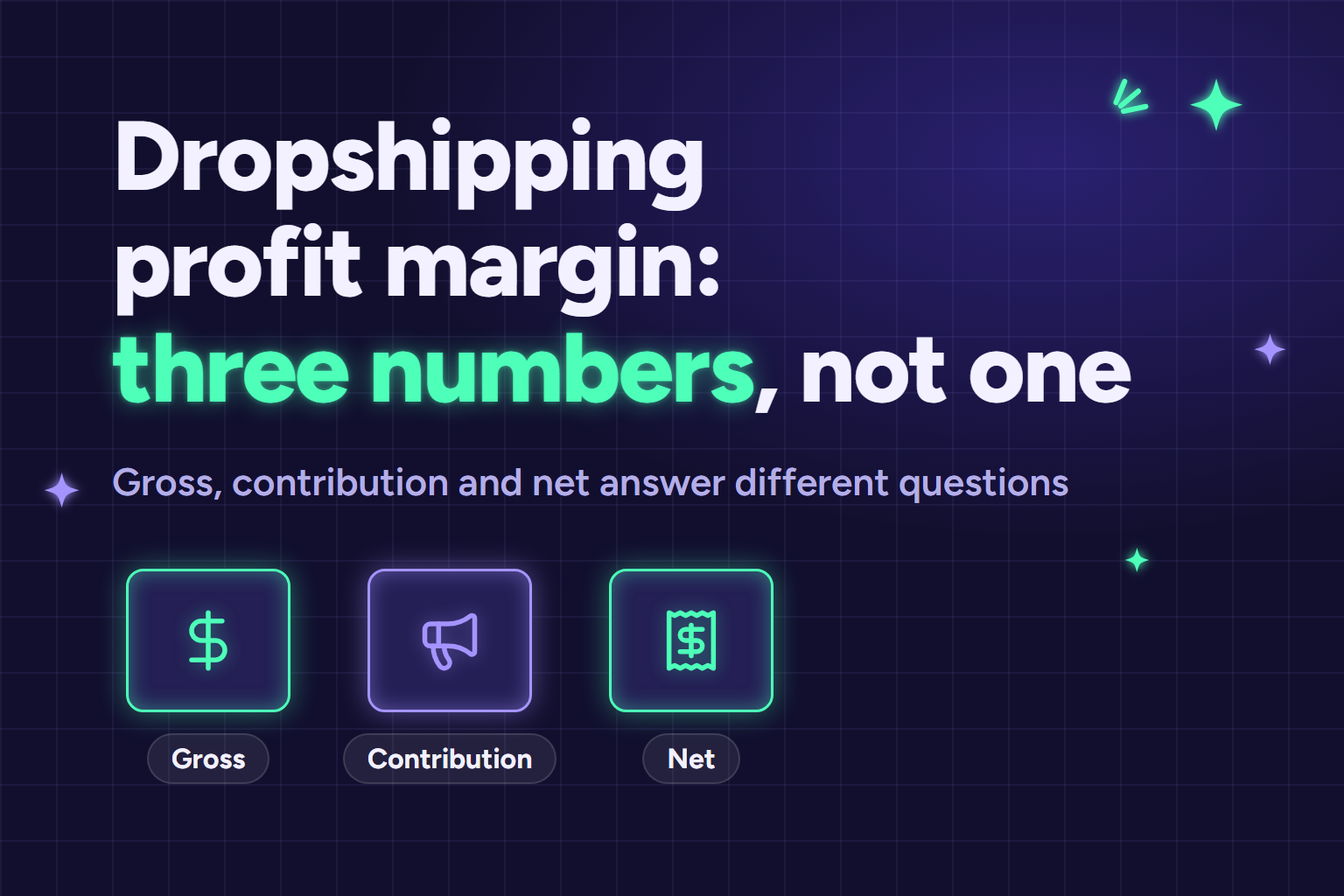
TL;DR: A realistic dropshipping profit margin in 2026 is 15 to 20% net for a working store, 20 to 30% for a strong one, and under 10% for most beginners. Those net figures sit under a gross margin of roughly 55 to 70%, and a store needs at least 45 to 50% gross to absorb ads, fees, and returns at scale. The number that decides whether you can scale is contribution margin, which sits between gross and net and tells you whether one more advertising dollar makes or loses money.
Three margins, not one
Most articles on this topic quote a single figure. That is why their numbers contradict each other so badly. There are three margins, and they answer completely different questions.
Gross margin is revenue minus the cost of goods. Selling at $60 something that costs you $20 gives you $40 of gross profit, a 67% gross margin. This tells you whether a product is worth selling at all.
Contribution margin is gross profit minus every variable cost of that specific order. Advertising, payment processing, supplier shipping, duties, and expected refunds. If those come to $28, your contribution is $12, or 20%. This tells you whether selling one more unit makes you money.
Net margin is what remains after fixed costs too. Your Shopify plan, apps, subscriptions, and your own time. This tells you whether the business is actually a business.
Beginners obsess over gross margin because it is the easiest to calculate and the most flattering. Experienced operators watch contribution margin, because it is the only one that moves in real time when you change a price or a bid.
What is a realistic dropshipping profit margin?
Most working dropshipping stores run 55 to 70% gross, 25 to 40% contribution, and 15 to 20% net, and the gap between those three layers is why published figures look contradictory. Here is a reconciled view by store stage.
| Layer | Beginner store | Working store | Strong store |
|---|---|---|---|
| Gross margin | 40 to 55% | 55 to 70% | 65 to 75% |
| Contribution margin | Under 20% | 25 to 40% | 40 to 50% |
| Net margin | Under 10% | 15 to 20% | 20 to 30% |
Analysis of over 1,200 dropshipping stores puts a typical working store near 65% gross and roughly 15% net. Broader ecommerce data across 5,000 stores puts contribution margin between 33 and 51%. Independent sources converge on 15 to 20% net for experienced sellers and below 10% for beginners.
One figure is worth sitting with. Roughly 10 to 20% of dropshipping stores stay profitable long term. That is not because margins are impossible. It is because most stores never separate these three numbers and so never find out which one is broken.
A useful floor: a store needs around 45 to 50% gross margin to absorb advertising, fees, and returns at scale. Below that, everything has to go right.
How do you calculate dropshipping profit margin?
Take one order: selling price minus supplier cost is gross profit, minus every per-order variable cost is contribution, and minus a share of fixed costs is net profit. Divide each by the selling price to get the margin, then multiply by order volume. Do not start from a monthly bank balance.
Take a product selling at $60 with a $20 supplier cost.
Gross profit. $60 minus $20 is $40. Gross margin 67%.
Subtract variable costs. Supplier shipping $6. Payment processing at 2.9% plus 30 cents, so $2.04. Import duty and customs processing, call it $3 on goods arriving from overseas. Advertising at a $25 acquisition cost. Expected refunds at 3% of revenue, so $1.80.
Variable costs total $37.84. Contribution is $2.16, a contribution margin of 3.6%.
Subtract fixed costs. At 100 orders a month, a $39 Shopify plan plus $60 of apps spreads to about $1 per order. Net profit is $1.16 per order, a net margin under 2%.
That product is technically profitable and practically worthless. It cannot survive a supplier price rise, a bad ad week, or a refund cluster.
Now change one input. Drop the acquisition cost to $15 by improving the ads and the product page. Contribution goes to $12.16, contribution margin 20%, net margin about 19%. Same product, same supplier, viable business.
This is the point of separating the layers. Nothing was wrong with the product. The problem was in a variable cost, and you cannot see that from a net margin alone.
The same three margins at store level
One order tells you whether a product works. A month tells you whether a store does. Here is a store doing $20,000 in monthly revenue on 250 orders, an $80 average order value.
Revenue $20,000. Cost of goods at $28 per order, so $7,000. Gross profit $13,000, a 65% gross margin. This is the number most sellers quote when asked how their store is doing.
Now the variable costs. Advertising at $22 per order comes to $5,500. Payment processing at roughly 3.3% all-in is $660. Supplier shipping at $5 per order is $1,250. Duties on imported goods at $3 per order add $750. Refunds at 3% of revenue take $600.
Variable costs total $8,760. Contribution is $4,240, a contribution margin of 21%.
Fixed costs next. Shopify Basic at $39. Apps at $120. Email platform at $50. Design and content help at $400. Fixed costs come to roughly $609.
Net profit is $3,631, a net margin of 18%.
That store is genuinely healthy. But notice how far apart the three numbers are: 65%, 21%, 18%. Someone describing this store as a 65% margin business is not lying, they are just describing the layer that flatters them most.
Notice something else. Advertising alone consumed 42% of gross profit. If the acquisition cost drifts from $22 to $30, contribution drops to $2,240 and net margin falls to roughly 8%. Nothing about the products changed. One variable cost moved, and the store halved its profitability.
This is why a monthly bank balance is a poor management tool. By the time it moves, the cause is six weeks old.
Margin changes with where your traffic comes from
The same product can be a 3% business or a 30% business depending only on the channel that brought the buyer.
Paid social. Acquisition cost of $15 to $30 is normal. This is the channel that makes cheap products unworkable, and it is also the fastest way to find out whether anything sells.
Organic search. Acquisition cost approaches zero per order once a page ranks, though it costs months of work to get there. A store selling the same product through search rather than ads often runs 20 points of contribution margin higher.
Email to existing customers. Effectively free per order beyond the platform fee. Contribution margin on these orders sits close to the gross margin, which is why repeat purchase moves store profitability more than any pricing change.
Marketplaces. No acquisition cost, but a commission instead. Roughly 10% on Etsy against a $25 ad cost is a straight trade, and which one wins depends entirely on your order value.
The practical consequence is that you should not judge a product's margin without saying which channel you mean. A product that fails on paid ads at $30 can be a solid business through search or repeat purchase.
It also means channel mix is a margin lever. Moving 20% of orders from paid to email does more for net margin than most supplier negotiations will.
Everything that eats your margin
Beginners usually account for the product and the ads. The rest of the list is where the surprise lives.
Advertising is almost always the largest single cost. At typical rates you are paying $15 to $30 to acquire a customer, which frequently exceeds the entire gross profit on a cheap item.
Payment processing on Shopify Payments costs 2.9% plus 30 cents per online card sale on Basic, 2.7% plus 30 cents on Grow, and 2.5% plus 30 cents on Advanced. Using a third-party gateway instead adds a further 2% on Basic, 1% on Grow, and 0.6% on Advanced.
Import duties and customs fees are new since 2025. The United States ended the $800 de minimis exemption for all countries on August 29, 2025, so every parcel now goes through customs entry and carries duty regardless of value. Reports of sellers sourcing overseas describe $15 products picking up $3 to $8 in duties and processing. On a low-priced item that is a large share of the gross profit.
Refunds and chargebacks lag your sales by weeks, which is what makes them dangerous. A store that looks profitable in week two can be underwater by week six.
Apps and subscriptions creep. Four apps at $20 to $30 each is a real monthly cost before you have sold anything.
Your own time belongs on the list even though nothing debits it. A store netting $800 a month on 30 hours of work is paying you under $7 an hour.
Margin by price band
Product price changes margin structure more predictably than almost anything else. This is about the price band, not the category.
| Selling price | Typical gross margin | Practical problem |
|---|---|---|
| $10 to $30 | 40 to 60% | Gross profit rarely covers acquisition cost |
| $30 to $80 | 55 to 70% | Workable if acquisition cost stays under $20 |
| $80 to $200 | 50 to 65% | Fewer orders, but each one absorbs ad cost easily |
| $200 and above | 45 to 60% | Longer consideration, higher return risk, best margins in dollars |
Notice that the percentage margin barely improves as price rises, and sometimes falls. What improves is gross profit in dollars, which is what actually pays for the customer.
A $25 product at 60% gross margin yields $15. A $150 product at 50% yields $75. The cheaper product has the better-looking percentage and cannot survive a single $25 acquisition. Percentages are for comparing products. Dollars are for paying bills.
Our guide on choosing dropshipping niches covers how category choice affects competition and repeat purchase, which is a separate question from this one. Our list of high margin products for dropshipping names 20 product ideas where that dollar gap stays wide.
Why do most beginners land under 10%?
Most beginners land under 10% net because they pair low-priced products with paid ads, so a $15 to $30 acquisition cost swallows the gross profit. Four patterns account for nearly all of it.
Selling cheap products with paid ads. The most common failure by a wide margin. The gross profit never had a chance against the acquisition cost.
Pricing from competitors instead of from costs. Matching a competitor's price assumes their cost base matches yours. It rarely does, and if they are buying at volume it definitely does not.
Not counting the small stuff. Processing fees, app subscriptions, duties, and refunds individually look trivial and collectively take 10 to 15 points off the margin.
Scaling before the unit economics work. Increasing ad spend on a product with a 3% contribution margin does not produce more profit. It produces more risk at the same profit.
The fix for all four is the same. Calculate contribution margin on one order before you spend anything on scaling it.
How to increase dropshipping margins
Five levers, roughly in order of how much they move the number.
Raise average order value. This is the strongest lever because acquisition cost is per customer, not per item. Selling two items instead of one to the same buyer doubles gross profit against an unchanged acquisition cost. Bundles, volume pricing, and a relevant post-purchase offer all do this.
Sell to the same customer twice. The second order has no acquisition cost at all, so its contribution margin is close to its gross margin. Email, a genuine reason to return, and consumable or accessory products make this possible.
Reduce acquisition cost. Better creative and a faster, clearer product page often move this more than bidding changes do. A page that converts at 3% instead of 2% cuts your cost per order by a third.
Negotiate or change suppliers. Once you have consistent volume, supplier pricing is negotiable. Sourcing domestically or nearshore also removes the duty line entirely, which can be worth more than a small unit-cost saving.
Raise your price. The most underused option. If your product is differentiated at all, a 10% price rise usually costs less volume than it adds in margin. Test it before assuming demand is fragile.
Notice that four of the five have nothing to do with what you paid the supplier. Beginners spend most of their energy on the one lever with the least room in it.
How to track this without a spreadsheet nightmare
Knowing how to calculate dropshipping profit once is useful. Knowing it weekly is what changes decisions.
Track three numbers and nothing else at first. Average order value, cost per purchase from your ad platform, and refund rate. Between them they explain most contribution margin movement, and all three are available without building anything.
Set a review rhythm. Weekly for cost per purchase, because it moves fastest and does the most damage. Monthly for supplier costs and refund rate, because both drift slowly and quietly.
Recalculate contribution margin whenever any input changes by more than about 15%. A supplier raising a price by $2, or an acquisition cost drifting from $18 to $24, is enough to turn a working product into a losing one without anything looking obviously wrong.
Keep one figure written down somewhere visible: the acquisition cost at which each product breaks even. That single number turns ad reporting into a decision instead of a chart.
How a dropshipping profit margin changes as a store matures
Margins are not fixed. They follow a fairly predictable curve, and knowing where you are on it prevents a lot of unnecessary panic.
Months one to three. Net margin is usually negative. You are paying to learn which products and creatives work, and most of that spend buys information rather than profit. A negative number here is expected, not a warning sign, provided you are testing deliberately rather than scaling blindly.
Months three to six. One or two products start working and net margin crosses into positive territory, typically in the 5 to 12% range. This is the most dangerous stage, because a thin positive number feels like success and tempts people to scale before contribution margin can support it.
Months six to twelve. Repeat customers begin arriving, email starts contributing orders with no acquisition cost, and supplier terms improve with volume. Net margin commonly settles into the 15 to 20% band here. Most of that improvement comes from channel mix rather than better products.
Beyond a year. A store reaching 20 to 30% has usually done it through average order value and repeat purchase, not through cheaper sourcing.
The pattern to watch for is a dropshipping profit margin that plateaus below 10% past month six. That is not a slow start, it is a structural problem in the product price or the acquisition cost, and more time will not fix it. Our realistic timeline for making money dropshipping tracks the same months from the cash side.
FAQ
Benchmark questions
What is a good profit margin for dropshipping?
A good profit margin for dropshipping is 15 to 20% net, and anything above 20% is strong. Gross margin of 45 to 50% is the practical floor for a store that intends to scale on paid traffic.
What is the average dropshipping profit margin?
The average working store lands at 15 to 20% net. Beginners typically sit below 10%, and high performers reach 20 to 30%.
Why do published margin figures vary so much?
They vary because sources quote different layers without saying which. A 65% figure is almost always gross margin, and a 15% figure is almost always net. Both can describe the same store.
Practical questions
How do I calculate dropshipping profit on one order?
Selling price minus supplier cost gives gross profit. Subtract advertising, payment processing, supplier shipping, duties, and expected refunds to get contribution. Subtract your share of fixed monthly costs to get net.
Do import duties really change the math?
Yes, on cheap products. Reported duties and processing of $3 to $8 on a $15 product can take a third or more of its gross profit. On higher-priced products the effect is much smaller.
Is a 10% margin ever acceptable?
Yes, but only temporarily, and only if you know why. A 10% margin while building repeat purchase or testing a new channel is a decision. A 10% margin you cannot explain is a store about to fail quietly.
Leave a Reply