Disclosure: some links in this article are affiliate links, meaning we may earn a commission if you subscribe. That is exactly why the first section of this article exists, and we have tried to write the version we would want to read.
TL;DR: The best product research tools for dropshipping do three jobs: ad spy, product databases, and marketplace analytics. Entry pricing runs roughly $20 to $50 a month, and specialist ad spy tools reach $149. Most sellers need one tool, and beginners need none before their first product test. Read the next section before subscribing, because most rankings in this category are published by the tools themselves.
Who publishes the rankings you are reading
Search this topic and look carefully at the domains in your results.
One of the top rankings is published by ZIK Analytics, a product research tool. Another is published by Sell The Trend, a product research tool, which places itself first. Another is published by Minea, a product research tool, whose conclusion is that the best overall option is Minea. A fourth is published by ProductLair, whose recommended stack begins with ProductLair.
This is not a scandal. Companies publishing content about their own category is normal marketing. But it does mean that most of the comparison content in this category is written by parties with a direct financial interest in the outcome, and you should read all of it, including this article, with that in mind.
The effect shows up in the numbers. Minea's ad database is described as tracking over 900 million ads in one vendor-published roundup and around 10 million in another. Sell The Trend's entry price appears as $29.97 on its own site and $39.97 in a third-party ranking. These are not small discrepancies, and they are not explained.
So the useful thing this article can do is not to declare a winner. It is to tell you what each type of tool actually does, roughly what it costs, and how to test one yourself in a free trial before any money moves.
The three jobs these tools do
Most confusion in this category comes from treating very different products as competitors.
Ad spy tools index advertisements running on Facebook, TikTok, Instagram, and Pinterest, then let you search them. You use them to see what is being promoted heavily, how long a campaign has been running, and what the creative looks like. They tell you nothing about suppliers or margins.
Product databases aggregate products with attached data on demand, competition, supplier cost, and sometimes store revenue. You use them to filter for candidates rather than to study competitors.
Marketplace analytics cover eBay and Amazon specifically, showing what sells and at what price on those platforms. These matter only if a marketplace is one of your channels.
A fourth group, all-in-one platforms, bundles research with supplier sourcing, importing, and order automation. These compete less with research tools and more with your fulfillment stack.
Buying two tools from the same group is usually waste. Buying one from each group you actually need is usually enough.
What is the best ad spy tool for dropshipping?
The best ad spy tool for dropshipping depends on your ad channel: Minea for several platforms, PiPiAds for TikTok, AdSpy for Facebook at scale. These are the tools you want if your research starts from creative rather than from products.
Minea covers Facebook, TikTok, Instagram, and Pinterest, refreshes frequently, and adds reverse image search so you can trace a product you saw on social back to the ads and stores running it. Entry pricing is commonly quoted around $49 a month, with a credit-based free trial. It is ad intelligence only, with no supplier data or fulfillment.
PiPiAds is the TikTok specialist, with a database in the tens of millions of TikTok ads and product search by revenue trend. Around $77 a month. Expensive as a general research tool, defensible if TikTok is your primary channel.
AdSpy is the Facebook and Instagram specialist, with a self-reported database in the region of 150 million ads, at around $149 a month. The database depth is the point: things surface here before they reach cheaper tools. It is aimed at operators running Facebook at scale, not at beginners.
Dropispy is Facebook-only at roughly $30 a month, with a smaller database that is adequate for most product research.
The honest framing on this group is that Facebook Ad Library and TikTok Creative Center are free and cover much of the same ground more slowly. What you are paying for is search, filtering, and historical data, which is a real convenience rather than a different kind of insight.
Product databases and all-in-one platforms
Sell The Trend bundles product research, an AliExpress order-velocity explorer, ad search, supplier access, and a store builder. Entry pricing is quoted between $29.97 and $39.97 a month depending on the source, with a 14-day trial. The bundle is the argument: it costs less than assembling equivalents separately.
Dropship.io offers a product library, ad library, competitor research, and a Chrome extension, at roughly $39, $59, and $99 across three tiers. It suits people who like filtering data themselves rather than receiving a shortlist.
Ecomhunt curates a handful of hand-picked products daily with supplier links, engagement data, and ad examples, at around $29 a month. It is the simplest tool in the category and the best starting point for learning what product research data looks like. The trade-off is that curated products are, by definition, already discovered.
Niche Scraper includes a Shopify store scraper for analyzing a competitor's catalog and traffic, at around $50 a month.
Tradelle combines research with fulfillment, starting near $20 to $30 a month depending on billing.
Marketplace analytics
ZIK Analytics focuses on eBay, with keyword and competitor research built for that marketplace. Relevant only if eBay is a channel you actually sell on.
Helium 10 does the same job for Amazon, at a considerably higher price point aimed at full-time Amazon sellers.
Neither belongs in a Shopify-only stack.
Dropshipping product research tool pricing at a glance
| Tool | Type | Entry price | Free access | Best for |
|---|---|---|---|---|
| Ecomhunt | Curated products | ~$29/mo | Limited free tier | Learning what research data looks like |
| Dropispy | Ad spy (Facebook) | ~$30/mo | Limited | Facebook research on a small budget |
| Tradelle | Research + fulfillment | ~$20 to $30/mo | Free plan | Research and fulfillment in one place |
| Sell The Trend | All-in-one | ~$30 to $40/mo | 14-day trial | One subscription from research to import |
| Dropship.io | Product database | $39/$59/$99 | Trial | Filtering the data yourself |
| Minea | Ad spy (multi-platform) | ~$49/mo | Credit-based trial | Creative research across four ad platforms |
| Niche Scraper | Store spy | ~$50/mo | Limited | Studying competitor Shopify stores |
| PiPiAds | Ad spy (TikTok) | ~$77/mo | Limited | Sellers whose main channel is TikTok |
| AdSpy | Ad spy (Facebook, large) | ~$149/mo | None | Facebook advertisers already at scale |
For a beginner, one tool at $30 to $50 a month is enough; the $77 and $149 tools pay back only when TikTok or Facebook ads are already your main channel. Treat these as approximate. Pricing in this category changes often, promotional rates are common, and annual billing usually cuts 20 to 40%. Check the current price on the tool's own site before subscribing.
Where the data actually comes from
Understanding the source explains both the price differences and the contradictory claims.
Ad spy tools work by scraping public ad libraries and social feeds at intervals. Nothing they show you is private. The value is in the indexing, the search interface, and the history, since the free libraries do not let you filter well or look far back.
Product databases combine supplier catalog data with estimated store revenue. The word estimated is doing a lot of work there. Store revenue figures are usually modeled from traffic and category averages, not measured, and the tools rarely say so.
This matters in two ways.
Freshness varies enormously. A tool refreshing every few hours and a tool refreshing weekly can show the same product with completely different momentum. Neither is lying. They are looking at different moments.
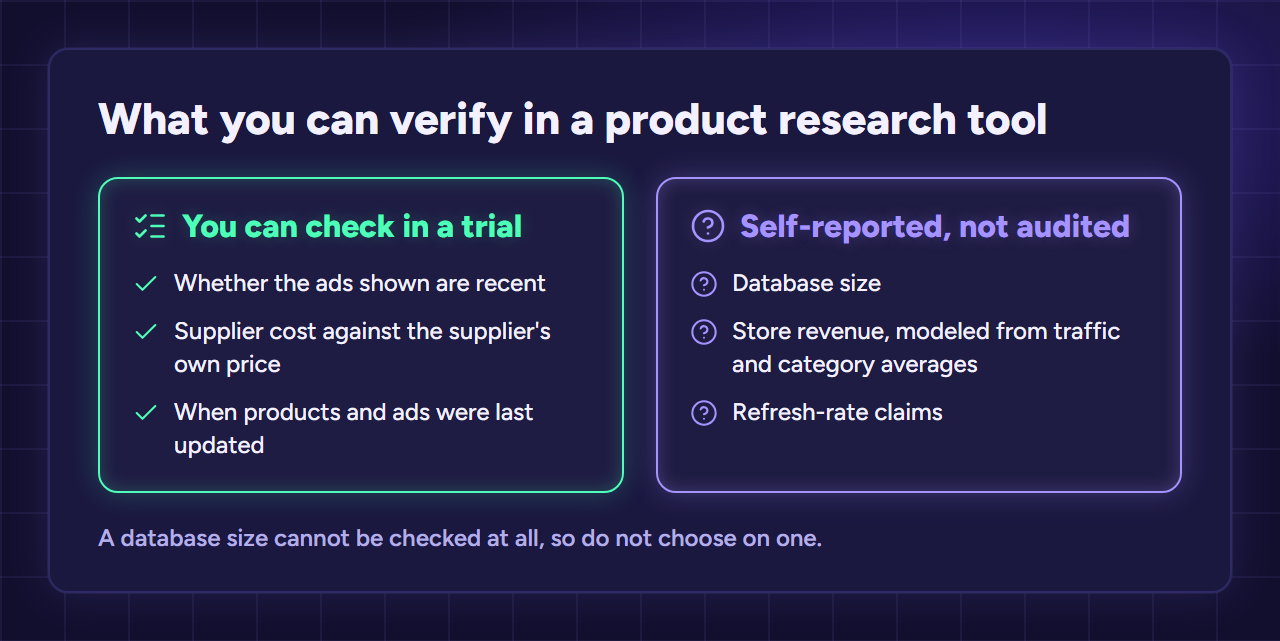
Database size claims are self-reported. Nobody audits them. Minea's ad database has been quoted at both 900 million and 10 million ads, a 90x gap. At least one figure is wrong, and there is no neutral source to settle it. Treat all such numbers as marketing rather than specification.
The practical takeaway is to weight what you can verify. Checking whether the ads shown are recent takes seconds. So does checking whether a quoted supplier cost matches what the supplier actually charges. A database size cannot be checked at all, so do not choose on one.
Building a stack of the best product research tools for dropshipping, by stage
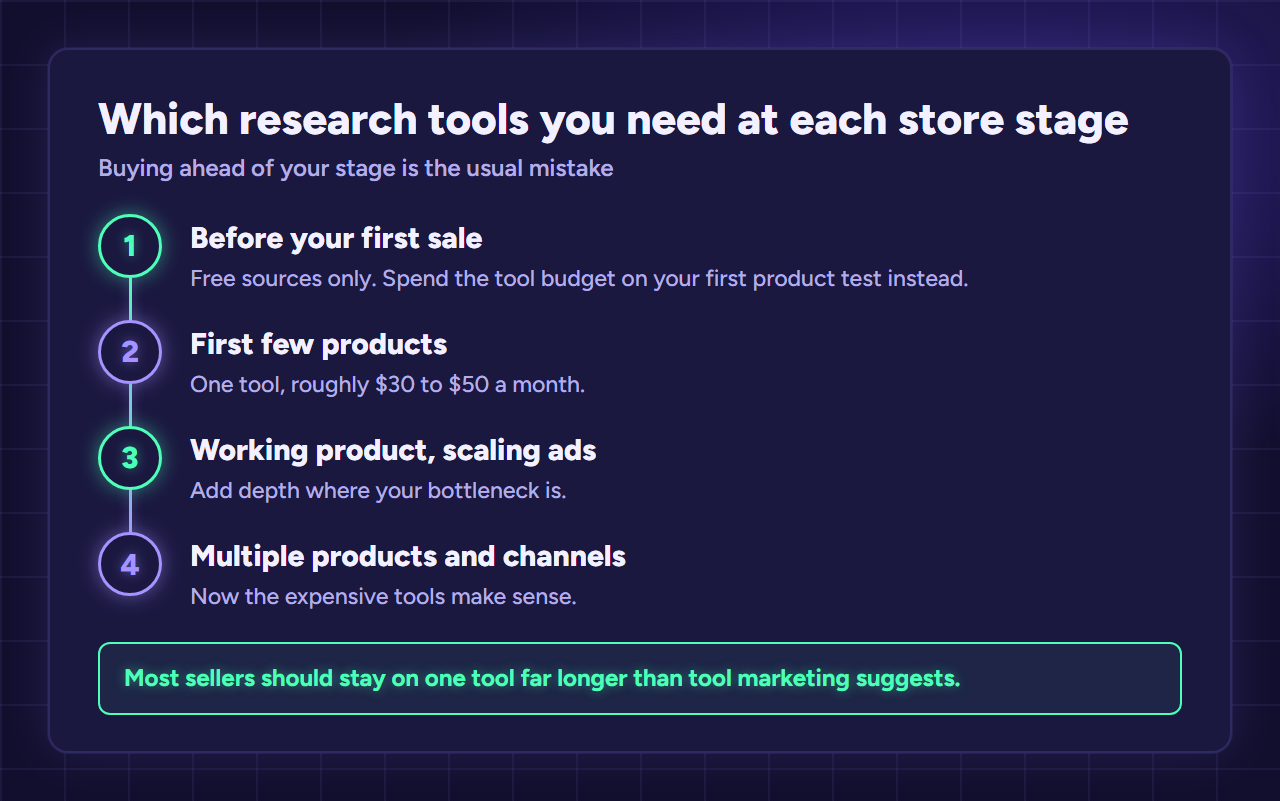
What you need changes as the store does, and buying ahead of your stage is the usual mistake.
Before your first sale. Free sources only. Google Trends, Facebook Ad Library, TikTok Creative Center, marketplace best sellers and reviews. Spend the tool budget on your first product test instead. If money is the constraint, our guide on zero-budget starts covers how to start dropshipping with no money step by step.
First few products, researching weekly. One tool. Either a cheap curated feed to learn what good data looks like, or one ad spy tool if you are already comfortable with the research process. Roughly $30 to $50 a month.
A working product, scaling ads. Add depth where your bottleneck is. If you are constantly hunting creative angles, a larger ad database earns its price. If you are hunting new products for a proven funnel, a product database does.
Multiple products, a team, several channels. Now the expensive tools make sense, because an hour saved is worth more than the subscription and historical depth becomes a real advantage.
Most sellers should stay on one tool far longer than tool marketing suggests. Adding a second is a decision to make when a specific job is not being done, not a way of feeling more thorough.
Minea vs Sell The Trend
These two come up together constantly, mostly because both run affiliate programs and both publish comparisons of themselves against the other.
They are not really competitors. Minea is an ad intelligence platform. Sell The Trend is an all-in-one suite that includes a weaker version of ad research alongside sourcing, importing, and a store builder.
Choose Minea if you already have a store and supplier workflow, and what you need is creative intelligence across several ad platforms.
Choose Sell The Trend if you want one subscription covering research through to importing products, and you are willing to accept that no single component is best in class.
If you only need one and you are early, Sell The Trend's bundle is usually the more economical starting point. If your bottleneck is specifically knowing what creative is working, Minea does that job better.
What no tool will do for you
Worth saying plainly, because tool marketing implies otherwise.
They will not tell you whether a product is profitable for you. Tools report demand signals and competitor activity. Whether a specific product clears your acquisition cost depends on your pricing, your ads, and your supplier, none of which the tool knows.
They will not find something nobody else has seen. Every subscriber sees the same database. A product surfacing in a popular tool has already surfaced for thousands of other sellers that morning.
They will not replace judgment. The filtering is the easy part. Deciding which of forty plausible candidates is worth $400 of testing is the hard part, and it stays yours.
They will not fix a broken funnel. If your store does not convert, a better product feed changes nothing.
Our breakdown of Shopify dropshipping economics covers the real costs and profits a tool subscription has to fit inside.
How to test a tool without wasting the trial
Free trials are short and easy to squander on browsing. A structured hour is worth more than a distracted week.
Bring a product you already know. Search for something you have researched manually. If the tool's data matches what you found, that is a useful signal about accuracy. If it disagrees, find out why before trusting anything else it says.
Check the freshness dates. Look at when the ads or products in your results were last updated. Stale data is the most common quiet failure in this category.
Run one real search end to end. Take a candidate from the tool all the way to a supplier and a landed cost. Count how many steps you had to leave the tool to complete.
Time yourself. Note how long the research takes with the tool against how long it took you without one. That difference, multiplied by your hourly value, is the actual return.
Check the cancellation path before you subscribe. Some tools in this category make this harder than it should be.
Are dropshipping research tools worth it?
For most beginners, a paid research tool is not worth it until after the first product test.
Every core research source is free. Google Trends, Facebook Ad Library, TikTok Creative Center, Amazon best sellers, and marketplace reviews cost nothing and are the same underlying signals most paid tools repackage. Paid tools compress the time it takes to search them, which is worth real money once your time is scarce, and worth nothing when it is not.
The sensible sequence is to do your first few rounds of research free, notice which part is slowest, then buy the tool that fixes that specific bottleneck. A subscription bought before you know your bottleneck is usually the wrong one.
There is also a budget argument. A $50 monthly subscription is one eighth of a $400 product test. Early on, spending on tests teaches you more than spending on discovery, because the market's answer is the only data that settles anything. Our breakdown of store startup costs puts that subscription next to everything else it costs to start a Shopify store.
Buy a tool when you are researching often enough that hours matter, or when you need historical ad data you cannot get free. Not because a ranking article told you it was the best.
FAQ
Choosing questions
What is the best product research tool for beginners?
Ecomhunt or Sell The Trend, mostly on price and simplicity. But free sources are a reasonable first step, and most beginners get more from spending that money on testing.
Do I need more than one tool?
No, not at the start. One tool per job you actually have, which for most Shopify sellers is one, sometimes two.
Which tool has the most accurate data?
No tool can prove it has the most accurate data, including the tools themselves. Database sizes are self-reported and the published figures contradict each other. Test accuracy yourself against a product you already know.
Cost questions
How much should I budget?
Between $30 and $50 a month covers most needs. Above that you are paying for database depth that matters mainly at scale.
Are annual plans worth it?
Only after a full month of real use. Annual billing typically saves 20 to 40%, which on a $49 monthly plan is roughly $118 to $235 a year. But committing before you know whether the tool fits your workflow is how people end up paying for a year of something they opened twice.
Is there a genuinely free option?
Yes, several tools have limited free tiers, and the underlying free sources are open to everyone. The free tiers are usually enough to evaluate whether a paid tier would help.
Why do rankings of the best product research tools for dropshipping disagree so much?
Because most of them are published by the tools themselves, and because the underlying statistics are self-reported. Database sizes, refresh rates, and even entry prices are quoted inconsistently across sources. Any ranking that names a single winner without saying who paid for the page is worth reading skeptically, this one included.
Can I cancel easily if it does not work out?
Usually, but check first. Cancellation friction varies across this category, and finding the process before you subscribe takes two minutes. Screenshot the plan terms and the price you were charged, since promotional rates sometimes renew at a higher figure without a clear warning.
Leave a Reply