How Long Does It Take to Make Money Dropshipping? (Realistic Timeline)
Key takeaways
- A first sale usually lands within days to a few weeks of launching. That part is easy, and it means less than you think.
- Consistent profit takes most people months, not weeks, because ad platforms, payment processors, and shipping timelines all run on their own schedules.
- Your first “profitable” month isn’t settled until refunds and disputes clear, which can trail the sale by months.
- Running ads speeds up learning if you fund it properly. Going organic is cheaper to be wrong at, and slower.
- Budget size decides how fast you learn. Effort decides whether you learn the right thing.
Most answers to this question fail in one of two ways. They either promise a first sale in 48 hours, or they hedge with “it depends” and leave you no wiser.
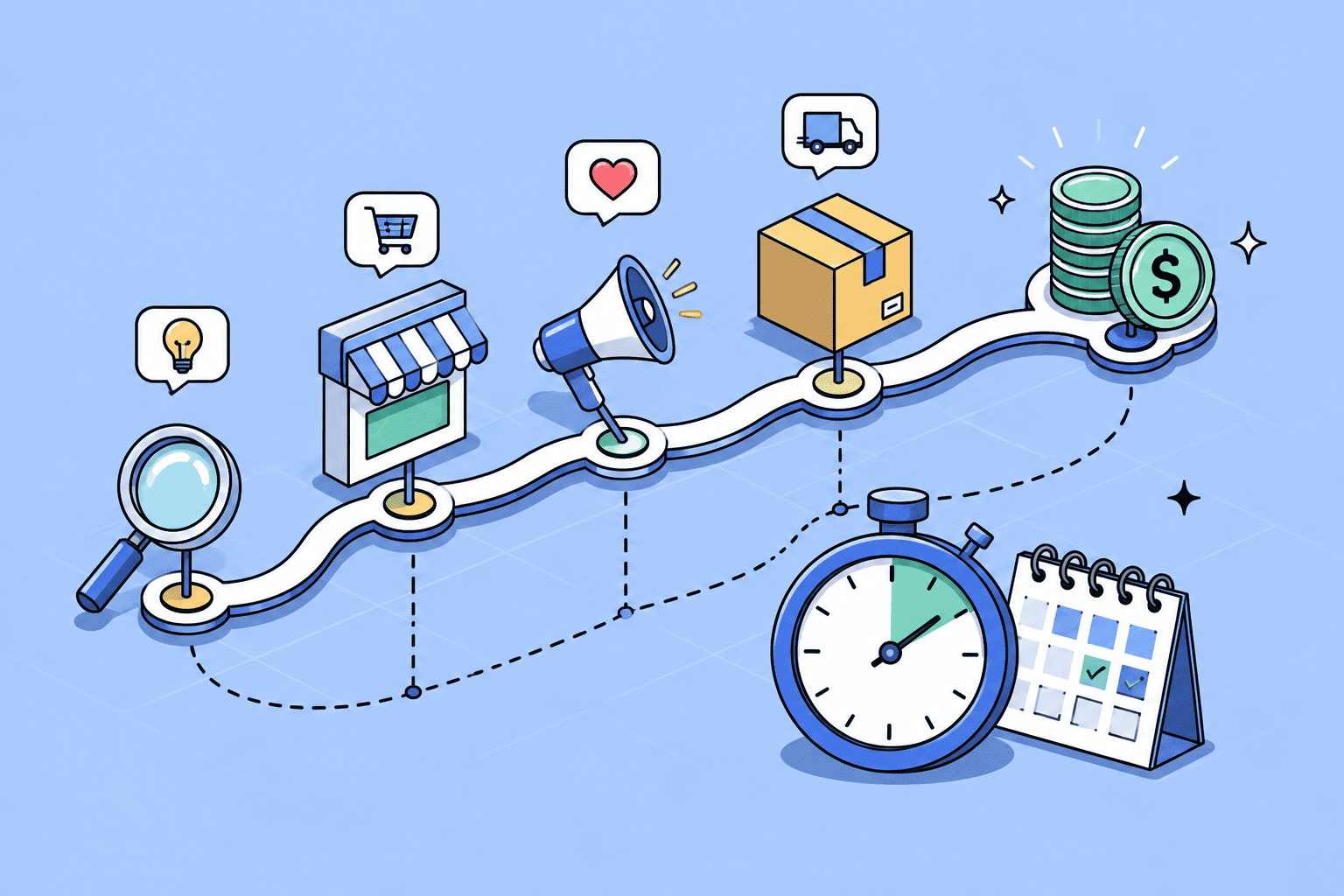
Here’s the version I’d want if I were starting. The first sale usually arrives within days to a few weeks. Steady profit takes most people several months. And the distance between those two points has surprisingly little to do with how hard you work. It’s set by clocks you don’t control: how fast an ad platform can learn, how fast your processor releases money, how long a parcel takes to arrive, and how long a customer has to dispute the charge.
Once you can see those clocks, the timeline stops feeling random and starts looking like arithmetic.
The short answer
| Milestone | Realistic timing |
| Store built and live | A weekend |
| First sale | Days to 3 weeks (with a real ad budget or an existing audience) |
| First verdict on a product | 2–4 weeks per product tested |
| A product that profits repeatably | 2–4 months of testing for most people |
| Cash you can safely spend | 1–3 months behind the sale |
| Income that replaces a salary | 12 months or more, if it happens |
Those ranges assume you’re funding tests properly and not switching niches every few weeks. Both assumptions break constantly, which is the real reason most timelines stretch.
“Making money” is four different milestones
Lumping them together is why the question feels unanswerable. Separate them and each one gets a defensible answer.
1. Your first sale. Proof that a stranger will hand you money. Fast, cheap, and emotionally enormous. It tells you almost nothing about whether the business works.
2. Your first profitable week. Revenue minus product cost, shipping, fees, apps, and ad spend comes out positive across seven days rather than one lucky afternoon.
3. Money you can actually spend. The payout has landed, the refund window has mostly closed, and nobody is going to claw it back.
4. Income that replaces something. Rent, a car payment, a job. This is the milestone people mean when they ask, and it’s the one nearly every timeline online quietly skips.
Milestone one can happen in a week. Milestone three cannot, no matter how good you are, and the reason is mechanical.
The four clocks that set your floor
The ad-testing clock
Meta’s delivery system needs roughly 50 optimization events per ad set within a seven-day window before performance stabilizes and it exits the learning phase. Below that, results swing hard and your numbers are mostly noise.
Do the arithmetic on what that costs. If your cost per purchase is $30, then 50 purchases in seven days works out to roughly $214 a day for that ad set. Someone testing at $15 a day across three ad sets isn’t running a small version of that experiment. They’re running an experiment that never produces a readable result.
Significant edits reset the counter, too. Changing budgets by more than about 20%, swapping creative, or altering audiences sends the ad set back to the start. Beginners tend to tinker daily, which is the single most common way a two-week test turns into a two-month one with no data to show for it.
The payout clock
A sale is not money. According to Shopify’s own documentation, Shopify Payments payouts can reach a Shopify Balance account within one business day, but payouts for new merchants can take up to five business days, and accounts flagged as higher risk can sit on custom schedules stretching from 5 to 20 business days.
Meanwhile, your ad spend comes out today. That gap is the working capital problem nobody mentions in the YouTube videos, and it’s why people with a “profitable” store still run out of money.
The delivery and dispute clock
Standard AliExpress shipping to the US commonly runs around two to three weeks, sometimes longer during Chinese holidays. So a sale made on the 1st might not arrive until the 20th, and your customer’s opinion of you doesn’t exist until then.
Here’s the part that catches people. Cardholders generally have 120 days to file a chargeback, and for goods that never showed up, that clock starts from the last date the customer expected delivery, not the purchase date. Long shipping windows don’t just annoy customers. They push your financial risk months into the future.
Your month-one profit figure is a forecast. It becomes a fact somewhere in month three.
The traffic clock, if you’re going organic
Skipping ads to save money means buying time instead. Ahrefs tracked new pages and found that only 1.74% reached Google’s top 10 within a year, with the average number one ranking page sitting at five years old.
There’s a hopeful detail buried in the same study: among pages that did break into the top 10, about 41% managed it within the first month. Ranking tends to happen fast or not at all. If a page hasn’t moved in three months, more patience rarely fixes it. A different keyword might.
The timeline when you’re running paid ads
Week 0. Build the store. A weekend is enough. Spending a month on your logo is procrastination wearing a productive costume.
Weeks 1 to 2. First sales often land here. Costs look terrible, results bounce daily, and none of it means anything yet because the algorithm is still exploring. Resist every urge to fix it.
Weeks 3 to 6. Your first real verdict on your first product. Most verdicts are no. That’s the expected outcome, not a personal failing, and cutting a loser here is worth more than any optimization you could run on it.
Months 2 to 4. If you’ve tested several products properly rather than half-testing a dozen, this is where something usually clicks. A profitable week arrives before a profitable month does.
Months 4 to 6. Cash flow catches up with performance. Payouts arrive on a predictable rhythm, refunds from earlier months have landed, and you finally know what you actually made in month two.
Months 6 to 12. Scaling, if there’s something worth scaling. This is also where most people who quit have already quit, usually somewhere around week five.
The timeline when you have no ad budget
Selling through TikTok, SEO, or an existing community changes the shape of the curve rather than the total time. The first sale takes longer, often several weeks to a few months. Being wrong costs almost nothing, so you can test far more patiently.
The trade-off is feedback speed. Paid traffic tells you a product is dead in two weeks. Organic traffic can take three months to tell you the same thing, and by then you’ve written twenty posts about it.
If you’re starting with under a few hundred dollars, organic is the honest choice. Just budget six to twelve months rather than six to twelve weeks, and pick a niche you can stand talking about for that long.
What actually speeds this up
- Fund one test properly instead of five badly. One ad set with enough budget to reach 50 events beats five ad sets that all read “Learning limited.”
- Sell at a higher price point. At a $20 product, a $25 cost per purchase kills you. At $80, it’s a business. Higher average order value buys you room to be a mediocre advertiser while you learn.
- Pick a supplier with faster shipping. Shorter delivery windows mean fewer refunds, fewer disputes, and a financial picture that settles in weeks rather than months.
- Stop editing live tests. Every significant change restarts the learning clock. Set it, fund it, and leave it for the full window.
- Keep one niche for at least three products. Serial niche-switching resets your product knowledge, your creative, and your audience data all at once.
What slows it down
Thin margins are the usual culprit, since they leave no room for the mistakes every beginner makes. Underfunded ad sets are next, because they generate opinions instead of data. After that it’s daily tinkering, twenty to forty day shipping, and treating the first bad week as a verdict.
There’s one more that’s harder to admit: running out of money before the clocks finish running. That isn’t a marketing failure. It’s a planning failure, and it’s avoidable.
About that “90% fail in the first month” statistic
You’ll see this everywhere. It’s worth knowing that it traces back to no primary study I can find. Chase the citations and they loop between blogs, and the claimed window shifts from one month to four months to a year depending on who’s repeating it. That drift is the tell of a number nobody measured.
What is defensible: most stores stop before the clocks in this article have finished running. People quit in week five, which is roughly one properly funded product test in. The failure isn’t usually the model. It’s the timeline mismatch between what was promised and what the mechanics allow.
When to keep going, and when to stop
- End of month 1. Did you complete one properly funded test with a readable result? If not, your problem is budget structure, not product choice.
- End of month 3. Have you had at least one profitable week? If nothing has ever profited, the niche or the price point is likely wrong.
- End of month 6. Is any month profitable after refunds and fees are counted honestly? If not, and nothing is trending upward, stopping is a legitimate answer.
- Any month. Are you funding tests with money you need for rent? Stop now. No timeline is worth that.
FAQ
- How long until my first dropshipping sale? Usually days to three weeks with a funded ad budget, or several weeks to a few months going organic. The first sale is the easiest milestone to hit and the least informative one, so treat it as a signal that checkout works rather than proof the business does.
- Can you make money in the first month? You can make revenue in the first month. Profit is possible but uncommon, and profit you can safely spend is rarer still, because payouts and refund windows lag the sale. Treat month one as paid tuition and judge it on data quality, not earnings.
- How long until dropshipping becomes profitable? Most people who get there report a few months of product testing before something profits repeatably. The variable that moves this most isn’t effort, it’s whether each test is funded well enough to produce a readable result.
- How much money should I have to survive the timeline? Enough to fund several full product tests plus a few months of platform and app fees, and none of it money you need for living costs. Underfunding is the most common reason a viable store dies before the data arrives.
- Is dropshipping faster without paid ads? No, it’s slower to the first sale but far cheaper to be wrong. Organic traffic through TikTok or SEO trades money for time, so budget six to twelve months rather than six to twelve weeks.
- How long until dropshipping replaces a job? For the minority who reach it, usually a year or more, and it typically requires moving beyond generic products into a brand with repeat customers. Anyone promising this in 90 days is selling a course.
The bottom line
You can make your first dollar dropshipping within a couple of weeks. Making money you can rely on takes most people somewhere between three and twelve months, and the delay is structural rather than motivational.
Plan for six months of runway, fund one test at a time properly, and judge results after the clocks have run instead of after your feelings have. That’s the whole game, and it’s a lot less romantic than the thumbnails suggest.
EasyCommerce Club is where I break down ecommerce like a friend would.
Leave a Reply