Ask ten people what the average dropshipping income is and you’ll get ten different answers — usually somewhere between “it’s dead, you’ll make nothing” and a screenshot of a $50,000 revenue month. The truth sits in a much less exciting place: most dropshippers earn modestly, a small group earns very well, and the difference between the two is rarely luck.
This guide breaks down what dropshippers realistically earn in 2026 — per month and per year, by experience level — and, more importantly, how much of that revenue they actually keep after ads, product costs, and fees. Then we’ll look at what separates the stores that reach consistent profit from the majority that never do.
The short answer: average dropshipping income in 2026
The figures below are compiled from published industry breakdowns — including one platform’s analysis of 1,200+ dropshipping stores and seller-reported earnings from community discussions — rather than any official statistic. No verified census of dropshipper income exists, so treat these as reference ranges:
| Experience level | Typical monthly net income | What’s happening at this stage |
|---|---|---|
| Beginner (months 1–6) | $0 – $2,000 (losses are common) | Testing products, learning paid ads, burning budget on failed tests |
| Intermediate (6–18 months) | $2,000 – $10,000 | One or more winning products, ads that convert, repeatable systems |
| Advanced (18+ months) | $10,000 – $50,000+ | Multiple winners or stores, data-driven scaling, often building a brand |
Annually, that translates to roughly $20,000–$120,000 for most working dropshippers, with a smaller experienced group earning $120,000 to $600,000+ per year. Weekly, beginners land anywhere from $0 to around $1,000, while seasoned sellers can pull in several thousand.
Two caveats before you anchor on any of these numbers.
First, these are ranges, not guarantees. Only an estimated 1–5% of dropshippers ever reach consistent profitability — stable profit month after month, not one lucky spike. Around 90% of new stores don’t survive their first year, usually because of poor product research, unreliable suppliers, or ad budgets that ran out before a winner appeared.
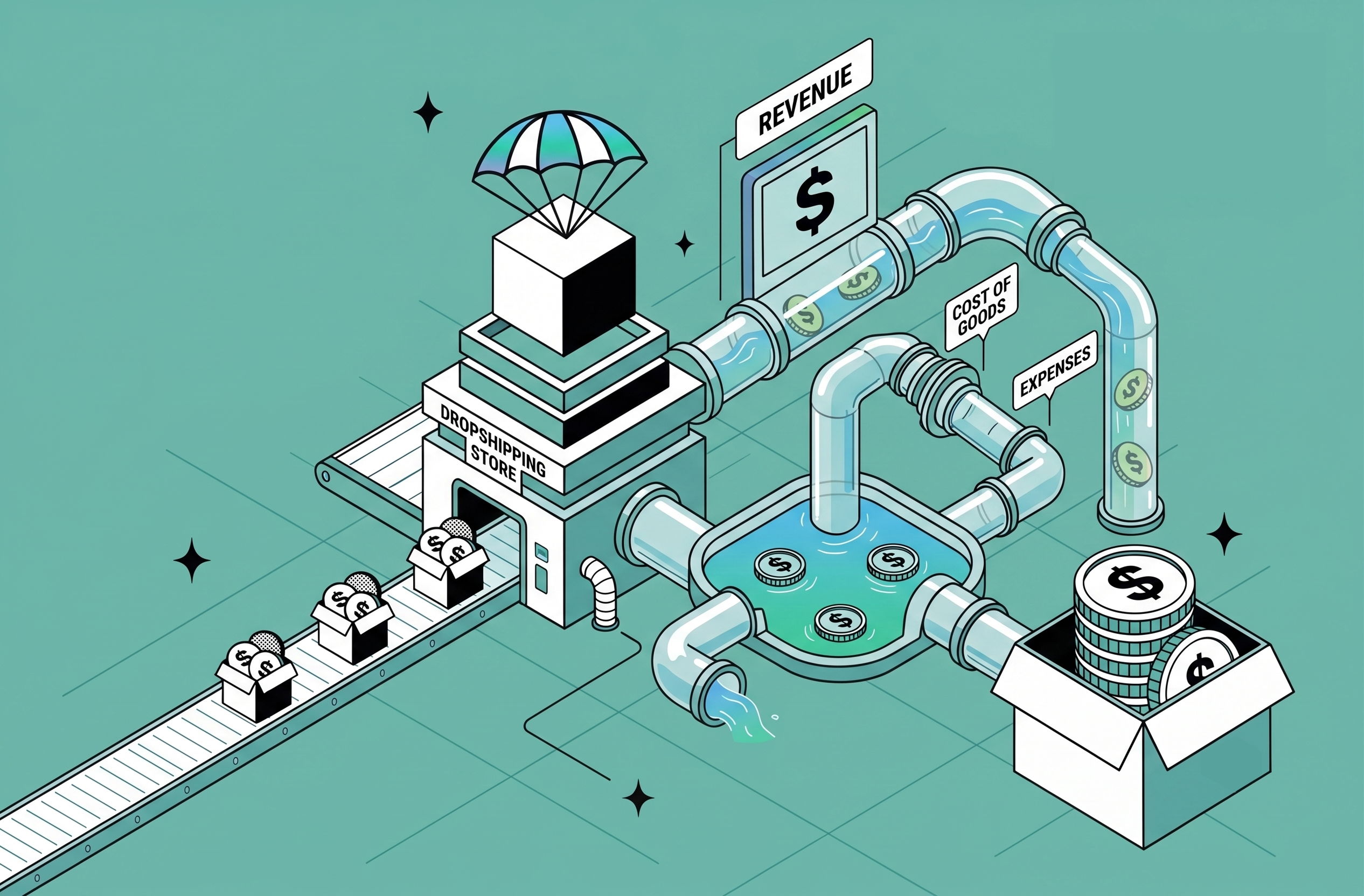
Second, and this is the part most income screenshots hide: income means net profit, not revenue. A store “doing $30K a month” might be keeping $4K — or losing money.
Revenue vs. net profit: the number that actually matters
Every dropshipping income conversation should start with this distinction, because it’s where beginners get misled the most.
- Revenue is everything customers pay you: price × orders.
- Net profit is what’s left after product costs, shipping, ad spend, platform and app fees, payment processing, refunds, and taxes.
Here’s what the gap looks like in practice. Say your store generates $10,000 in monthly revenue:
| Line item | Amount |
|---|---|
| Revenue | $10,000 |
| Cost of goods sold (~40%) | –$4,000 |
| Gross profit | $6,000 |
| Advertising | –$2,000 |
| Platform, apps, payment fees, misc. | –$500 |
| Net profit | $3,500 (35% margin) |
That’s a healthy store. Plenty of stores with the same $10,000 top line spend $5,000 on ads instead of $2,000 and walk away with a few hundred dollars — or nothing.
What counts as a good margin? Published estimates vary widely here, so it’s worth knowing the spread: some industry sources report typical gross margins of 20–30%, while others report 65–70% before advertising and fees are deducted — the difference largely comes down to niche and how costs are counted. On net margin, the figure that matters, the commonly cited healthy benchmark is 5–20%+, with 20%+ indicating an unusually efficient operation. (Author’s note, for reference only: in my view, anything under 10% net leaves little buffer — one bad ad week or a refund spike can erase the month.)
If you take one habit from this article: track net profit weekly, not revenue. It’s the only number that tells you whether the business is working.
How long does it take to earn consistent income from dropshipping?
Faster than a traditional business, slower than the gurus promise.
- First sale: Estimates differ by source — some report the first 7–14 days of active product testing and ad learning; others put it at 4–8 weeks after launch.
- Consistent profit: Typically 3–6 months for sellers who test aggressively and cut losers fast; 6–18 months is the realistic window for most.
- $5,000–$10,000/month: Usually 6–12 months of continuous testing, learning, and reinvesting profit back into ads and tools.
- Six figures annually: Achievable in roughly 18–24 months for operators who master a niche, build supplier relationships, and scale marketing efficiently.
The variables that compress or stretch this timeline are your starting budget (more capital = more tests = faster learning), niche competitiveness, and how quickly you kill products that aren’t working instead of hoping they’ll turn around.
6 factors that decide how much you’ll earn
Two sellers can list the identical product and end up with wildly different bank balances. These are the levers that create the gap.
1. Niche and product selection
High-perceived-value niches — beauty tools, jewelry, pet accessories, home fitness, baby products — support markups of 50–100% because customers buy on branding and emotion. Commodity products (generic gadgets, basic phone cases) tolerate 15–25% markups and force you into price wars. Narrowing your niche also slashes competition: “standing desk accessories for remote workers” faces a fraction of the competitors that “office products” does, which means cheaper customer acquisition and fatter margins.
2. Customer acquisition cost (CAC)
Advertising is almost always a dropshipper’s biggest expense, which makes CAC the metric that quietly controls your income. Know your break-even CAC — the most you can pay for a customer without losing money — and treat it as a hard ceiling. Successful sellers get there by testing creatives constantly, pausing losers within days, retargeting site visitors (which converts far better than cold traffic), and layering in low-cost channels like email, SMS, and organic short-form video.
3. Pricing strategy
Don’t just add a flat markup to supplier cost. Price against the full unit economics: product cost + shipping + payment fees + realistic ad spend per order. Then test upward — raising a price from $45 to $50 often increases total profit even if volume dips slightly, because the margin gain outweighs the lost orders.
4. Supplier reliability and shipping speed
An unreliable supplier can destroy a profitable store in weeks. Stockouts during your best sales period, slow shipping that triggers chargebacks, and inconsistent quality that drives refunds all bleed directly out of net profit. Keep backup suppliers for your core products, and as volume grows, consider agents or fulfillment partners with local warehousing — faster delivery lifts conversion, cuts refunds, and drives repeat purchases.
5. Operating cost discipline
Platform fees, apps, and tools feel small individually and add up brutally. Audit your stack regularly and keep only what measurably improves conversion or saves time. The same goes for automation: manually forwarding orders and tracking numbers eats 15–20 hours a week that could go into marketing.
6. Repeat customers
Acquiring a customer is the expensive part; the second and third orders are nearly pure margin because their acquisition cost is already paid. Stores with a 20–25% repeat rate can generate dramatically more annual profit from the same ad spend than stores where everyone buys once. Loyalty perks, post-purchase email flows, and genuinely fast support are what move this number.
How to increase your dropshipping income
If your store is live and the numbers are thin, these are the moves most consistently recommended across industry guides. The ordering by impact is the author’s judgment, offered for reference only — your highest-leverage fix depends on where your own numbers leak.
1. Raise your average order value (AOV). Since traffic is your biggest cost, extracting more revenue per order is the fastest profit lever there is. Bundles (“3 for the price of 2”), volume discounts, free-shipping thresholds, and one-click post-purchase upsells all increase order size with zero extra ad spend. One well-documented Shopify case study — a plush toy store that generated $100,000 in revenue over two months, keeping roughly $19,000 in profit after $31,000 in ads and $48,000 in goods and shipping — credited a simple 3-for-2 bundle with doubling its AOV.
2. Kill losing products fast. Give a test 3–7 days or a defined budget. If click-through is low, cost-per-click is high, and add-to-carts aren’t appearing after meaningful spend, cut it and move on. Emotional attachment to a product is one of the most expensive habits in dropshipping.
3. Shift toward higher-ticket or higher-margin products. Cheap impulse buys need enormous volume to matter, while higher-ticket products with strong perceived value offer more room for profit per sale. As a purely illustrative example: a $120 product at a 30% net margin earns $36 per order — the same profit as eighteen orders on a product netting $2 each.
4. Build a brand, not just a store. Once a product proves demand, invest in custom packaging, private labeling, better creative, and a store that looks like a real company. Branded stores charge 30–50% more for comparable products, defend against copycats, and earn the trust that makes scaling paid ads sustainable.
5. Optimize for net profit, not revenue. Review your P&L weekly. Know your profit per product, per channel, and per campaign. Sellers who track only revenue routinely scale unprofitable products because “the numbers were going up.”
Is dropshipping income enough to go full-time?
Not at first, for most people. In the $0–$2,000 beginner phase, income fluctuates too much to replace a salary, and there are no benefits or guaranteed paychecks to fall back on. Going full-time starts to make sense when net profit holds at $3,000–$5,000+ per month for several consecutive months — enough of a track record that one bad month won’t sink you.
It’s also worth resetting the “passive income” framing. Dropshipping outsources fulfillment, not the business. Product research, ad management, supplier communication, and customer support are ongoing work — successful sellers typically put in 15–30+ hours a week, especially in the first year.
The bottom line
The dropshipping average income in 2026 is a wide range for a reason: this is a real business with a real skill curve, not a template you copy. Most sellers earn between a few hundred and a few thousand dollars a month; a disciplined minority earns $10,000–$50,000+ monthly by treating margins, testing, and customer experience as seriously as product hunting.
The market itself is still growing fast — Grand View Research projects the global dropshipping market will reach roughly $1.25 trillion by 2030 — so the opportunity isn’t the constraint. The closing advice here is the author’s take, for reference only: start with realistic expectations, measure net profit from day one, cut losers quickly, and reinvest in what works. In my experience, that’s the pattern behind every income screenshot worth believing.
FAQs
How much do dropshippers make a month? Beginners typically earn $0–$2,000 per month (losses included), intermediate sellers $2,000–$10,000, and advanced sellers $10,000–$50,000+. One industry estimate puts the median seller with 12 months of consistent effort at around $1,500–$3,000 in monthly net profit.
How much do dropshippers make a year? Most working dropshippers earn roughly $20,000–$120,000 annually. Experienced operators with optimized stores or multiple brands can reach $120,000–$600,000+, and rare outliers exceed $1 million.
Can you make $100k a year dropshipping? Yes, but it’s an advanced-seller outcome, not a starting expectation. It generally requires 18–24 months of experience, healthy net margins (15–20%+), meaningful ad budget, and strong branding.
What’s a realistic profit margin for dropshipping? Gross margins commonly run 20–70% depending on niche and sourcing. For net margin — what you actually keep — 10–20% is a healthy benchmark, and 20%+ is excellent.
How much money do you need to start? You can technically start with under $100, but most sellers who reach profitability start with $500–$2,000, with the majority of that budget going to ad testing across 3–5 potential products.
Why do most dropshippers fail? An estimated 80–90% of stores fail within the first year, usually from a combination of poor niche selection, unreliable suppliers, untracked costs, and quitting before finding a winning product. Nearly all of these are execution problems, not flaws in the model itself.
Sources & a note on the numbers
Income figures, margins, timelines, success/failure rates, and the case study in this article are drawn from published industry sources: TrueProfit’s analysis of 1,200+ dropshipping stores, Shopify’s dropshipping guides, Zendrop’s earnings breakdown, BettaMax’s income report, Qikify’s income analysis (including the Subtle Asian Treats case study, originally reported by Shopify/Oberlo), and Grand View Research’s dropshipping market forecast. These are estimates from private analyses and self-reported seller data — no independently verified statistic on average dropshipping income exists. Strategic recommendations and any passages marked as the author’s note are opinion, offered for reference only, not financial advice.
You can read more about Shopify dropshipping basic guide that I wrote here. e
I’m building EasyCommerce Club to be the ecommerce resource I wish I’d had starting out — plain-language guides, essential information.
Leave a Reply