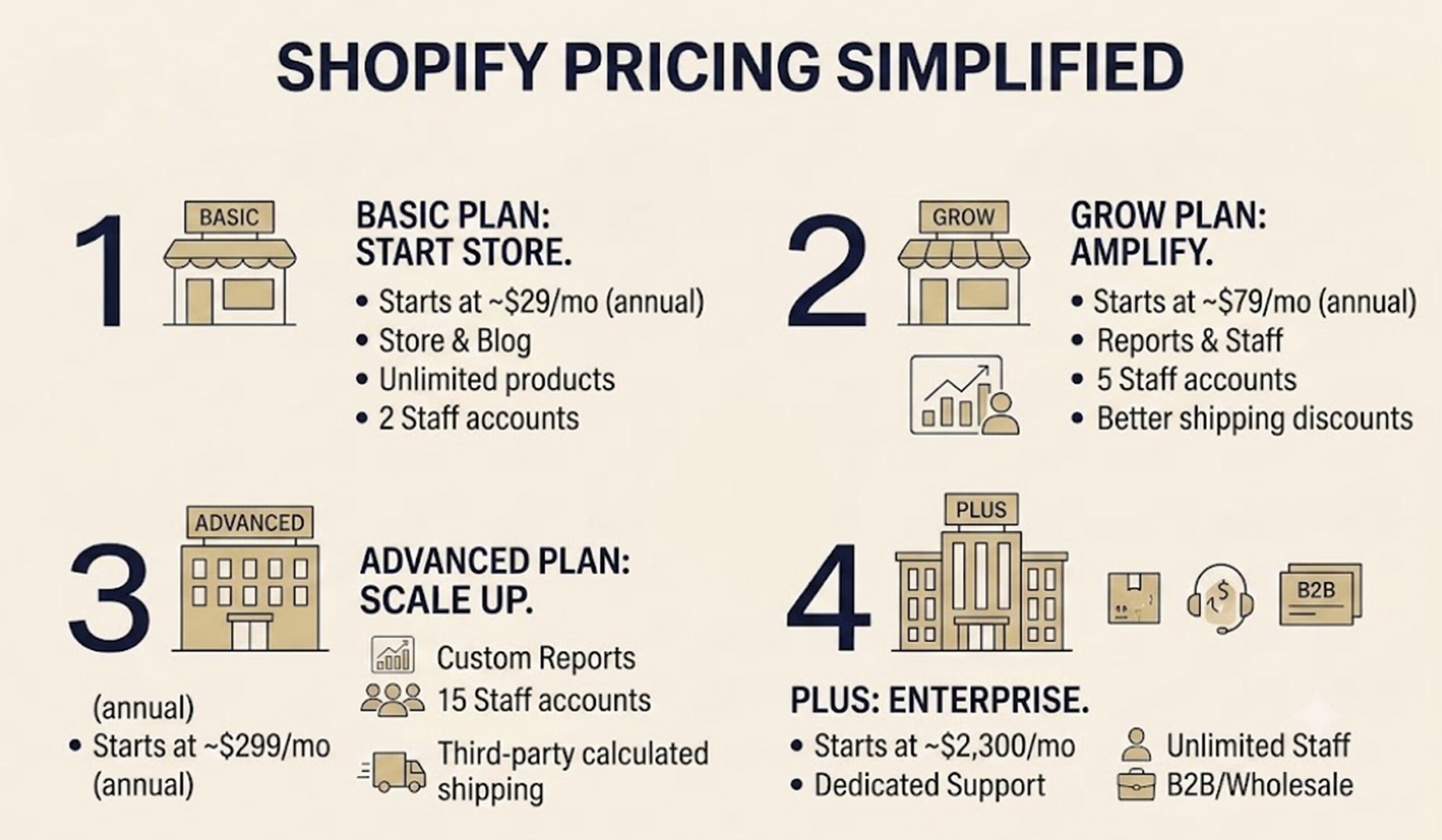
If you’ve read my guide on what Shopify is, you already know the short version of pricing: plans start at $5 a month and climb to $2,300+ for enterprise. For a brand-new store, the plan choice itself is easy — Basic, the cheapest plan with a real online store, and that’s the right call. Nobody launching their first shop needs to agonize over Grow versus Advanced. The questions that actually matter at that stage sit around the plan: what the transaction fees mean per sale, and why everyone online insists the “real” cost is higher than the pricing page.
The higher tiers only become a real decision once there’s a real business behind them — a team that needs admin access, sales volume where fee percentages start to matter, or a store being moved over from another platform that already ships internationally and runs custom reports. That’s when matching the plan to the operation is worth thinking through carefully.
So this post does both jobs: it walks through every Shopify pricing plan the way I’d explain it to a friend — what each one costs, what you actually get, the extra fees to budget for — and it maps each tier to the kind of business it’s actually built for. All prices below are the 2026 US figures from Shopify’s official pricing page, checked the day I wrote this.
Key takeaways
- Shopify’s three core plans cost $39, $105, and $399 per month — or $29, $79, and $299 per month if you pay yearly, which saves you 25%.
- On top of the subscription, you pay a card processing fee on every sale (2.9% + 30¢ on Basic, dropping as you upgrade), plus an extra 0.6–2% surcharge if you don’t use Shopify Payments.
- The Starter plan ($5/month) is a checkout link for social selling, not a real online store; Shopify Plus (from $2,300/month) is for large businesses.
- Most new sellers should start on Basic with Shopify Payments — you get a full store, unlimited products, and AI selling channels for the lowest cost.
- Your true monthly cost is usually higher than the plan price once you add apps, a domain, and possibly a premium theme — budget for that from day one.
Shopify pricing plans at a glance
The full 2026 US lineup, straight from Shopify’s pricing page:
| Plan | Monthly billing | Yearly billing (per month) | Online card rate* | Third-party payment fee | Staff accounts | Best for |
|---|---|---|---|---|---|---|
| Starter | $5 | — | 5% | — | None | Selling via links and social, no full store |
| Basic | $39 | $29 | 2.9% + 30¢ | 2% | Owner only | New stores and solo sellers |
| Grow | $105 | $79 | 2.7% + 30¢ | 1% | 5 | Small teams and growing stores |
| Advanced | $399 | $299 | 2.5% + 30¢ | 0.6% | 15 | High-volume and international sellers |
| Plus | From $2,300 (3-year term) | Negotiated | Shopify’s most competitive rates | 0.2% | Unlimited | Large and enterprise businesses |
*Card rates are US rates with Shopify Payments for standard online transactions. Rates vary by country and card type.
Two more options sit outside the core lineup: POS Pro (+$89/month per location) adds advanced tools for physical retail stores, and the new Agentic plan ($0/month) lets you sell products directly through AI chat channels with no store at all — you only pay card fees when you make a sale.
Every plan starts with a 3-day free trial, and new merchants currently pay just $1/month for the first 3 months — plenty of time to build and launch before the standard rate kicks in.
Billed yearly: You pay for twelve months upfront in exchange for a lower monthly rate. It saves 25%, but Shopify doesn’t refund annual plans, so I’d only commit once you’re sure you’re staying.
Basic ($39/month): where most people should start
Basic is the cheapest plan that gives you a real online store — full website, unlimited products, blog, custom domain support, and Shopify’s checkout. Despite being the entry plan, it’s not stripped down: you get abandoned checkout recovery, discount codes, email and SMS campaigns, automated sales tax calculations, 10 inventory locations, and 24/7 live chat support.
Two things surprised me about Basic in 2026. First, it now includes agentic commerce — your products can be found and bought through AI assistants like ChatGPT, which used to be the kind of feature you’d expect locked behind expensive tiers. Second, Shopify’s 1% credits program: you earn 1% back on your sales (up to $5,000 in credits on Basic), applied against your Shopify bills.
The real limitation is staff accounts: Basic has none. Only the store owner can log into the admin (you can invite third-party collaborators, like a designer, but not give a teammate their own account). The moment a co-founder or employee needs regular access, you’ve outgrown Basic — that’s the main trigger to upgrade, more than any revenue number.
Who it’s for: first-time sellers, solo founders, side hustles, and any store where one person runs the admin. This is the plan I’d start on.
Grow ($105/month): when you have a team
Grow is Basic plus room for people and data. You get 5 staff accounts, lower card rates (2.7% + 30¢ online), a smaller third-party payment surcharge (1% instead of 2%), and a higher credits cap ($7,500). Real-time carrier-calculated shipping rates become available as a paid add-on at this tier.
The honest way to think about Grow: you’re mostly paying for team access. The fee savings help — I’ll show the math in the upgrade section below — but if you’re a solo operator, the extra $66/month over Basic rarely buys you much.
Who it’s for: stores where more than one person works in the admin day to day. That usually means either a store that grew on Basic until a second pair of hands was needed, or an established business arriving from another platform with a small team already in place — for those, Grow is realistically the entry plan, not Basic.
Advanced ($399/month): for volume and international selling
Advanced steps things up for stores that have genuinely scaled: 15 staff accounts, card rates down to 2.5% + 30¢, a 0.6% third-party surcharge, a $10,000 credits cap, and — the features that actually define this tier — a custom report builder, third-party calculated shipping rates included, and stronger tools for selling across regions. Support is also upgraded to “enhanced” live chat.
Third-party calculated shipping rates: Instead of you guessing flat shipping fees, carriers like UPS or FedEx quote the real cost live at checkout based on the customer’s address and package weight. It makes shipping prices accurate — customers pay what shipping actually costs, and you stop losing money on underpriced deliveries.
Who it’s for: businesses bringing real volume onto Shopify — a larger team, serious international shipping, or reporting needs the store already depends on. It’s the tier that matches an operation of that size from day one; for everyone else, it’s the plan you grow into once Grow’s limits actually start to pinch, not before.
Starter and Plus: the two ends of the spectrum
Starter ($5/month) isn’t an online store — it’s a checkout you can attach to links in Instagram bios, WhatsApp messages, and social posts, with a very simple storefront. Card fees are a steep 5% per sale, which is fine at tiny volume and painful beyond it. It’s a reasonable way to test whether anyone will buy your product before committing to a real store, and that’s about it.
Shopify Plus (from $2,300/month on a 3-year term) is the enterprise tier — this is what large brands run on. You get unlimited staff accounts, a fully customizable checkout, up to 200 inventory locations, unlimited B2B catalogs, up to 9 free expansion stores for different countries or brands, priority 24/7 phone support, and Shopify’s best payment rates. Shopify currently offers the first month of Plus for $399 so bigger merchants can trial it. One detail worth knowing if you’re eyeing this tier: industry analyses report that above roughly $800K/month in sales volume, Plus pricing shifts to a percentage-of-revenue model rather than the flat fee — at that scale you’d be negotiating directly with Shopify anyway.
If you’re reading a beginner blog to choose between Basic and Grow, Plus is not your problem yet — and honestly, that’s a nice problem to have later.
The fees beyond the subscription
This is the part most people miss when they compare Shopify pricing plans, so I’ll make it concrete.
Card processing fees apply to every sale. With Shopify Payments (Shopify’s built-in payment processor), a $100 order on Basic costs you $3.20 in processing ($2.90 + $0.30). That’s normal — every platform and payment processor charges something similar — but it means your real Shopify cost scales with your revenue, not just your plan.
The third-party payment surcharge is the fee to actually avoid. If you process payments through an outside provider like PayPal or Stripe instead of Shopify Payments, Shopify adds its own surcharge on top of that provider’s fees: 2% on Basic, 1% on Grow, 0.6% on Advanced. The simplest money-saving rule in this whole article: use Shopify Payments if it’s available in your country, and the surcharge disappears entirely.
The costs around the plan itself:
| Extra cost | Typical range | Notes |
|---|---|---|
| Custom domain | ~$10–20/year | Not included in any plan |
| Premium theme | ~$100–500 one-time | Optional — free themes are genuinely usable |
| Apps | $0 to $50+/month each | Most stores run a few; many have free tiers |
| POS Pro (physical retail) | $89/month per location | Only if you run brick-and-mortar stores |
How much do apps really add up to? It depends entirely on your stage. A lean new store can run on free apps and pay nothing. One agency analysis of mid-market brands puts typical app stacks at $350–1,400/month once you’re running serious email marketing, reviews, and loyalty tools — but that’s a scaling cost, not a launch cost. When I estimated in my Shopify guide that a typical small store lands around $50–300/month all-in, this is where the range comes from.
One cost that offsets the rest: the 1% back in Shopify credits mentioned earlier. A store doing $4,000/month in sales on Basic earns about $40/month in credits — which quietly covers most of the subscription.
When should you upgrade? (the honest math)
If you started on Basic — as most new sellers should — the question eventually becomes when to move up. There are two valid reasons: you need a feature the next tier unlocks, or the lower card rates save you more than the higher subscription costs. The feature reason is easy to spot (usually staff accounts). The fee math is worth seeing once:
Each tier jump lowers your online card rate by 0.2 percentage points. On $10,000 of monthly sales, that’s $20 saved. Moving from Basic to Grow on yearly billing costs an extra $50/month — so the fees alone justify it at roughly $25,000–35,000 in monthly revenue. One industry breakeven analysis puts the Basic-to-Grow crossover at about $33,000/month and Grow-to-Advanced at about $147,000/month. (Author’s note, for reference only: in practice, almost nobody upgrades because of this math — they upgrade because they hired someone and need a staff login. Treat the breakeven numbers as a sanity check, not a rule.)
The reverse advice matters more: don’t start on a higher plan “to be safe.” Upgrades take effect immediately whenever you want them, so there’s no penalty for starting on Basic and moving up the week you actually hit a wall.
How to choose your plan: quick decision guide
The pattern is simple: the plan should match the business you have today, not the one you hope to have.
- Testing whether anyone will buy, selling through social links only → Starter ($5/month)
- Launching a new store → Basic ($39/month, or $29 yearly) — full stop. Start here, upgrade only when you hit an actual wall.
- A team of 2–5 works in the store admin, or sales are past ~$30K/month → Grow ($105/month, or $79 yearly)
- Larger team, custom reporting, heavy international shipping → Advanced ($399/month, or $299 yearly)
- Enterprise scale, custom checkout, B2B operations → Plus (from $2,300/month — talk to Shopify’s sales team)
And whichever plan you pick: turn on Shopify Payments, consider yearly billing once you’re committed (25% off), and start with a free theme.
If you’re planning to run your store as a dropshipping business, the same logic applies — Basic is the standard starting plan, and your bigger budget line will be ad spend, not the subscription. I’ve broken down what that full cost picture looks like, including what dropshippers actually earn, in separate guides.
FAQ
How much does Shopify cost per month? The core plans cost $39 (Basic), $105 (Grow), and $399 (Advanced) on monthly billing — or $29, $79, and $299 per month when billed yearly. Starter is $5/month, and Shopify Plus starts at $2,300/month on a 3-year term. Card processing fees apply on top of every plan.
Is there a free Shopify plan? No. Shopify offers a 3-day free trial, and new merchants currently pay $1/month for their first 3 months before standard pricing begins.
How much does Shopify take per sale? With Shopify Payments in the US, standard online card rates are 2.9% + 30¢ on Basic, 2.7% + 30¢ on Grow, and 2.5% + 30¢ on Advanced. On a $100 sale, that’s $3.20, $3.00, or $2.80 respectively. If you use a third-party payment provider, Shopify adds a 0.6–2% surcharge on top of that provider’s own fees.
What’s the difference between the Basic and Grow plans? The big ones: Grow gives you 5 staff accounts (Basic has none — owner only), lower card rates (2.7% vs 2.9%), a 1% instead of 2% third-party payment surcharge, and a higher credits cap. If you work alone, Basic covers nearly everything Grow does.
Can I change my Shopify plan later? Yes. Upgrades take effect immediately with prorated billing; downgrades apply at the end of your current billing cycle. Note that yearly plans are prepaid and non-refundable.
Is Shopify worth the price? For most people serious about selling online, I think so — the subscription buys you hosting, security, checkout, and updates you’d otherwise manage yourself. I walk through the full value question, including the trade-offs, in my What Is Shopify guide.
Sources & a note on the numbers
All plan prices, card rates, transaction fees, staff account limits, credits caps, and trial details in this article come from Shopify’s official US pricing page, verified on the day of writing. Third-party figures are attributed where used: the app cost range for mid-market brands and the note on Plus revenue-based pricing at scale come from a Commerce-UI (Shopify Plus agency) pricing analysis, and the plan-upgrade breakeven estimates come from an ecomm.design pricing guide. Prices are US pricing and vary by country; Shopify’s plans, rates, and promotions change over time, so always confirm on Shopify’s official pricing page before signing up. Plan recommendations and any passages marked as the author’s note are opinion, offered for reference only.
I’m building EasyCommerce Club to be the ecommerce resource I wish I’d had starting out — plain-language guides, essential information.
Leave a Reply