
TL;DR: The best dropshipping niches are narrow sub-segments priced to carry a roughly $25 ad cost per order, with low returns, a reason to buy again, light shipping, and no health claims. On that scorecard, outdoor and hobby gear and higher-priced pet equipment score best. Apparel is the one to avoid, with return rates commonly reported at 30 to 40%. Pet, home, and wellness appear on every list, which is why a category name alone tells you nothing about competition.
Why don't most dropshipping niche lists work?
Most niche lists fail because they recommend the same few categories to millions of readers, and because a category is the wrong unit for judging profit.
The recommendation lists in this category are close to identical. Pet supplies, home and garden, health and wellness, beauty devices, eco-friendly goods, phone accessories. Read four articles and you have read them all.
There are two problems with that.
The first is self-defeating advice. A category recommended in fifty articles reaching millions of readers is not an undiscovered opportunity. By the time "low competition pet wellness" is a heading, several thousand people have opened a supplier tab.
The second is that the category is the wrong unit. Pet supplies contains a $6 chew toy competing against Temu and a $180 orthopedic dog bed selling to owners of aging large breeds. Those are not the same business. One cannot survive a $25 acquisition cost and the other absorbs it easily. Calling both "the pet niche" hides the only thing that mattered.
So this article does something slightly different. It gives you the dimensions that actually separate a workable sub-segment from an unworkable one, then applies them.
The five dimensions that decide a niche
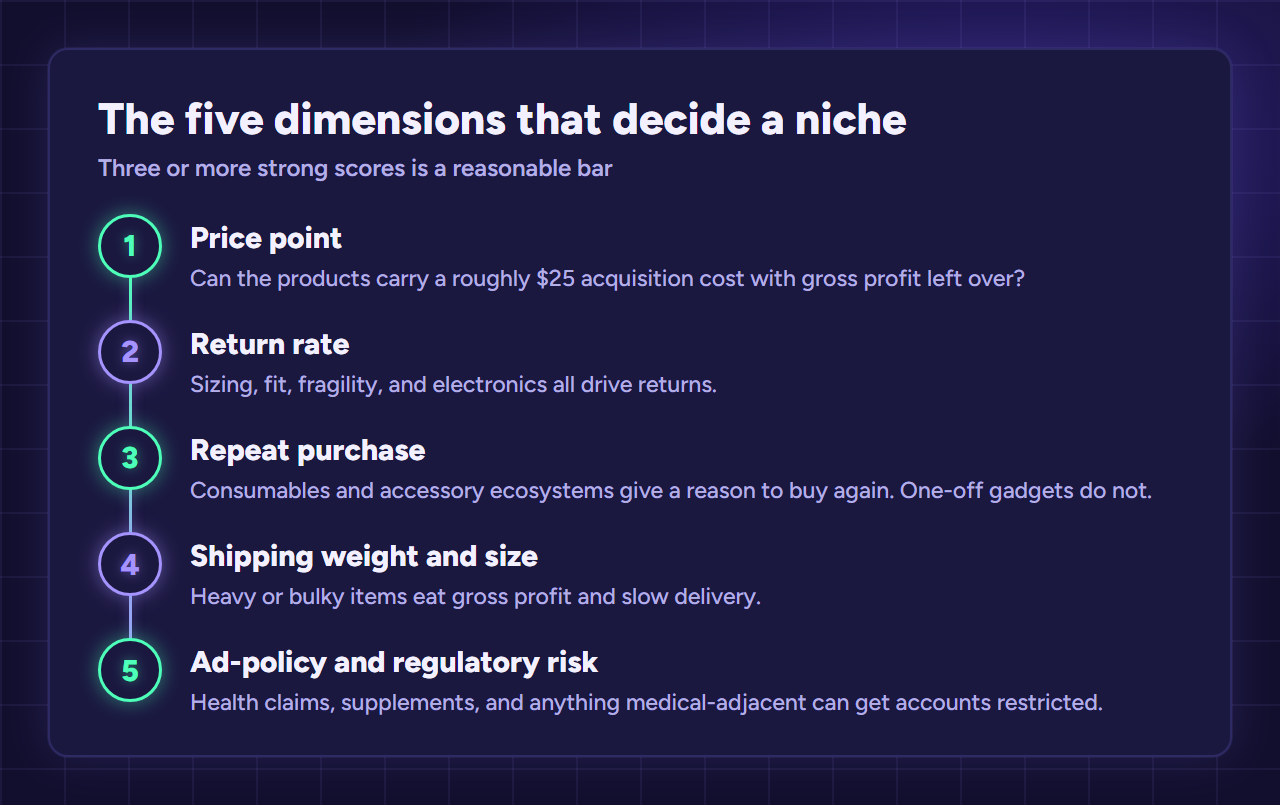
Score any category you are considering against these. Three or more strong scores is a reasonable bar.
Price point. Can the products carry a roughly $25 acquisition cost with gross profit left over? At a median TikTok cost of about $0.50 per click and a 2% ecommerce conversion rate, one paid order costs roughly $25, so a product with $20 of gross profit loses money on every ad-driven sale. This eliminates more candidates than everything else combined, which is why it goes first.
Return rate. Sizing, fit, fragility, and electronics all drive returns. A 30% return rate turns a healthy margin into a loss, and it arrives weeks after the sale looked profitable.
Repeat purchase. Does the customer have a reason to buy again? Consumables and accessory ecosystems do. One-off gadgets do not. This is the difference between paying for a customer once and paying every time.
Shipping weight and size. Heavy or bulky items eat gross profit directly and slow delivery, which drives complaints and chargebacks.
Ad-policy and regulatory risk. Health claims, supplements, and anything medical-adjacent can get accounts restricted. A category you cannot advertise is not a category you can sell in.
Notice that none of these are about whether a category is trendy. Trend affects how quickly you find buyers. These five decide whether finding them is worth anything.
Scoring the major categories
Here is the honest read on the categories that appear in every ranking of the best dropshipping niches, scored on the five dimensions above.
| Category | Price point | Returns | Repeat | Shipping | Ad risk | Overall |
|---|---|---|---|---|---|---|
| Pet supplies | Mixed | Good | Strong | Good | Low | Workable |
| Home and kitchen | Good | Good | Weak | Mixed | Low | Workable |
| Health and wellness devices | Strong | Mixed | Weak | Good | High | Risky |
| Beauty technology | Strong | Mixed | Weak | Good | High | Risky |
| Apparel and fashion | Weak | Poor | Mixed | Good | Low | Avoid |
| Phone accessories | Weak | Good | Weak | Strong | Low | Hard |
| Baby and kids | Mixed | Mixed | Strong | Good | Mixed | Workable |
| Outdoor and hobby gear | Strong | Good | Mixed | Mixed | Low | Strong |
| Automotive accessories | Strong | Mixed | Weak | Mixed | Low | Workable |
Two rows deserve explanation, because they contradict most published advice.
Most profitable dropshipping niches: where the scores actually land
Outdoor and hobby gear scores best and gets recommended least. Specialist equipment for a defined activity carries genuine price points, low return rates because buyers know exactly what they want, and passionate communities that are cheap to reach. It scores poorly on mass appeal, which is precisely why competition is thinner.
The pattern generalizes. The strongest sub-segments serve a specific person doing a specific thing, at a price that reflects the fact that they care. Someone furnishing a reptile terrarium, equipping a home workshop, or outfitting a fishing kayak is not price-shopping the way a phone case buyer is.
Pet supplies works, but only above a price threshold. The category's reputation is deserved. Repeat purchase is strong, buyers are emotionally invested, return rates are low. But the cheap end is a bloodbath against marketplace sellers. Orthopedic beds, mobility aids, specialist feeding equipment, and health monitoring all clear the economics. Chew toys do not.
Home and kitchen is solid but weak on repeat purchase. Someone buys the gadget once. Building a second sale requires deliberately choosing sub-segments with consumables or accessories attached.
Baby and kids has excellent repeat dynamics and real safety-vetting obligations. Supplier quality matters more here than anywhere else, and getting it wrong carries consequences beyond a refund.
Low competition dropshipping niches, and what that phrase really means
Low competition is almost always a description of a sub-segment, not a category.
You will not find an unclaimed category. You will regularly find an unclaimed intersection: a specific product for a specific person, where the total market is too small to interest a large seller but large enough to support you.
Three ways to find that intersection.
Go narrower on the customer, not the product. Not dog supplies. Supplies for large-breed senior dogs, where the buyer has a real problem and a budget.
Go narrower on the situation. Not kitchen gear. Kitchen gear for small apartments, or for people cooking for one.
Go where aesthetic or expertise creates a barrier. Categories requiring genuine taste or subject knowledge stay thin because most quick-launch stores cannot fake either.
The trade-off is honest: a smaller market means a lower ceiling. A well-run store in a narrow segment is more likely to reach $10,000 a month than $100,000. For most people starting out, that is the better bet.
Scoring one sub-segment end to end
Here is the framework applied to a single candidate, so the scoring is not abstract.
The candidate: mobility and support equipment for senior large-breed dogs. Ramps, orthopedic beds, support harnesses, joint supplements excluded.
Price point: strong. Ramps and orthopedic beds sit between $70 and $200. Gross profit at a 50% margin is $35 to $100 per unit, which absorbs a $25 acquisition cost with room to spare. This alone puts it ahead of most of the pet category.
Return rate: good. Nothing is sized to a human body, nothing is fragile, and buyers research before purchasing. The main return risk is a ramp not fitting a specific vehicle, which clear product specifications largely solve.
Repeat purchase: moderate. The equipment is not consumable. But the buyer's situation persists and worsens, so a customer who bought a ramp in spring is a genuine candidate for a bed in autumn. Building the second sale here requires deliberate email work rather than luck.
Shipping: mixed. Beds are bulky and ramps are long. This is the weakest score and it is a real cost. It also argues for domestic suppliers, which conveniently sidesteps the import duty issue entirely.
Ad risk: low. No health claims are needed. The product is equipment, and it can be described as equipment.
Verdict: three strong, one moderate, one mixed. Clears the bar. Notice how differently this scores from "pet supplies" as a category, which is the entire point of working one level down.
Notice also what is not in the assessment. Nothing about whether the niche is trending, and nothing about total market size. A market that supports a few hundred orders a month at $120 is a real business.
How niche choice changes your acquisition cost
The category you pick does not just set your margin. It sets how expensive customers are to find, and the two interact.
Broad consumer categories are expensive to advertise into because everyone is bidding for the same attention. Apparel and generic home goods sit here. You pay more per click precisely because the audience is large and desirable.
Specialist categories are cheaper per click and convert better, because the targeting is unambiguous. Someone in a forum for a specific hobby is easier to reach and more likely to buy than a general shopper.
There is a second effect that matters more. Specialist categories have searchable demand. People look up "dog ramp for SUV" in a way nobody looks up a generic gadget they have never heard of. That makes organic search viable, which changes your economics far more than any margin improvement, because organic orders carry no acquisition cost at all.
The practical consequence is that a narrow niche with a lower ceiling can out-earn a broad one, because it can be served through channels that do not charge per customer.
Seasonality, the factor niche lists skip
Almost no niche article mentions this, and it changes what a category is worth.
Some categories are steady year-round. Pet health, home organization, and most equipment fall here. Revenue is predictable and you can plan against it.
Others concentrate revenue into a short window. Outdoor and garden gear, holiday-adjacent products, and fitness equipment in January all deliver most of the year's sales in a few months.
Neither is better, but they demand different things from you. A seasonal category means cash flow gaps, inventory and supplier pressure in peak weeks, and a much smaller margin for error, because a bad six weeks is a bad year. A year-round category is more forgiving of slow learning.
For a first store, steady beats seasonal. You are trying to learn a system, and a category that only tells you the truth for eight weeks a year is a poor teacher.
Check this before committing. The five-year view in Google Trends shows seasonality clearly, and it takes about a minute.
Dropshipping niches to avoid
Knowing what not to sell saves more money than knowing what to sell.
Apparel and fashion. The largest category by dropshipping revenue share at roughly 28%, and the hardest to profit in. Return rates commonly reported at 30 to 40% from sizing, color, and quality mismatches. Margins get quoted in the 10 to 20% range. You are also competing directly with fast-fashion platforms operating at a scale you cannot match. If you go here anyway, men's apparel is the softer entry, with simpler sizing and fewer returns.
Anything cheap that Temu, SHEIN, or Amazon already sell. You cannot win a price war against companies whose entire model is price. Under $20, this is most things.
Supplements and anything with health claims. Ad platforms restrict them, regulators care, and a single policy strike can cost you an ad account you built a business on. Our legality guide covers whether dropshipping is legal and the rules that actually get sellers in trouble.
Consumer electronics with warranties. Defect rates, warranty expectations, and support burden all land on you while the margin sits with the brand.
Fragile items. Breakage is a cost you pay twice, in refund and in reputation.
Viral novelty products. Fidget toys and their descendants attract enormous competition within weeks, margins collapse, and there is no repeat purchase to fall back on.
How did the end of de minimis change niche selection?
The end of the US de minimis exemption pushed dropshipping economics toward higher-priced products and suppliers closer to the customer.
The United States ended the $800 de minimis exemption for all countries on 29 August 2025. Every parcel now clears customs and carries duty regardless of value. That change is not neutral across categories, and older niche lists predate it.
Cheap, low-priced imported goods took the hardest hit, because a few dollars of duty is a large share of a small gross profit. Reported figures put the added cost at $3 to $8 in duties and processing on a $15 product. Higher-priced categories absorb it comfortably. Categories where domestic or nearshore suppliers exist avoid it entirely.
The practical effect is that the import change pushed the economics further toward exactly the sub-segments this article already favors: higher price points, specialist products, and suppliers closer to the customer. If you were weighing a $15 accessory category against a $120 equipment category, that decision got easier.
Trending products to sell on Shopify right now
Trend is the weakest of the selection criteria, but it is not nothing. It affects how fast you find buyers, so it is worth knowing where momentum sits.
Phone accessories built around new hardware. MagSafe cases and wallets, magnetic mounts, card-format chargers, and accessories for foldable phones. Constant device refresh cycles create genuinely new sub-niches. Margins are usually quoted around 3x markup, but note the price point problem: these are cheap items facing an acquisition cost they struggle to carry.
Fitness recovery equipment. Massage guns, compression tools, and recovery accessories. Price points work, and buyers treat it as equipment rather than a gadget.
Beauty devices. LED masks, microcurrent tools, IPL handsets. Strong price points and highly visual for social video, which is why they get recommended everywhere. The catch is intense competition, high quality expectations, and ad-policy exposure if you make claims.
Smart home and pet monitoring. Cameras, feeders, sensors. Good price points, weak repeat purchase.
Eco and refillable household goods. Growing steadily, with the useful property of built-in repeat purchase through refills.
Treat all of these as starting points rather than answers. A trending category tells you demand exists. It says nothing about whether you can serve it profitably, which is what the scorecard is for.
How do you choose a dropshipping niche?
Score two or three categories you already know against the five dimensions, drop any that fail on price point, and narrow the rest to one specific buyer before you test.
Start with two or three categories where you have some genuine knowledge or interest. Subject knowledge is a real advantage and it is the only one you already own.
Score each against the five dimensions. Discard anything failing on price point, because no amount of marketing skill fixes gross profit that cannot cover a customer.
Narrow the survivors to a specific sub-segment and a specific buyer. Write that buyer down in one sentence. If you cannot, the segment is still too broad.
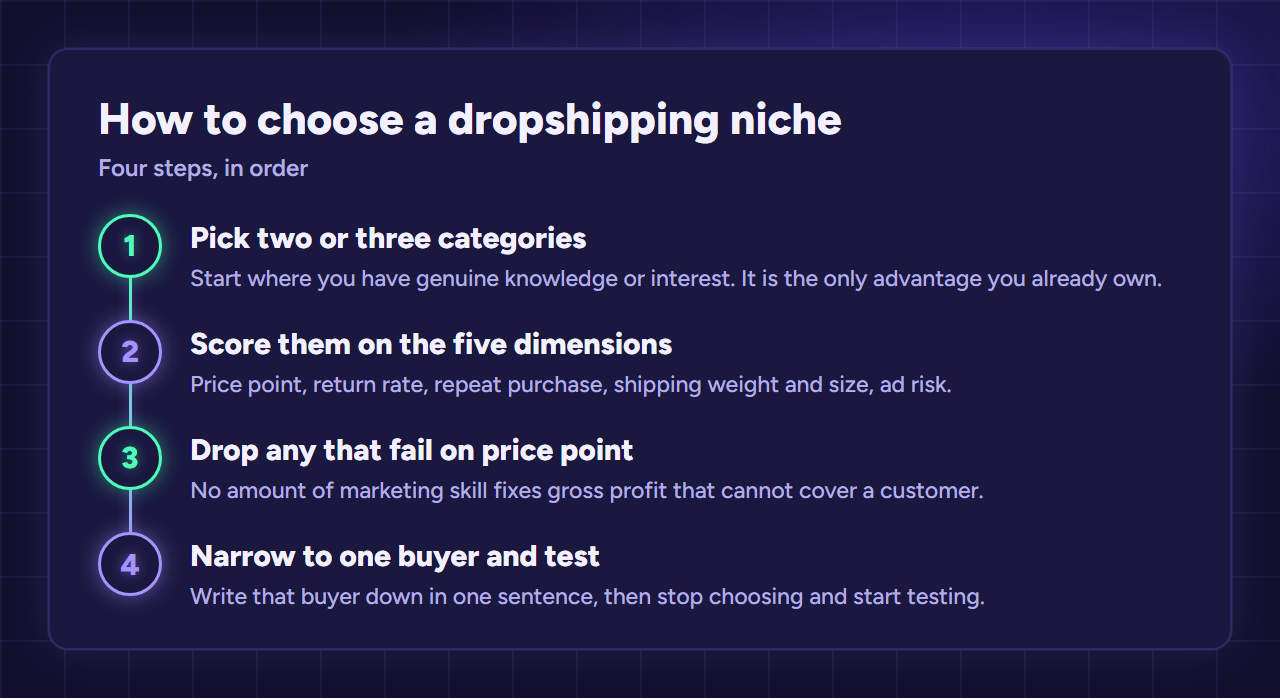
Then stop choosing and start testing. Niche selection has diminishing returns fast, and the market answers questions that research cannot. Our margin guide goes through high margin products for dropshipping you can test inside a niche, and our cost breakdown covers the real costs and profits of Shopify dropshipping once you have one priced out.
One last thing. Commit for longer than feels comfortable. Most people abandon a workable niche in month two because it has not worked yet, then repeat that in a new category. The switching itself is often the reason nothing compounds. For what a normal ramp-up looks like, see our realistic timeline for making money dropshipping.
Do the best dropshipping niches change every year?
The trending products change every year, but the economics that make a niche profitable do not.
Lists get rewritten every year, which implies the answer moves constantly. Some of it does. Most of it does not.
What genuinely changes is the trend layer. Which specific products have momentum, which platforms surface them, and which hardware cycles create new accessory categories. That turns over in months, and any article naming specific products is partly out of date by the time you read it.
What does not change is the economics underneath. Price point has to cover acquisition cost. Returns destroy thin margins. Repeat purchase is worth more than a first sale. Heavy things cost more to ship. Restricted categories are dangerous to build on. Those five held five years ago and will hold five years from now.
This is why chasing the annual list is a poor strategy. You are tracking the layer that moves fastest and matters least, while ignoring the layer that decides whether you make money.
A useful test when you read any recommendation, including the ones above. Ask whether the argument is about demand or about economics. Demand arguments are about attention and they expire. Economics arguments are about arithmetic and they do not.
The practical version of this is to pick a category on the five dimensions, then let the trend layer inform which specific products you test inside it rather than which category you enter. That way the fast-moving part of the market works for you without dictating your whole strategy.
The best dropshipping niches for you, in the end, are the ones where the arithmetic works and you know enough about the buyer to say something the next store cannot.
FAQ
Choosing questions
What are the best dropshipping niches for beginners?
Sub-segments of pet supplies, home and kitchen, or a hobby you personally understand, at price points above roughly $40. The price floor matters more than the category.
Are low competition dropshipping niches real?
At the sub-segment level, yes. At the category level, no. Any category a popular article recommends is being entered by thousands of people that week.
Should I run a general store instead?
Usually not. Niche stores generally perform better, because they build repeat purchase and let you speak to one buyer clearly. A general store makes every ad and every page work harder for less.
Category questions
Is the pet niche saturated?
Only at the cheap end. Higher-priced pet health, mobility, and specialist equipment still works, and the repeat purchase dynamics remain among the best of any category.
Why is apparel usually a bad choice?
Because returns and thin margins eat the profit. Return rates are commonly reported at 30 to 40%, margins get quoted at 10 to 20%, and you compete directly with fast-fashion platforms. It is the largest dropshipping category and one of the least profitable for small sellers.
How many niches should I try before settling?
Two or three tested properly, not ten researched superficially. Testing costs money and teaches you something. Researching costs time and mostly teaches you what other people have written.
Why do lists of the best dropshipping niches all name the same categories?
Because the economics favor a handful of categories and most lists draw on the same sources. The underlying economics genuinely do favor pet, home, and a few others. Beyond that, most of these articles are published by suppliers and tools with something to sell, and they copy each other. Either way, a category being widely recommended is evidence against it being low competition.
Leave a Reply